
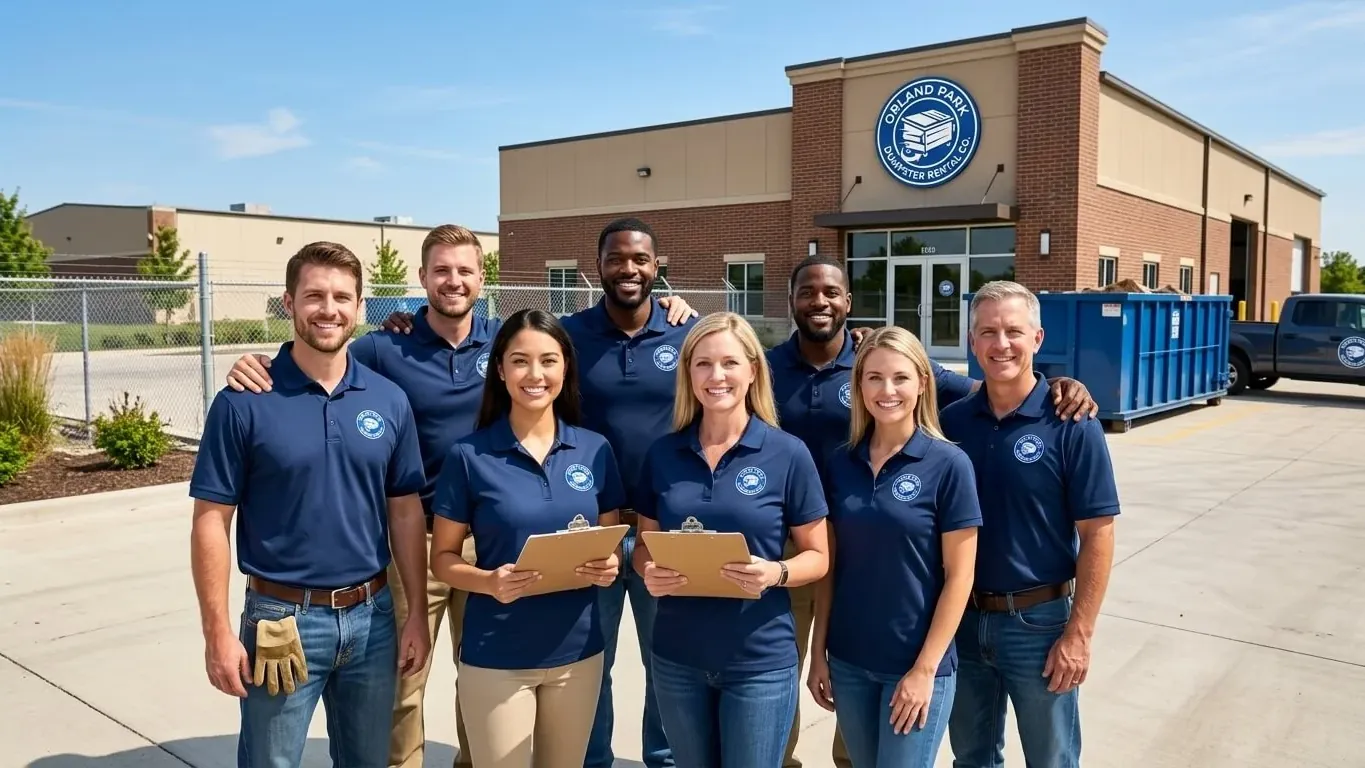
About us
Locally Owned Dumpster Rental in Orland Park Since 2011
One truck, a landline and a village that had filled up in thirty years and was starting to renovate itself all at once. Here is how Orland Park Dumpster Rental grew out of that, and why Dave Kolar is still the one who picks up.
Our story
It started with a bathroom, a bulk-item rule and a very full cart
Dave Kolar grew up in the south-west suburbs and went onto a remodeling crew straight out of school. His twenties were spent inside houses that had gone up while Orland Park was doubling every ten years — kitchens taken back to the studs, bathroom tile chiselled off a mortar bed nobody had disturbed since the house was new, August roofs, and basements and garages holding thirty years of whatever a family had not thrown out. On job after job the same two things went wrong. The box landed a day later than it had been promised for. Or it landed, and the figure on the invoice was not the figure from the telephone call.
Behind both sat the same silence. Nobody had told the homeowner that a bathroom’s worth of tile and mortar bed hits a truck’s lawful weight while the container still looks half empty, or that a roof is counted in squares and in layers rather than by how big the house is. And nobody had told them the thing that costs the most days of all: the Village’s own service was never going to take any of it. The weekly allowance is “up to three cubic yards of refuse per week” plus one bulk item, and the Village defines a bulk item as “an item the resident would take with them if they moved out of the residence.” A vanity, a tub surround and a hollow-core door is a three-week program at the curb. A bathroom stripped in a weekend is the whole week’s three cubic yards before the cabinets come out.
In 2011 he started with one roll-off truck, based at 11601 183rd Pl, and answered the telephone himself. That address mattered more than he expected it to, and it is still the shortest explanation of this business anybody has: the yard is inside the Orland Park village limits and it is in Will County, in Frankfort Township, with the county line running a short distance north of the gate. Most of the village is Cook. This corner is not. Dave still takes the bulk of the morning calls and still keeps the board himself. The first job on it was a basement, a garage and thirty years of a loft, booked by a family whose previous hauler had canceled on them twice with a closing date coming at them. Fifteen years later that family is still in the book, and still handing the number out.
Nothing about what happened next was clever. In a village of this size the work moves the way it has always moved: a framer gives the number to a roofer, somebody says over a fence that the box turned up when it was supposed to, a supply counter repeats it. What kept the telephone busy was three particular things about this place. How it was built. Orland Park went from 6,391 people in 1970 to 51,077 by 2000, the 1970s alone up 260.6 percent, and a village that arrives in three decades comes due in waves rather than one house at a time. That is an inference drawn from Census figures rather than a housing statistic, and we keep it labeled as one. Who owns the houses. 85.8 percent owner-occupied, 24.8 percent of residents 65 or over, a median value of $367,200, and a median monthly owner cost without a mortgage of $978. The person paying for the container is nearly always the person who owns the problem, and has often owned it since the house was new. And the gap between what the Village collects and what a project produces. Trucks went on as the calls arrived, never ahead of calls that had not. 15 years on it is still dispatched off 11601 183rd Pl, and the phone still rings on a desk with somebody local behind it.
What you are actually buying is the number, not the truck
Putting a container on a driveway is not hard, and plenty of people do it. What this trade has historically been poor at is saying what the thing will cost while there is still time to change your mind — a headline figure with the tonnage allowance somewhere further down, and then a line on the invoice nobody read out loud. The pricing here was built against exactly that, in the first month of 2011, and it has not moved since.
It comes out of four questions. What is going into the box. Roughly how much of it there is. How many days you want it standing — and inside Orland Park that one has a lid on it, because the Village sets a maximum of “30 days from the day of placement on the site.” And the street address, which is never small talk here, because it fixes the county and therefore whether anybody besides you has a say in where the steel sits. Out of those four comes a single figure holding the delivery, the collection, the days and the disposal. Ask for the wrong size and you will be told, including on the days when the wrong size was the more expensive one.
What the word “local” buys you in a village split between two counties
Most places use that word as decoration. Here it can be checked, because the local knowledge comes with section numbers and telephone numbers attached to it. It means a dispatcher who already knows which streets take a 20 and which do not, which approaches go soft after a wet week on this clay, and above all which government your address answers to. Inside Orland Park the Village has published the container rules itself — “Permits are not required,” then thirty days, private property, five feet from any lot line, 768 cubic feet and eight feet above grade — and the Village is on 708-403-6100. On the Cook County side of the village a whole-building or detached-garage demolition brings the County in as a permitting authority in its own right, on (312) 603-8200; the Village’s own demolition page says so in terms, telling applicants that a “Cook County Permit must be obtained for entire building and detached garage demolition permits.” On the Will County side — where our own gate is — those Cook County ordinances do not reach, and we could not establish what Will County requires instead. We say that plainly rather than filling the gap, and we hand over the county’s number. Then the road out front, which may belong to the Village, to a county highway department or to IDOT; the Village’s own engineering page says State and County work is “out of the Village’s jurisdiction.” And JULIE on 811 before anything is dug. Five possible answers, and working out which one is yours before a truck is loaded is most of what a company down the road is good for.

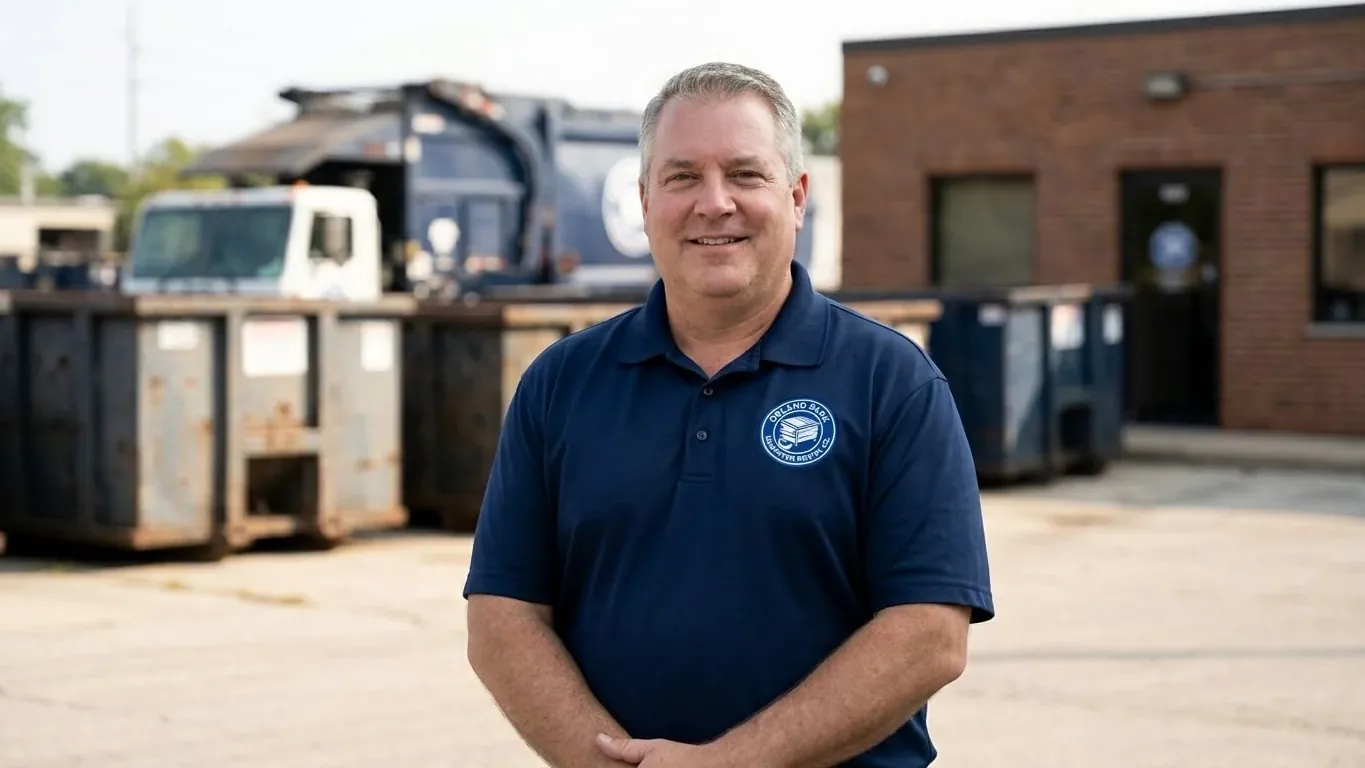
At a glance
- Trading since2011
- Run byDave Kolar
- Yard11601 183rd Pl
- County of the yardWill, in Frankfort Township
- Boxes we run10, 15, 20, 30 and 40 yd³
- Where we runOrland Park and 17 more
Our values
Six things that are not up for negotiation
The number said out loud is the number on the invoice
Whatever figure is agreed on the telephone is the figure that arrives in writing. Where the size turns out to have been misjudged, that misjudgment is ours to absorb and not yours to fund with a second box.
When something slips, a person rings and says so
Weather, a breakdown or a queue at a scale can put a delivery back. When it does the telephone rings and somebody explains it, which beats an afternoon spent watching an empty drive. In March, on ground like this, it happens more often than we would like.
It is a driveway before it is a jobsite
Plywood under the wheels and both rails before anything lands, the approach walked on foot first, and a driver who will lift a box and reset it rather than argue about where it ended up. On a clay-rich unit the state’s own geologists measure at more than 125 feet thick, that is not decoration.
Weight comes out before it ever crosses a scale
Scrap metal, clean wood and flattened cardboard are pulled and recovered wherever a load allows it, and you will be told to lift the salvage — solid doors, hardware, cast iron — before the truck arrives, because whatever stays in the box is charged by the ton. Electronics come out as well: Illinois keeps covered devices out of landfills, and one of only two permanent Cook County drop-offs is on Wolf Road, run by the Road District of Orland Township.
The uncomfortable sentence goes first
If the job is genuinely two hauls rather than one, or the yard waste has to travel separately because a statute says so, or there is a call to the Village or to a county desk that nobody has mentioned to you yet, that gets said while the box is still empty rather than afterwards.
We say so when the answer is not ours to give
Four of the five closest towns on our board sit in a county whose demolition and asbestos requirements we could not establish. Bluffing that would be easy. Instead you get Will County’s own number and a plain “we could not find one” — which is not the same sentence as “there is none.”
Experience
15 years of south-west suburban drives, and what they put on the board
The four ways a container job goes wrong here, in order of what they cost
Sizing dense debris by how much room it takes up. Broken concrete, block, brick, mortar and a tile bed reach payload while the box still looks part filled. The container that looked too small was the right one; the big one would have arrived and then been unable to leave.
Ordering a big box for a tear-off. Shingle is counted in squares and in layers, and it makes lawful weight a long way short of filling a 30. On a ranch or a split-level out of the middle of this village’s build-out there is very often a second course still nailed to the deck, which doubles the number without anybody deciding it should.
Putting a 30 on an Orland Park driveway without checking the Village’s own ceiling. The residential cap is 768 cubic feet, which works out at about 28.4 cubic yards, with a maximum height of eight feet above grade. A 20 sits comfortably underneath it. A 30 is a real question, and it is a far better question before the truck loads than after the box is on the drive.
Assuming the Village will quietly absorb the overflow. It will not, and it could not even if it wanted to. The weekly round is three cubic yards and one bulk item; the Curbside Spring Clean-Up publishes a list of what it takes and construction debris is not on that list; and 65 ILCS 5/11-19-1 bars any Illinois municipality under a million people from franchising construction and demolition debris collection at all. All four of those are avoidable inside a two-minute telephone call, which is the reason the telephone call is not optional here.
The work itself repeats in a fairly short list. Kitchens and baths taken back to the studs in houses nobody has touched since they were built. Basements finished in the eighties and stripped out now. Whole-house declutters ahead of a sale. Downsizing and estate clear-outs, in a village where a quarter of residents are 65 or over and a great many own outright. Roof tear-offs, siding and window jobs, each of which is a $95 Village permit as published — confirm the current fee with the Village. Decks, sheds and detached garages pulled down with footings still attached. Aprons, patios and retaining walls broken into 10 yard boxes. Storm and tree debris, which the Village’s curbside yard-waste round will not take once it is “whole trees, stumps” or “limbs greater than 4 inches in diameter.” Tenant fit-outs and strip-outs along the retail corridor. And teardowns, where the county line decides how much paperwork rides along. Every one of those behaves differently the moment it crosses a scale, and knowing which one is in front of you before the truck loads is most of what this company is for.
What we carry, and where a load ends up
- Every load goes to a facility permitted to receive it. Illinois EPA’s Bureau of Land permits those facilities, and the state’s landfill standards sort them into inert and putrescible and chemical rather than into the numbered classes used in other states. That is why what sits in a container decides where it can be tipped — and why one dirty item folded into an otherwise clean load changes the answer for all of it
- No landfill, transfer station or recycler is named anywhere on this site, and no gate rate or tipping fee is published. The context we will publish, because Cook County publishes it first, is the line in its own 2024–2029 solid waste plan: “based on current disposal rates, Illinois’ Region 2 has less than five years of landfill capacity available” — which, alongside 415 ILCS 5/39.2 requiring local siting approval before any new facility may even apply to the state, is why loads out of here travel
- Clean concrete, brick, rock, stone and reclaimed asphalt stay out of mixed loads altogether. Uncontaminated, with no rebar standing proud of it, that material answers to Illinois EPA’s definition of clean construction or demolition debris, and it travels a road of its own. Drywall, wood and shingle do not qualify, whatever anybody tells you on a jobsite
- Corrugated gets flattened and scrap metal gets pulled before either crosses a scale. Covered electronic devices come out because Illinois keeps them out of landfills under the Consumer Electronics Recycling Act, and because the Road District of Orland Township runs one of only two permanent Cook County drop-offs on Wolf Road, open forty hours a week, on (708) 403-5148
- No liquid, no tire, no landscape waste and no asbestos enters any container this company owns. Tires and used oil because 415 ILCS 5/55 and 415 ILCS 5/21.6 keep them clear of municipal waste; landscape waste because 415 ILCS 5/22.22 was written around the container and a roll-off is not biodegradable; asbestos on no terms at all, from any building of any age. And a sheet goes over every load before it leaves an address, because the four busiest months of the year here are also the four wettest
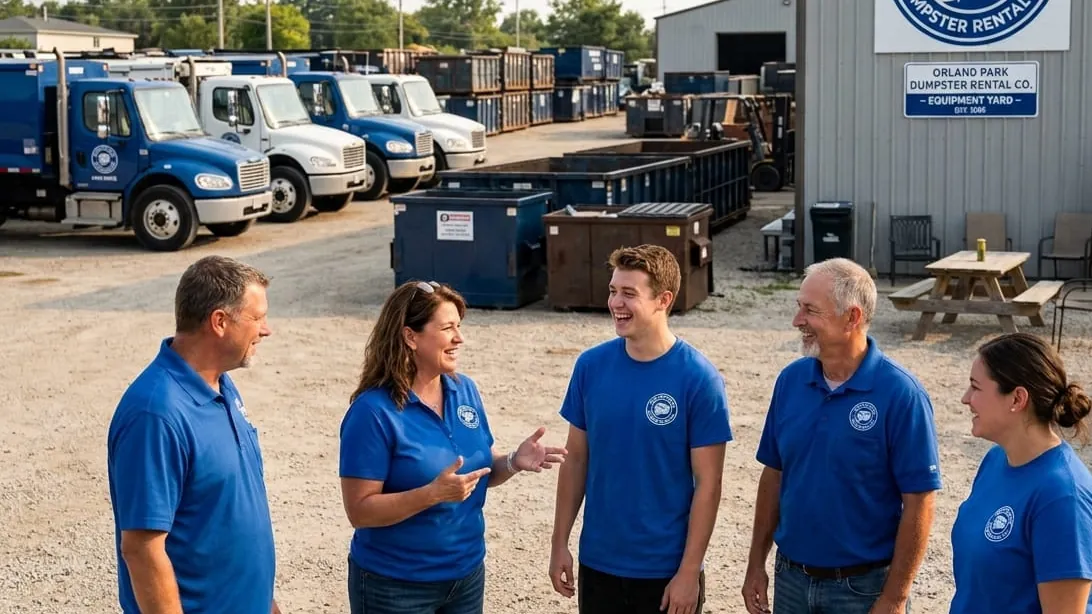

Community
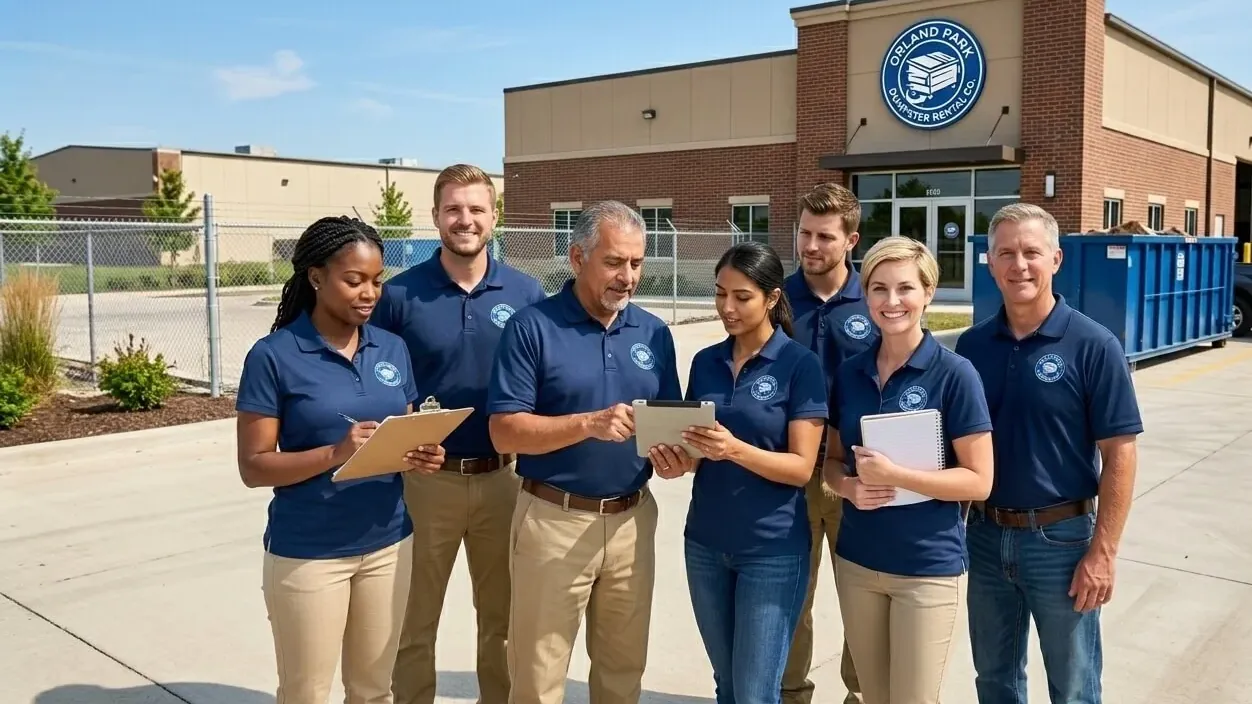
The village we work in is the village we live in
A container goes out at no charge to school and church clean-up days a few times a year. Where a storm has put a tree through the garage of somebody elderly and living on a fixed income, the job gets discounted rather than quoted. There is a name on a couple of youth teams, which in practice means somebody from the yard carrying nets around on a Saturday morning. None of that is remarkable and none of it deserves a plaque; it is what a small business in a village of this size does, because the same faces keep coming back round.
Orland Park was incorporated in 1892 and spent the next seventy years small: 2,592 people in 1960. Then it arrived all at once — 6,391 in 1970, 23,045 in 1980, 35,720 in 1990, 51,077 in 2000, 58,703 in 2020 — across 22.03 square miles at 2,664.9 people per square mile, with 23,256 households and a median household income of $98,910. Orland Square Mall opened in March 1976, in the middle of the biggest decade of all, and the Village switched from well water to Lake Michigan water in 1985, buying it through a 36-inch main from Oak Lawn that serves a dozen other communities alongside this one. That switch is the reason “documentation that water has been turned off or that existing wells have been capped” is still printed on the Village’s demolition checklist today. There are capped wells under this village, and seven elevated water towers and two underground reservoirs above and beneath it — which is a concrete, unromantic reason to dial 811 before a stake goes in.
The Village runs a council-manager form of government adopted in 1983, with the hall on Ravinia Avenue and the main number 708-403-6100. Fire protection is not a Village department at all: the Orland Fire Protection District is its own unit of government, and its fire-code ordinance is captioned “Cook and Will Counties, Illinois” — it straddles the line exactly as the village does. So does the National Weather Service, which files most of Orland Park in its Southern Cook County zone and writes “Orland Park (small part)” into the Northern Will County list. That small part is where this yard stands. And around the edges the village cannot grow: Orland Grassland holds “more than 750 acres of open prairie,” an Illinois Nature Preserve under the Forest Preserves of Cook County, with a south entrance on 104th Avenue below 179th Street, and there are further preserve holdings along Tinley Creek — which the Forest Preserves record as a 9.49-mile stream running from its headwaters in Orland Hills to the Cal-Sag Channel in Crestwood. A village that cannot spread outward is a village that rebuilds inward, and that is the whole shape of this trade here.
The weather record is specific rather than atmospheric. NWS Chicago confirmed an EF-0 tornado here on 27 July 2026 — “3 NW Orland Park,” a 2.9-mile path, 85 mph, 250 yards at its widest — on a day that also drove an EF-1 through Country Club Hills, Hazel Crest and Homewood, produced a 104 mph gust at Bult Field and left, by the local paper’s count, nearly 9,000 ComEd customers in the village without power. On 15 July 2024 the same office confirmed 32 tornadoes across its forecast area, a record for it. And the one older residents will name unprompted is 21 April 1967, an F4 whose path the Weather Service prints as “Palos Hills to Oak Lawn…” with 33 deaths. We are not a FEMA partner, an insurance partner or an emergency-management partner, and we will not be written up as one.
The runs go out to the Will County towns of Mokena, New Lenox, Homer Glen, Frankfort and the City of Lockport; across suburban Cook to Orland Hills — a separate village entirely, with its own hall on 94th Avenue on (708) 349-6666 — Tinley Park, Palos Park, Crestwood, Midlothian, Worth, Alsip and the cities of Oak Forest, Palos Heights, Palos Hills and Hickory Hills; and to Lemont, which sits in Cook, DuPage and Will at the same time. Outside Orland Park we state nobody’s local ordinance, because nothing we read establishes one; the hall’s number goes across instead. And of everything those 23,256 households put out, a good deal less needs burying than usually ends up buried — which is why the metal, the clean wood, the corrugated and the clean concrete leave the load before it ever reaches a scale, and why the doors, the hardware, the cast iron and the light fittings are worth lifting out while the box is still on the drive.
About Orland Park Dumpster Rental
Who owns Orland Park Dumpster Rental?
Dave Kolar. He opened it in 2011 with one truck and still runs it from 11601 183rd Pl. There is no national chain sitting above it, no broker reselling somebody else’s capacity, and no call center two states away handing south-west suburban jobs to whoever quoted cheapest that morning. Dial the number and you have reached the people who own the steel.
Are the trucks yours, or are you booking somebody else's?
They are ours — trucks, containers and drivers all belong to this company and all sit at 11601 183rd Pl rather than somewhere else in the region. That has one practical consequence worth caring about: a delivery window that is worth something. A broker taking a booking is passing it along and hoping. When the board here says Tuesday morning, the person saying it is looking at one of our own trucks and can see what else is on it that day.
What areas do you actually serve?
Orland Park and seventeen places around it, and they fall into three groups because in this market the county is what changes the answer. Five are in Will County — Mokena at 2.0 straight-line miles, the closest place on the board and in our own county and our own township; New Lenox, Homer Glen, Frankfort (the village, which is not Frankfort Township) and the City of Lockport. On every one of those, Cook County’s demolition permit, its asbestos permit and its 70 percent diversion mandate do not apply, and we could not establish what Will County requires instead, so you get the county’s number rather than a guess. Eleven are in suburban Cook County — Orland Hills, which is a separate village with its own hall on 94th Avenue and its own number, (708) 349-6666, and not a part of Orland Park; Tinley Park, Palos Park, Crestwood, Midlothian, Worth, Alsip, and the cities of Oak Forest, Palos Heights, Palos Hills and Hickory Hills. There the county’s machinery does bite, and we can be specific with figures. And one sits in three counties at once: Lemont, in Cook, DuPage and Will, which is why it has a page to itself. Outside Orland Park we state no village’s or city’s own ordinance, because nothing we read establishes one. Our full service area is listed here.
Do you carry insurance?
Yes — ordinary commercial cover, carried on every container that leaves the yard, and an account holder who asks for the certificate can have it the same day. That is a private arrangement between this company and its insurer, and it is a question with a one-word answer. What it is not is a statement about anybody’s rules, or about where this company stands with any authority; we take some care never to let it drift into being one. What any authority requires of any particular arrangement is that authority’s business to state, not ours.
Do you handle commercial accounts?
Yes, and they take up a large share of the week: builders, remodelers, roofers, restoration firms, property managers, restaurants, retail and landlords. An account puts you nearer the front of the board, brings next-day swaps while a job is running, and produces one invoice at the end of the month. There is a structural reason it matters in this village rather than just a convenient one. This is a retail economy with a mall approaching its fiftieth year and a long corridor along La Grange Road, and tenant turnover on that scale keeps producing interior demolition, fixture strip-out, ceiling grid, shelving and carpet tile. It is also, under 65 ILCS 5/11-19-1, work that no Illinois municipality of this size is permitted to franchise away. See commercial dumpster rental, or ring and the account gets opened on the call.
Talk to a real person
Put the difficult question to Dave first
There is no queue, no ticket number and no form promising a reply inside one business day. The number rings at the yard on 11601 183rd Pl and somebody who knows this village answers it — and where the honest answer turns out to belong to the Village, to Cook County or to Will County, that desk’s number is what you get instead of a pitch.
Independently owned in Orland Park since 2011 · Mon–Fri 6:30am–5pm, Sat 7am–1pm