
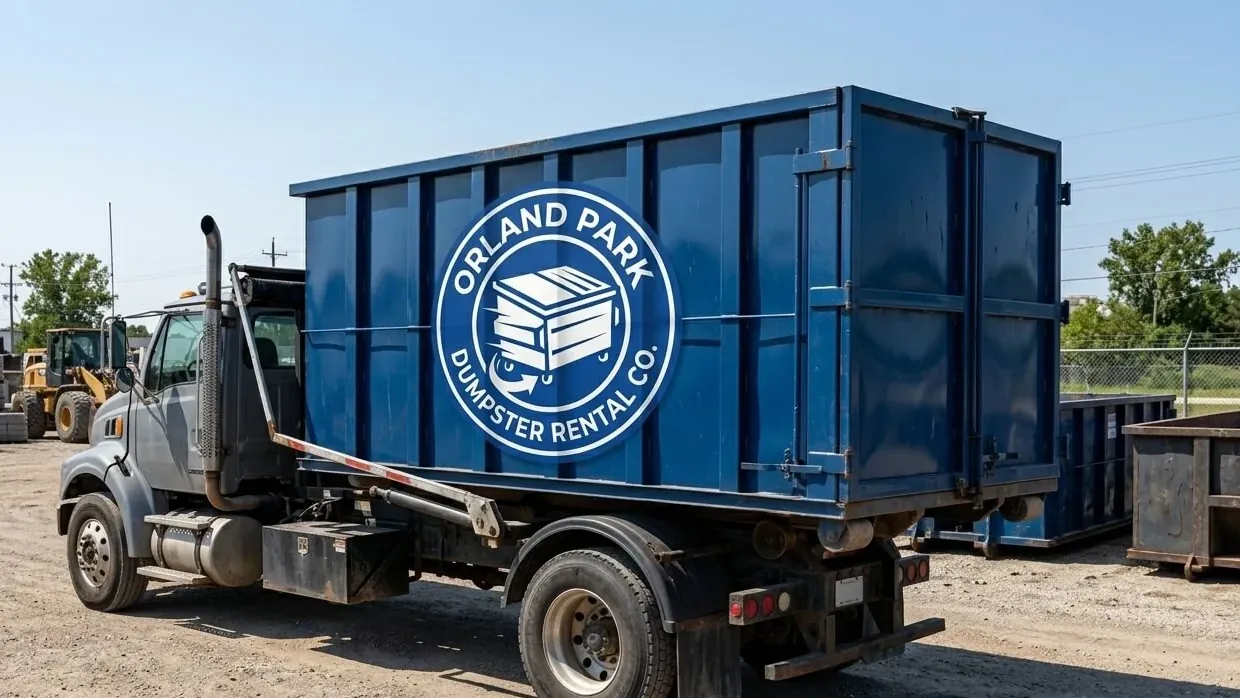
Commercial
Commercial Dumpster Rental in Orland Park, IL
Containers for retail, restaurant, office, institutional and light industrial property across Orland Park and the south-west suburbs — and the page where we say plainly which of the Village’s residential rules do not travel with you onto a commercial site.
The first thing a commercial customer in Orland Park should know is the thing this site says most often and means most literally here: the Village’s refuse arrangement was never going to take your construction debris, and state law is the reason. 65 ILCS 5/11-19-1 — as reproduced currently by FindLaw — provides that “A municipality with a population of less than 1,000,000 shall not award a franchise or contract to any private entity for the collection of general construction or demolition debris from residential or non-residential locations.” Read the last three words. This is not a residential carve-out that happens to leave businesses out in the cold; the statute names non-residential locations expressly. Orland Park was 58,703 people at the 2020 Census and every municipality in this service area is far under a million, so the position is identical everywhere we deliver.
The second thing is a warning about numbers you may have read on this very site. The Village publishes a page called “Dumpsters and Storage Pods (Residential)” which says “Permits are not required” and then sets four limits — 30 days, private property, a five-foot lot line setback, and 768 cubic feet with a maximum height of eight feet above grade. Those numbers are written for residential zoning districts, and the word is in the page title. We do not apply them to a commercial job and neither should anyone else. The Village’s published permit list carries a separate Seasonal Outdoor Storage item, and we did not establish what governs a container on a commercial or industrial parcel here. That is a question for Development Services on 708-403-6100, and it is worth one phone call before a six-week fit-out rather than after.
Third, the fire code — and Illinois arranges this differently from most states, so it is worth two minutes. There is a statewide fire code and it is NFPA 101, the Life Safety Code, adopted by rule at 41 Ill. Adm. Code 100.7. But the State Fire Marshal’s own guidance splits jurisdictions three ways, and in a home rule municipality without adopted equivalency those state rules reach state-licensed facilities rather than ordinary buildings. Orland Park is a home rule village by operation of the Illinois Constitution, because it has more than 25,000 residents. What actually governs here is what the Village and the fire district adopt locally — and both of them adopt the International Fire Code, not NFPA 101. The Village says it uses the IFC as the basis for its property maintenance regulations; the Orland Fire Protection District, a separate unit of government at 9790 West 151st Street spanning both counties, says its code is the 2018 International Fire Code with amendments. When somebody quotes you “the fire code” about a container against your building, ask which one they mean.
Fourth — and this is the honest bit — we are not going to publish a separation distance in feet between your container and your building. The figure that circulates online comes out of the model fire code, we did not read the operative section from a source we trust this year, and the person who will actually measure it is a fire inspector rather than a copywriter. The right call is the Orland Fire Protection District: tell them the wall, the openings, the eave line and the size of the box, and place accordingly. That one call is cheaper than moving a loaded container.
Fifth, the work itself. This is a retail village with a long commercial spine along US 45 (LaGrange Road) and US 6 (159th Street), and commercial property here turns over on its own cycle rather than on a housing cycle. Orland Square Mall has been open since 15 March 1976 at 1,229,884 square feet; the Village Board approved a roughly 230,000 square foot ground-up retail development at the south-west corner of 159th Street and LaGrange Road on 19 January 2026. Between the two ends of that range sits a continuous supply of tenant fit-out, fixture strip-out, ceiling grid, carpet tile and shell work. It is bulky, it is scheduled, it runs on swap dates rather than on weekends, and it is work the Village is legally barred from franchising away from you. Ring the yard on (708) 928-8633 with the site, the surface and the gate width.
The Commercial Jobs This Corridor Actually Books
Tenant Fit-Out And Retail Reset
Ceiling grid, shelving standards, gondola, partition studwork, carpet tile, signage and flattened cartons by the pallet. Volume is the binding constraint and weight almost never is, so the usual answer is 30 yard work, with a 40 reserved for lots whose service court is long enough to land one.
Restaurant Refit Or Kitchen Strip-Out
Stainless, hoods, walk-in panels, quarry tile, millwork and flooring. Two notes for this market: quarry tile in a mortar bed is a weight load and belongs in its own low box, and the fire district will have a view on where a container stands against a cooking occupancy.
Office Clear-Out And Furniture Disposal
Desks, task chairs, cubicle panels, filing and the store room nobody has opened since the last lease. Fast to load and light for its volume. Electronics come out first and go somewhere else — Illinois keeps covered devices out of the landfill entirely.
Warehouse And Light Industrial Cleanout
Racking, split pallets, banding, shrink wrap, dead stock and the corners of a building nobody has emptied since the lease was signed. Volume disappears fast here and weight arrives slowly. What sets the tempo is how often a truck can get in and back out again, so settle the swap dates first and the container size second.
Multifamily And Property Management Turnover
Furniture, carpet, appliances and abandoned property on a hard turnaround. Worth knowing that the residential asbestos exemption in the federal rule is written around buildings of four units or fewer, so a larger building sits in a different bracket from the start.
Institutional, School And Church Cleanouts
Classroom furniture, pews, kitchen equipment, gym flooring and decades of stored material. These are exactly the occupancies where the state Life Safety Code layer and the locally adopted fire code both come into the conversation, so build the placement question into the schedule early.
Contractor Container On A Commercial Site
Mixed construction and demolition debris on a site working to a program. Swaps booked ahead of the work, the pad left clear so the replacement drops on the same spot, and every load kept level with the rail so no pull gets refused. See the construction page.
Storm Damage On A Commercial Property
The 27 July 2026 event put a confirmed EF-0 on the ground at “3 NW Orland Park” and left nearly 9,000 ComEd customers in the village without power. Roof membrane, fascia, signage, fencing and downed limbs across a parking lot are a different load from a fit-out and usually want a second box.
Sizing A Container For A Business Property
A business property loads by bulk far more often than by weight, so the arithmetic here runs the opposite way round to a house. The 30 yard does most of the work on a fit-out, a retail reset or an office strip — ceiling grid, gondola, partition studwork, carpet tile, furniture and cardboard by the pallet. Move up to a 40 yard only where the debris is genuinely feather-light and the lot has the length to accept it: a 40 is twenty-two feet of steel on the ground, and a service court behind a La Grange Road unit rarely has that to spare. Once weight enters the picture the whole calculation inverts. Quarry tile bedded in mortar, block, terrazzo, slab and lifted paving belong in a 10 yard spread in one course, because the scale runs out on masonry long before the container looks used. A 20 answers for a single small unit, or a tight rear yard where nothing longer can turn. On any job producing both, two containers beat one badly mixed one. And note what is not steering this decision: the Village’s 768-cubic-foot figure is a residential zoning rule and we do not size a commercial job against it. Describe the property on (708) 928-8633.
20 Yard Dumpster
What leaves the yard most weeks. Rated volume sits inside the Village’s rule; the outside of the box is a question worth asking.
View this size →30yd³30 Yard Dumpster
A whole-floor gut, or fifty years of one family’s storage. Check it against the Village rule first.
View this size →40yd³40 Yard Dumpster
Light, bulky commercial material only, and it needs the longest straight approach on this list.
View this size →Where The Residential Rules Stop, And What Replaces Them
On a commercial property the constraints arrive in a different order from a driveway. First, the things that are invisible from the street. Fire lanes, standpipe and sprinkler connections, transformer pads and gas meters, grease trap lids, drive-through lanes, the route the collection truck takes on service day and the hours the loading bay is actually in use. Tell us about all of them at booking rather than on delivery morning, because a container placed across any one of them is a container that gets moved twice. Second, the surface. Orland Park sits on the Valparaiso Morainic System, and the Illinois State Geological Survey describes the surface unit here — the Wadsworth Formation — as an “extensive surficial clay-rich stratigraphic unit” more than 125 feet thick. Asphalt over clay in July takes an impression from a loaded box more readily than concrete does, so we mat under the wheels and both rear rollers as standard and we would rather set down on a concrete apron or a well-built base than on the soft edge of a lot after a wet week. On the National Weather Service’s Chicago O’Hare 1991–2020 normals, May through August average 3.71 to 4.49 inches of rain a month, so wet weeks are not rare. Third, the code question, stated carefully. The state’s fire code is NFPA 101; Orland Park’s is the International Fire Code; the Orland Fire Protection District says it has adopted the 2018 IFC with amendments. The model code does contain a separation requirement for large containers. We are not publishing a number for it, because we did not read the operative section this year and because your inspector will measure the real thing. Call the district. Fourth, the rules that genuinely do reach a commercial site here. The Village Code forbids obstructing or encroaching on public streets and forbids using streets, parkways and sidewalks for business purposes — so a container standing in the road or across a public sidewalk is a problem on a commercial lot as surely as on a residential one, and remember that several of the biggest streets around you belong to Cook County or to IDOT rather than to the Village. Fifth, the county layer, if the work turns into demolition. In suburban Cook County an interior strip-out is one thing and taking a building down is quite another: see the demolition page before you set a date.
Landed on the wrong service? Describe the job out loud and we will name the container that actually fits it — quite often that means pointing you at a different page here, or at the Village’s own collection, which costs you nothing at all. Ring (708) 928-8633.
One figure, one call
The address first — it settles Cook or Will — then what is going in. Size, figure and day, in about two minutes.
(708) 928-8633Sizes that suit it
How it works
Commercial Dumpster Rental, from the phone call to the collection
- 1
Tell us the job
Two minutes, and a street name and a nearest cross street is enough. Give us the address rather than the town, because in this village the address is what decides which of five governments answers your question. By the end of the call you have one figure, and the disposal is already inside it.
- 2
We set it down
The driver walks the run in on foot before the truck follows it, and plywood goes down under both rails and all four wheels. This is Wadsworth clay; it does not forgive a wet March. On private property, five feet clear of any lot line, which is the Village’s own rule and a real constraint on a suburban lot.
- 3
Fill it flat and low
Use the days in your window. Heavy on the bottom, nothing standing proud of the rail, and keep it covered — rain here runs three and a half to four and a half inches a month through the summer, and water is weight.
- 4
Say the word
One call and it goes. Metal and clean cardboard are pulled off the top first, and what remains travels to a facility permitted to receive it.
Commercial Dumpster Rental FAQs
Does the 768 cubic foot rule apply to my business?
Not as far as anything we have read establishes, and this is one of the places where reading carefully matters. The Village’s figure comes off a page titled “Dumpsters and Storage Pods (Residential)”, and the size limit is written as “768 cubic feet for residential zoning districts”. That is a zoning-district scope, not a village-wide one. We could not establish what governs a container on a commercially or industrially zoned parcel in Orland Park, and we are not going to guess — note that the Village’s published permit list carries a separate Seasonal Outdoor Storage item, which suggests the commercial side is handled through a different route rather than the same one. Ring Development Services on 708-403-6100, describe the zoning district, the parcel and how long the box needs to stand, and get the answer from the people who issue the permits. Then ring us on (708) 928-8633 and we will work to whatever they tell you.
How far does the container have to be from my building?
No figure from us, and the refusal is worth explaining rather than simply making. Illinois’s statewide fire code is NFPA 101, the Life Safety Code, adopted at 41 Ill. Adm. Code 100.7 — but Orland Park is a home rule village, and the State Fire Marshal’s own guidance says that in a home rule municipality without adopted equivalency the state rules reach state-licensed facilities. What reaches your store is what is adopted locally, and that is the International Fire Code: the Village says it uses the IFC, and the Orland Fire Protection District says its code is the 2018 IFC with amendments. The model code does contain a separation rule for containers over a cubic yard. We did not read that section from a source we trust this year, so we are not publishing a figure a fire inspector will measure. The district is at 9790 West 151st Street and covers both counties. Call them, describe the wall and the openings, and place to their answer.
Can the Village’s refuse contract take our commercial waste?
Not for construction and demolition debris, and the bar is a statute rather than a contract term. 65 ILCS 5/11-19-1, in FindLaw’s current reproduction, says a municipality under 1,000,000 people “shall not award a franchise or contract to any private entity for the collection of general construction or demolition debris from residential or non-residential locations.” Non-residential is named in the sentence. Orland Park is 58,703 people, so it is squarely inside the prohibition, and so is every other municipality we deliver to. For ordinary day-to-day commercial refuse, that is a separate question and one for the Village and your own arrangements rather than for us — the Village’s residential program is a residential program, established under Title 4 of the Village Code and billed like a utility. What we do is the project work: the fit-out, the strip-out, the clear-out and the demolition.
Do we need to report anything to Cook County?
There is a county layer in suburban Cook County that has no equivalent in a lot of markets, and it is worth knowing about even where it is not your obligation. Cook County’s own page states that “The Cook County Solid Waste Ordinance requires waste haulers operating in suburban Cook County to report their collected waste, recycling, and yard waste tonnages to the Department of Environment and Sustainability quarterly, by municipality.” That is a fact about how this county works, not a claim about anybody in particular. Where it touches you directly is demolition: a Cook County demolition permit requires a Demolition Debris Diversion Plan demonstrating 70 percent diversion by weight, with an additional 5 percent reuse for residential property. The county desk is Cook County Environment and Sustainability on (312) 603-8200. See our county comparison for how it actually plays out.
Can you swap containers to keep a crew moving?
Yes, and on a scheduled commercial job a run of swaps normally works out cheaper than asking one container to do everything. Put the pull dates on the calendar at the same moment you book the delivery, so the empty is already routed rather than being chased down by a crew that has stopped work. Three things decide whether swaps run smoothly on a lot like yours. Keep the pad clear — the replacement has to drop exactly where the full one stood, and a delivery van left across it costs you the slot. Load flat: a box heaped above the rail cannot lawfully leave, and a box full of dense material can reach a road payload long before it looks full. And tell us the access constraints once, properly: gate width, overhead clearance, restricted hours, a shared service drive, a fire lane that has to stay open. Ring (708) 928-8633 and we will build the schedule around them.
More services
Other things we haul
Residential Dumpster Rental
Orland Park’s cart takes three cubic yards a week. A bathroom gut is that on its own.
Learn more →Construction Dumpster Rental
Mixed build waste in one box, swapped on call either side of the county line.
Learn more →Roofing Dumpster Rental
Squares and layers, never roof area — and never a 30 or a 40, whatever the roofer asks.
Learn more →Roll-Off Dumpster Rental
Five box sizes, and the two largest are worth a call to your own village before you order.
Learn more →Same-Day Dumpster Rental
What we can and cannot do today, said straight on the phone.
Learn more →Junk Removal Dumpsters
Clear a garage, a basement or a rental unit at whatever pace the week allows.
Learn more →Estate Cleanout Dumpsters
Patient work in a village where a quarter of the residents are over sixty-five.
Learn more →Demolition Debris Removal
Decks, garages and strip-outs — and in Cook County the County wants a permit too.
Learn more →Concrete & Heavy Debris
Its own low box for slab and apron concrete, loaded flat in one layer.
Learn more →Yard Waste & Brush Removal
Stumps, sod, dirt and anything over four inches — all of it off the curbside route.
Learn more →Where we deliver
Commercial Dumpster Rental across Cook and Will Counties and the south-west suburbs
Seventeen places, one crew, one flat figure. Each has a page of its own, and the first thing that page settles is which county answers for the address — Cook, Will, or in Lemont’s case three at once.
Talk to a real person
Need commercial dumpster rental in Orland Park?
Say what is going in and give us the address — the address, because on this village the county changes underneath you. Size, one flat figure and a day, settled before you hang up. No form to fill in, and no queue.
Orland Park and seventeen more places across Cook, Will and DuPage · Mon–Fri 6:30am–5pm, Sat 7am–1pm