
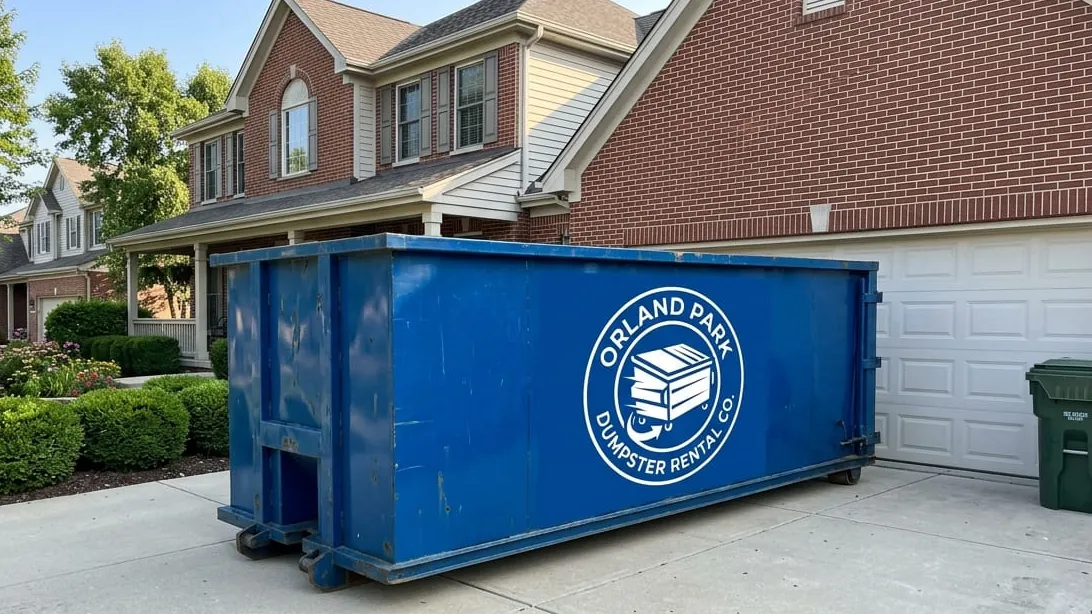
Residential
Residential Dumpster Rental in Orland Park, IL
Driveway containers for houses across the Village of Orland Park — mostly in Cook County, partly in Will, with our own yard on the Will County side. The Village does collect your household refuse. It cannot collect your remodel, and the reason is a state statute rather than a policy.
Start with the part that is genuinely different here, because most of this portfolio’s markets do not have it. The Village of Orland Park collects your household refuse. It is a Village service, established by ordinance in Title 4 of the Village Code, Chapter 12 — filed alongside water and sewer rather than in the health and nuisance title, because the Village sets the charge, bills it and runs an appeal process on it the same way it does a utility. You get a 96-gallon cart, overflow goes in bags or containers “no greater than 45-gallon in size” and under 50 pounds, everything is at the curb by 6:00 a.m., and the published ceiling is this: the Village’s contracted collection takes “up to three cubic yards of refuse per week” plus one bulk item. Collection questions go to the number the Village publishes for them, (800) 964-8988.
Now read the Village’s own definition of a bulk item, because it settles the whole question in one sentence: “A bulk item is considered an item the resident would take with them if they moved out of the residence (e.g., couch, small tables, mattress, etc.).” That is a beautifully clear line and your remodel falls on the wrong side of it. Drywall does not move house with you. A sofa does. Three cubic yards a week is generous for a household and hopeless for a project — a single bathroom gut is three to five cubic yards on its own, before the vanity and the tub surround arrive at the curb as this week’s one bulk item and next week’s. The one useful exception is carpet, which the Village does treat as a bulk item: cut and rolled into 4-foot lengths, no roll over 50 pounds, secured with tape or string, up to eight rolls a week.
And the Village could not stretch that service to cover your remodel even if it wanted to, which is the fact almost nobody in this market has read. 65 ILCS 5/11-19-1 is the section of the Illinois Municipal Code that lets a municipality contract for garbage collection in the first place — the section Orland Park’s own refuse arrangement lives under. It also carries a carve-out. In the words of FindLaw’s current reproduction of the statute: “A municipality with a population of less than 1,000,000 shall not award a franchise or contract to any private entity for the collection of general construction or demolition debris from residential or non-residential locations.” Orland Park’s 2020 population was 58,703. Every village, town and city in this service area is far under a million. So construction and demolition debris is not something the Village withheld from its contract. It is something the General Assembly took out of the Village’s hands entirely.
The next thing worth knowing before you book anything is that the Village says you do not need a permit for the container — and then sets four hard numbers. Its own page, titled “Dumpsters and Storage Pods (Residential)”, says “Permits are not required”, and then: a maximum of “30 days from the day of placement on the site”; the unit “shall be located on private property”; “a minimum lot line setback of five (5) feet from any lot line”; and a maximum total unit size of “768 cubic feet for residential zoning districts” with “a maximum unit height of eight (8) feet above grade”. The Village cites LDC § 6-304.C.12 as its authority. 768 cubic feet is roughly 28.4 cubic yards, which is the single most useful piece of arithmetic on this site: a 20 yard box is comfortably inside it and a 30 is a genuine question. Those figures are written for residential zoning districts and we do not carry them across to a commercial job.
The last piece is who lives here, because it decides what actually comes out of these houses. Census QuickFacts puts Orland Park at 85.8 percent owner-occupied across 23,256 households, at 2,664.9 people per square mile over 22.03 square miles, with 24.8 percent of residents aged 65 and over and a median owner-occupied value of $367,200. And the village arrived all at once: 6,391 people in 1970, 51,077 by 2000. Nearly everyone who lives here owns the house they are standing in, most of them have owned it a long time, and the village stopped growing outward years ago. That is not a market where houses go up. It is a market where houses get re-done — roofs, kitchens, baths, basements, siding, decks — and it is why a container question in Orland Park is almost always a renovation question in disguise. Ring the yard on (708) 928-8633 and describe the job room by room.
What Orland Park Houses Actually Clear Out
Attic, Garage And Basement Clear-Out
The anchor residential job in this village. Thirty or forty years in one house fills three spaces at once, and they empty together rather than one at a time. Put the tailgate wherever the carry from the garage door is shortest, and the back half of the job costs you half the effort.
Whole-House Declutter Before A Listing
Closets, carpet, furniture, the garage, and everything that migrated into the spare bedrooms after the children moved out. This is the classic 20 yard job, it sits comfortably inside the Village’s 768 cubic foot rule, and it is the one people most often under-estimate from the front hall.
Kitchen And Bathroom Rip-Outs
Cabinets, counters, tile, backer board, tub, vanity and flooring. One bathroom is already more than the Village’s three-cubic-yard weekly ceiling. In a house from the 1970s, find out what may contain asbestos or lead paint before the first cabinet comes off the wall.
Finished Basement Rework Or Water Damage
Paneling, drop ceiling, carpet and pad, insulation and ruined storage. Wet material is heavy and it loads badly, so keep it flat and separate from clean dry debris where you can. If you open up a sub-slab space, EPA’s line on radon is worth following: test the house afterwards regardless of zone.
Roof Tear-Off On A Ranch Or Split-Level
Torn shingle is a weight load, not a volume load. Count squares and layers rather than the footprint of the house, and note the hard ceiling: a tear-off never goes in a 30 or a 40. Our roofing page works through the arithmetic.
Deck, Fence And Shed Removal
Bulky, awkward and light for its volume, which inverts the usual sizing logic — take the larger box, because deck boards and fence sections will not stack. Where the posts were set in concrete, break the footings out as a load of their own and route them through heavy debris instead.
Storm And Tree Debris Around The House
Siding, soffit, fascia, screens, shingle litter and downed limbs. The Village’s weekly yard waste program says in terms that it does not take “sod, whole trees, stumps, and dirt” or “limbs greater than 4 inches in diameter”, which is most of what a real storm leaves. See our storm debris guide.
Carpet, Flooring And Padding Through The Whole House
The Village will take carpet at the curb as a bulk item — cut into 4-foot rolls, under 50 pounds each, up to eight rolls a week. Re-carpeting a whole house is more than eight rolls and it does not happen over eight weeks, so it usually wants a box on the drive for a weekend instead.
Sizing A Container Against The Village’s Own Limit
Sizing at an Orland Park house starts from the Village’s own arithmetic, which is unusual and genuinely useful. The residential cap is 768 cubic feet, or roughly 28.4 cubic yards, with eight feet above grade as the ceiling on height. That leaves a 20 yard comfortably inside the rule, height included, and a 20 is what an ordinary house here takes when the basement, the garage and the upstairs closets all go out inside the same two weeks. Where the work has a hard boundary drawn round it — a single bathroom, a single kitchen, the garage by itself, one straightforward single-layer tear-off — a 15 yard is the honest answer and the cheaper one to run. Mineral debris pushes the number down instead of up: broken concrete, brick, block, mortar-bedded tile, stripped sod and footing spoil use up the axle weight with a great deal of box still empty, which is the entire purpose of the 10 yard. And a 30 — for a house emptied end to end, or taken back to the studs — is the point at which 28.4 cubic yards stops being trivia and turns into a question you have to answer on your own driveway, so read that page before you order one. Roofing runs the other way and the ceiling is firm: a tear-off never goes in a 30 or a 40.
10 Yard Dumpster
Broken slab, apron and block. Dense material is full by weight long before the box looks it.
View this size →15yd³15 Yard Dumpster
A single-layer tear-off, or one room of a 1970s split-level taken back to the studs.
View this size →20yd³20 Yard Dumpster
What leaves the yard most weeks. Rated volume sits inside the Village’s rule; the outside of the box is a question worth asking.
View this size →Clay, Setbacks And The Thirty-Day Clock
Placement at an Orland Park house comes down to the ground, the rule book and the calendar. The ground first. The Illinois State Geological Survey’s surficial geology report for the Mokena Quadrangle — a map sheet that names Orland Park in its own community list — describes this area as centered on the Valparaiso Morainic System, with the Wadsworth Formation as the surface unit: an “extensive surficial clay-rich stratigraphic unit” exceeding 125 feet in thickness, over more than 185 feet of glacial sediment in places, over Silurian dolomite. Clay-rich is the operative half of that phrase. It is why plywood goes under the wheels and under both rear rollers on every delivery here, why we would rather set a loaded box on concrete or a well-built base than on turf or a soft edge, and why we ask about anything the driver cannot see — a recent pour, a shallow drain line, a sprinkler head, a service walk. We are not soil engineers and we will not publish an engineering number for what your driveway will carry. What we will do is plate it properly and tell you if we do not like the spot. The rule book second. The Village asks for five feet from any lot line, which on a suburban lot at 2,664.9 people per square mile rules out the classic placement hard against a side fence; a maximum of eight feet above grade, which is a live constraint on a heaped high-side box rather than a formality; private property, which means the driveway and not the street; and 30 days from the day of placement. The Village Code separately forbids obstructing or encroaching on public streets and caps open building-material storage in a residential district at seven days, or thirty where it is tied to construction — this is a village that thinks in month-long windows. We will not tell you a street placement can be permitted here, because the Village’s page makes no provision for one. The calendar third. On Chicago O’Hare, 1991–2020 normals published by the National Weather Service, January and February together average 22 inches of snow, and March averages 5.5 inches of snow against a 47 °F average high — thaw by day, freeze by night, on clay. March is the month we are fussiest about where a loaded container sits. And if anything on the job breaks ground — a fence post, a stake, a footing, a skid-steer scraping a pad — that is JULIE, and it is worth reading about before delivery day rather than after.
Landed on the wrong service? Describe the job out loud and we will name the container that actually fits it — quite often that means pointing you at a different page here, or at the Village’s own collection, which costs you nothing at all. Ring (708) 928-8633.
One figure, one call
The address first — it settles Cook or Will — then what is going in. Size, figure and day, in about two minutes.
(708) 928-8633Sizes that suit it
How it works
Residential Dumpster Rental, from the phone call to the collection
- 1
Tell us the job
Two minutes, and a street name and a nearest cross street is enough. Give us the address rather than the town, because in this village the address is what decides which of five governments answers your question. By the end of the call you have one figure, and the disposal is already inside it.
- 2
We set it down
The driver walks the run in on foot before the truck follows it, and plywood goes down under both rails and all four wheels. This is Wadsworth clay; it does not forgive a wet March. On private property, five feet clear of any lot line, which is the Village’s own rule and a real constraint on a suburban lot.
- 3
Fill it flat and low
Use the days in your window. Heavy on the bottom, nothing standing proud of the rail, and keep it covered — rain here runs three and a half to four and a half inches a month through the summer, and water is weight.
- 4
Say the word
One call and it goes. Metal and clean cardboard are pulled off the top first, and what remains travels to a facility permitted to receive it.
Residential Dumpster Rental FAQs
Do I need a permit for a container on my driveway?
No, and you have that from the Village rather than from us. Its own permit page for “Dumpsters and Storage Pods (Residential)” says “Permits are not required” in exactly those words. What it does impose is four numbers: 30 days from the day of placement, the unit “shall be located on private property”, five feet minimum setback from any lot line, and a maximum of 768 cubic feet with eight feet maximum height above grade. The Village cites LDC § 6-304.C.12 for it; we have read the permit page and not the code section, so that is as far as we take the citation. Two cautions. Those figures are written for residential zoning districts — do not carry them onto a commercial site. And a permit for the box is not a permit for the work: a roof, siding, windows or a demolition each carry their own Village permit, published at $95 apiece, and you should confirm current fees with the Village on 708-403-6100. Our permit guide lays all of it out.
What size does an ordinary Orland Park house take?
A 20 yard, most of the time, and here there is a second reason beyond the usual one. The Village caps a residential unit at 768 cubic feet, which converts to about 28.4 cubic yards — so a 20 sits comfortably inside the rule and a 30 is a genuine question you have to think about rather than a free upgrade. Beyond that it is the shape of the job. A clear-out that began as “the basement” usually turns out to be the basement, the garage and the upstairs closets going out in the same two weeks, which is more volume than anyone estimates from the doorway. Where the work has a boundary drawn round it — the hall bath on its own, one kitchen, the garage and nothing else — a 15 is right, and cheaper to run. If the material is mineral rather than bulky, the answer gets smaller, not bigger: see the 10 yard. Describe it room by room on (708) 928-8633.
What can I not put in the container?
Illinois keeps six materials out of a landfill-bound container by statute, and several of them are written about the container rather than about the landfill, which is why they reach your driveway. Landscape waste — 415 ILCS 5/22.22 provides that no person may knowingly put it “into a container intended for collection or disposal at a landfill, unless such container is biodegradable”, which is the entire reason the Village’s yard waste bags are made of Kraft paper. Lead-acid batteries (22.23), which uses the same container language. White goods (22.28), which is a component-removal rule rather than a flat ban — and that is exactly why the Village asks you to “call Customer Service… prior to collection” before a fridge goes to the curb. Tires (415 ILCS 5/55). Used oil (21.6), which bans liquid used oil and expressly says filters, oily rags, absorbent and empty containers are not that. And electronics, under the Consumer Electronics Recycling Act. After that it is the ordinary list: paint that is not dried out, solvents, fuel, pool chemicals, pressurized tanks, asbestos-containing material. See the full materials guide.
Can the box go in the street instead of the driveway?
Not on the strength of anything the Village has published. Its dumpster page says the unit “shall be located on private property”, there is no street obstruction or right-of-way permit on the Village’s published permit list, and the Village Code’s obstruction section separately forbids obstructing or encroaching on public streets and forbids using streets, parkways and sidewalks for business purposes. We could not find a route to a permitted street placement here, and we are not going to invent one. There is a second reason to keep off the road in this village anyway: the street in front of you may not be the Village’s at all. IDOT owns the state routes — US 45 (LaGrange Road), IL 7 (Southwest Highway), US 6 (159th Street) and IL 43 (Harlem Avenue). Cook County owns several of the biggest local arterials, including 104th Avenue, 108th Avenue, Wolf Road, Will-Cook Road, 151st Street, 153rd Street and 80th Avenue. On the Will County side of the village a road may belong to Will County. The Village’s own engineering page says State and County work is “out of the Village’s jurisdiction.” Keep it on the drive and none of that is your problem.
How long can I keep it?
The Village’s answer is the one that governs: a maximum of “30 days from the day of placement on the site”. That is a hard stop rather than a rolling allowance, and it is worth planning the job backwards from. Two local notes on timing. The wet part of the year and the busy part of the year are the same part of the year — on the National Weather Service’s Chicago O’Hare 1991–2020 normals, May through August average between 3.71 and 4.49 inches of rain a month — and an open container left uncovered through a wet two weeks gains weight you will pay to haul. Load the dense material low and flat so the top course sheds. The other note is the opposite season: March averages 5.5 inches of snow with a 47 °F average high, which is freeze by night and thaw by day on clay, and it is the month we are most careful about where a loaded box sits. Ring (708) 928-8633 when you want it collected and we will route it.
More services
Other things we haul
Commercial Dumpster Rental
Shops, restaurants and tenant fit-outs along the LaGrange Road corridor.
Learn more →Construction Dumpster Rental
Mixed build waste in one box, swapped on call either side of the county line.
Learn more →Roofing Dumpster Rental
Squares and layers, never roof area — and never a 30 or a 40, whatever the roofer asks.
Learn more →Roll-Off Dumpster Rental
Five box sizes, and the two largest are worth a call to your own village before you order.
Learn more →Same-Day Dumpster Rental
What we can and cannot do today, said straight on the phone.
Learn more →Junk Removal Dumpsters
Clear a garage, a basement or a rental unit at whatever pace the week allows.
Learn more →Estate Cleanout Dumpsters
Patient work in a village where a quarter of the residents are over sixty-five.
Learn more →Demolition Debris Removal
Decks, garages and strip-outs — and in Cook County the County wants a permit too.
Learn more →Concrete & Heavy Debris
Its own low box for slab and apron concrete, loaded flat in one layer.
Learn more →Yard Waste & Brush Removal
Stumps, sod, dirt and anything over four inches — all of it off the curbside route.
Learn more →Where we deliver
Residential Dumpster Rental across Cook and Will Counties and the south-west suburbs
Seventeen places, one crew, one flat figure. Each has a page of its own, and the first thing that page settles is which county answers for the address — Cook, Will, or in Lemont’s case three at once.
Talk to a real person
Need residential dumpster rental in Orland Park?
Say what is going in and give us the address — the address, because on this village the county changes underneath you. Size, one flat figure and a day, settled before you hang up. No form to fill in, and no queue.
Orland Park and seventeen more places across Cook, Will and DuPage · Mon–Fri 6:30am–5pm, Sat 7am–1pm