
Local Guide
Storm Debris Cleanup in Orland Park
The National Weather Service put a confirmed EF-0 at 3 NW Orland Park last July, and the Village will not take a whole tree, a stump or a limb over four inches. Here is how storm debris actually gets handled here.
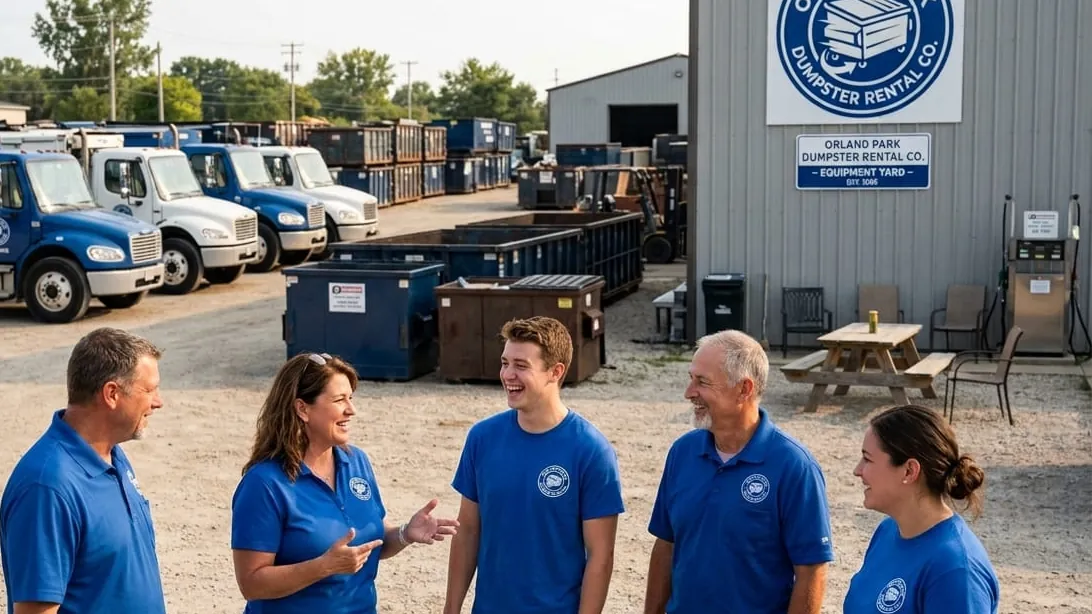
Before anything else on this page: we are a container company. We are not a FEMA contractor, we are not an emergency-management partner, we do not work for anybody’s insurer, and nothing here is an insurance opinion. What we can do is bring a box for the debris and tell you honestly what the record for this village actually shows.
It shows more than most people who live here would guess.
A tornado was on the ground in Orland Park last summer
On 27 July 2026, the National Weather Service confirmed a tornado in this village. From NWS Chicago’s own event summary:
- Rating: EF-0
- Location, in the service’s own words: “3 NW Orland Park”, Cook County
- Path length: 2.9 miles
- Maximum winds: 85 mph
- Maximum width: 250 yards
That was not the only thing that happened that day. In the same event, NWS Chicago confirmed seven tornadoes across its forecast area, including an EF-1 that tracked 11.4 miles at 110 mph through Country Club Hills, Hazel Crest and Homewood, and another EF-1 through Lynwood, Lansing and Munster. Elsewhere in the same system the service recorded a 104 mph gust at Bult Field, near Monee, 3.95 inches of rain at Bridgeview, and a 68 mph gust in the Oak Forest area.
Locally, The Regional News reported on 28 July 2026, in a piece by Kelly White, that “nearly 9,000 ComEd customers in the village” lost power, with trees uprooted, branches across roadways and signals out at 159th Street and La Grange Road. In the City of Palos Heights, the paper described “numerous overturned oak trees”, roughly a fifth of residents without power, and sewer back-ups.
Two notes on the numbers, because precision matters when they are this fresh. The seven is the count across the whole NWS Chicago forecast area; the local paper counted four in the south suburbs, which is a smaller geography rather than a contradiction. And the wind, rain and gust figures above are recorded at the places named, not at your house.
It is not an unusual year, either
Three more entries from the record, all from NWS Chicago:
- 15 July 2024. A derecho produced 32 confirmed tornadoes in the NWS Chicago forecast area — the service records it as the most from a single severe weather event in that forecast area, surpassing a previous record of 22. Eleven were in Cook County and six in Will County, including an EF-2 on the “Channahon to Matteson” track. That count is a forecast-area count covering 23 counties, not a village count.
- 10 June 2026. A brief EF-0 near Alsip during a derecho.
- 21 April 1967. An F4, printed in the service’s significant-tornado list with the path “Palos Hills to Oak Lawn”, and with 33 deaths and 500 injuries. Palos Hills is a city about eleven straight-line miles from our yard. That is the historical reference point for this corner of the south-west suburbs, and it is the reason older residents here treat a warning differently from newer ones.
The warning that covers you may not be the warning that covers your neighbor
This is a genuinely odd local fact, and it has an operational point.
On 3 March 2020, NWS Chicago subdivided Cook and Will Counties into smaller forecast zones. Orland Park appears in the municipality list for Southern Cook County (ILZ105). And it appears again, with a parenthesis the service wrote itself, in the list for Northern Will County (ILZ106), as “Orland Park (small part).”
The Village of Orland Park is mostly in Cook County and partly in Will, spread over four townships, and the National Weather Service handles that by listing the village twice. Our own yard is in the small part.
Practically: if you have containers, equipment or an open roof out during a warning, know which zone your address is in, because a warning for one is not a warning for the other. NWS Chicago is in Romeoville and its pages are at weather.gov/lot. The county split is explained further in our Cook or Will County guide.
And the thing that does not happen here: lake-effect snow
Since we are dealing in what the record shows rather than what people assume, here is a useful correction in the other direction.
Ask around and somebody will tell you Orland Park gets hammered by lake effect. It does not. Take NWS Chicago’s own write-up of the 30–31 January 2026 lake-effect event, which produced snowfall rates over three inches an hour and totals of ten to eleven inches. The totals it recorded:
- Dune Acres, Porter County, Indiana: 11.0 inches
- Porter, Indiana: 10.0 inches
- Chesterton, Indiana: 9.0 inches
- Gary, Indiana: 4.5 inches
- Park Ridge, Cook County: 3.6 inches
- Chicago O’Hare: 2.6 inches
- Chicago Midway: 0.9 inches
Midway is the closest reporting station to the south-west suburbs, and it recorded nine tenths of an inch in an event that gave Porter County eleven. Will County does not appear in the report at all.
Lake effect is essentially a non-event in Orland Park. What actually stops work here is ordinary system snow, and the freeze-and-thaw cycle on clay-rich ground — which is a different subject, covered in the driveway guide. For scale, on the National Weather Service’s 1991–2020 normals for Chicago O’Hare, January and February together average about 22 inches of snow, and March averages 5.5 inches against a 47°F average high.
What storm debris in this village is actually made of
Storm cleanup is not one material and it should not be one pile. In practice it arrives as four separate streams, and keeping them separate on the ground is the single decision that makes everything afterwards easier.
1. Trees, and this is oak country
The July 2026 reporting from this area is full of oak: overturned, split, uprooted. Mature hardwood is the heaviest debris a residential property produces, because green wood carries a great deal of water, and a root plate arrives with soil attached to it.
The Village’s weekly yard-waste program will not help you with any of it. Its published rules are that brush and branches must be cut into 4-foot lengths and bundled under 50 lb, that “Unbundled brush will not be collected,” and, in the Village’s own sentence, that “sod, whole trees, stumps, and dirt are not part of the weekly yard waste program.” It adds that “whole trees and limbs greater than 4 inches in diameter and stumps are not included in the weekly pick-up.”
Read that against what a storm produces and the overlap is almost total. A downed oak is, by definition, a whole tree with limbs over four inches and a root plate full of dirt. That is container work, and it is what yard waste removal is for.
There is also a season limit worth knowing before you need it: the Village collects yard waste weekly only from 1 April through the second full week of December. A February ice event falls outside it entirely.
2. Roof, siding, fence and gutter
Wind damage to a building produces a very different load: shingle, felt, flashing, soffit, fascia, vinyl or aluminum siding, fence panels and posts, gutter runs. This mixes reasonably well and it is the one storm stream that is genuinely suited to a mid-sized box, because the bulky light material uses volume that dense material never would. Sizing for a tear-off specifically is covered in the roof tear-off guide, and the short version there is that roofing hits weight long before it fills anything.
3. Water-damaged contents
The 27 July event produced 3.95 inches of rain at Bridgeview and sewer back-ups in Palos Heights. What comes out of a basement afterwards is carpet, pad, drywall to a line, insulation, furniture, boxed storage and often the contents of a lifetime. It is heavier than it looks, because it is wet, and it wants a smaller container than people expect.
4. The things that must not go in the box at all
Storm cleanup is the moment when the four-year-old can of generator fuel and the box of old fluorescent tubes get swept up with everything else. Keep them out.
- Liquids of any kind — fuel, oil, solvent, pool chemicals, paint that is still wet.
- Electronics, which are banned from Illinois landfills under the Consumer Electronics Recycling Act. The drop-off run by the Road District of Orland Township at 16125 S. Wolf Road, (708) 403-5148, is one of only two permanent Cook County sites; call first.
- Appliances, which under 415 ILCS 5/22.28 may not be collected for landfill disposal until their components have been removed. The Village asks residents to phone before a white good goes to the curb.
- Chemicals, which go through the Village’s “At Your Door” service on 800-449-7587.
Safety, in the order the risks actually arrive
- Downed and hanging lines. Assume every wire is live, keep everyone away from it, and call the utility. Nothing gets moved, cut or dragged in the vicinity of a line, and no ladder goes up near one.
- Hanging limbs. The most dangerous thing on most properties after a wind event is not on the ground yet. A limb caught in a canopy can come down hours later.
- Leaning trunks and tension in the wood. A trunk under load does unpredictable things when it is cut. That is a job for somebody with the right saw and the right training, and there is no shame in it being someone else.
- Roof access. Wet, damaged decking is not a surface to walk on to look at anything.
- Standing water indoors. Power off at the panel before anyone wades anywhere.
- Nails and glass in the grass. Every storm scatters both. Rolling magnet, boots, gloves.
Sequencing, when a whole street calls the same week
This is the honest operational part. After an event like 27 July, everybody in a two-mile band picks up the phone within about seventy-two hours. Some practical points:
- Call early even if you are not ready. A conversation on day one about a container you need on day four is much easier than a call on day four.
- Get the tree work scheduled before the container. An empty box sitting on a driveway while you wait for a tree service is thirty days of your allowance running down.
- Stage in separate piles. Wood in one place, building material in another, wet contents in a third, chemicals and electronics somewhere nobody will absent-mindedly load them.
- Document before you clear. Photograph everything from several angles before anything moves. Whatever your insurer needs, that will be part of it, and we make no representation about what that process requires.
- Remember the Village’s thirty-day limit and its five-foot lot-line setback. Both still apply after a storm; the Village’s dumpster page does not have a weather exception, and its rules are set out in our container rules guide.
- Watch what the wind does to a loaded box. Light debris blows out of an open container, and the storm that made the mess is often followed by another windy day. Tarp and weight it.
Which container
- A 10-yard container for trunk wood, root plates with soil in them, or a wet basement. Dense material, small box, loaded shallow.
- A 15-yard container for brush and limb wood in quantity, or a roof section with fence and gutter mixed in.
- A 20-yard container for a genuinely mixed property-wide cleanup, and it sits comfortably inside the Village’s residential limit of 768 cubic feet — roughly 28.4 cubic yards.
- Two containers rather than one large one whenever the streams are genuinely different. Wood and building debris are not the same load and they do not want the same box.
We serve the villages and cities around here on the same terms — Tinley Park, Orland Hills, Mokena, the City of Oak Forest, the City of Palos Heights and the rest — but nothing we have verified establishes any other municipality’s own rules. For anywhere except Orland Park, check with the village or the city.
The short version
- 27 July 2026: a confirmed EF-0 in Orland Park — “3 NW Orland Park”, 2.9 miles, 85 mph, 250 yards wide, per NWS Chicago.
- Seven tornadoes across the forecast area that day, including an EF-1 tracking 11.4 miles at 110 mph.
- 15 July 2024: 32 tornadoes, a record for the NWS Chicago forecast area.
- 21 April 1967: an F4 on the “Palos Hills to Oak Lawn” track, 33 deaths.
- Lake effect is not your problem here. Midway recorded 0.9 inches in an event that gave Porter County, Indiana 11.
- The Village will not take whole trees, stumps, dirt, sod or limbs over 4 inches, and will not take unbundled brush at all.
- Separate the streams on the ground. Wood, building debris, wet contents, and the things that never go in a box.
- Call early. Thirty days still applies.
Call (708) 928-8633 and describe what came down. We will tell you what size, how many, and in what order — and if the tree has to come out before the box goes in, we will tell you that too. More on junk removal, yard waste removal and roll-off containers. Storm and climate figures on this page come from NWS Chicago; stormwater in this watershed is the responsibility of the Metropolitan Water Reclamation District, which lists Orland Park among the 27 communities of the Cal-Sag Channel watershed.
Questions this guide did not answer? Call (708) 928-8633. We would rather spend two minutes on the phone than have you order the wrong container.