
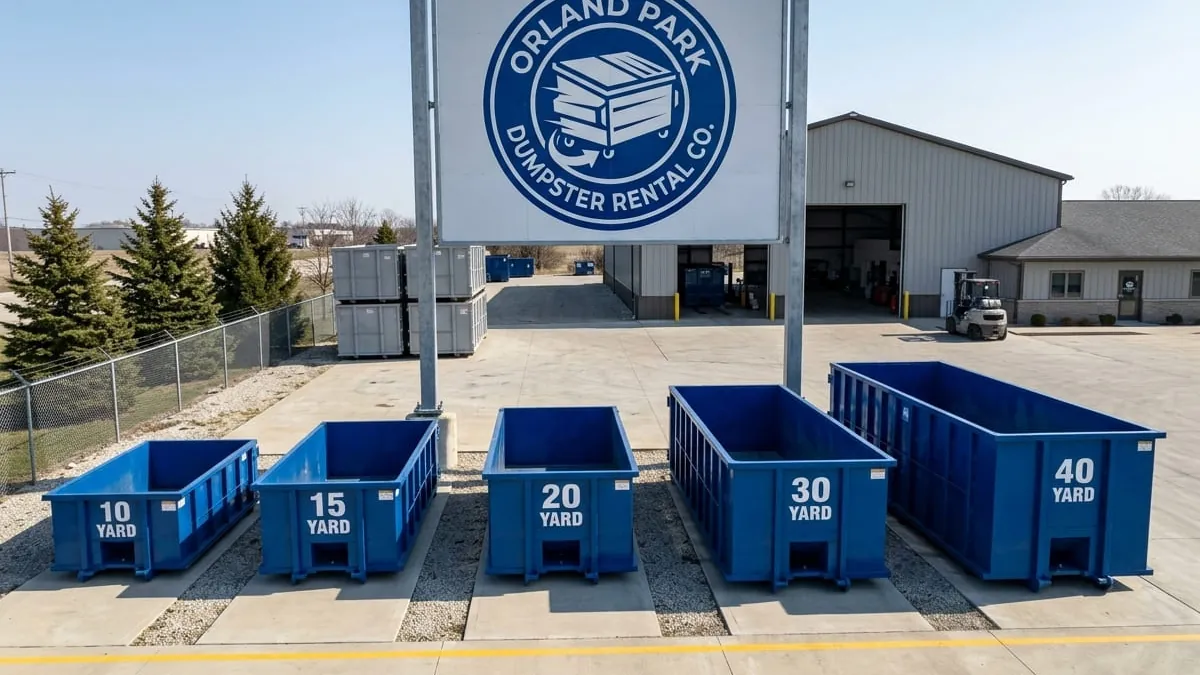
Compare all five sizes
Dumpster Sizes in Orland Park, IL — 10, 15, 20, 30 & 40 Yard
Two things settle the size here, and the size of the heap by the back door is not either of them. The first is the weight of what you are throwing away: apron and slab concrete, block, brick and mortar, spoil out of a footing, and a tear-off counted in squares and layers all weigh a great deal more than they read. The second is what the box will be standing on, which here is clay. Then this village adds a third that most markets do not have at all — the Village caps a residential unit at 768 cubic feet, and that works out at roughly 28.4 cubic yards, so the size question in Orland Park has an actual rule attached to it.
All sizes
Weight sets the box, the ground settles it, and the Village writes the ceiling
This table scrolls sideways on a phone, so take it slowly. The short version of it: anything carrying concrete, block, brick, mortar, footing spoil or torn shingle belongs at the 10 or the 15 whatever the heap looks like from the back step, because both of those boxes reach their weight ceiling long before they come anywhere near their volume one. Then there are three things about this particular village that no sizing chart written for anywhere else will carry. First, the Village publishes a size rule of its own. Its page for residential dumpsters and storage pods says “Permits are not required” and then sets four numbers: a maximum of “30 days from the day of placement on the site,” units “shall be located on private property,” “a minimum lot line setback of five (5) feet from any lot line,” and a ceiling of “768 cubic feet for residential zoning districts” with “a maximum unit height of eight (8) feet above grade.” 768 cubic feet is roughly 28.4 cubic yards — so a 20 sits comfortably inside it and a 30 is a genuine question against it. The Village cites Land Development Code § 6-304.C.12 as its authority; we have not read that section’s text and do not quote it. Those four numbers are for residential zoning districts and we never carry them across to a commercial job. Second, what Illinois keeps out of a landfill. Six materials are barred by statute — landscape waste, lead-acid batteries, white goods, tires, used oil and electronics — and the landscape-waste one is written as a container rule: under 415 ILCS 5/22.22 landscape waste may not go “into a container intended for collection or disposal at a landfill, unless such container is biodegradable.” A roll-off is not biodegradable, which is why grass, leaves and brush travel as their own clean load and never ride in a mixed box. Third, what a container may stand against here, and which office is entitled to come out and look at it. Illinois has no mandatory statewide building code for private construction — the Illinois Capital Development Board states in its own codes guidance that “a municipality or county is not required to adopt building codes,” and the codes the Board administers reach state-owned buildings. The State Fire Marshal’s rule adopts the NFPA 101 Life Safety Code; Orland Park adopts the International Fire Code instead; and the office that will actually come out and look at a container standing tight against a building is neither the Village nor the State but the Orland Fire Protection District, a separate unit of local government at 9790 West 151st Street spanning both counties, whose published fire-code ordinance states that it has adopted the 2018 International Fire Code with amendments. We publish no separation distance for this village, in feet or otherwise, because we could not find one — and a number borrowed out of some other state’s fire code would be worse than having none at all. Ask the District.
| Size | Capacity | Box size | Against the Village’s 768 cu ft | Weight allowance | Roughly equal to | Typical job |
|---|---|---|---|---|---|---|
| 10 Yard Dumpster | 10 yd³ | 12 x 8 x 3.5 feet | 270 cu ft rated — far inside | 2 to 3 tons | around 3 pickup loads | Broken slab, apron and block. Dense material is full by weight long before the box looks it. |
| 15 Yard Dumpster | 15 yd³ | 16 x 8 x 4 feet | 405 cu ft rated — inside | 2 to 3 tons | around 4 to 5 pickup loads | A single-layer tear-off, or one room of a 1970s split-level taken back to the studs. |
| 20 Yard Dumpster | 20 yd³ | 22 x 8 x 4.5 feet | 540 cu ft rated; 792 as a box — ask the Village | 3 to 4 tons | around 6 to 8 pickup loads | What leaves the yard most weeks. Rated volume sits inside the Village’s rule; the outside of the box is a question worth asking. |
| 30 Yard Dumpster | 30 yd³ | 22 x 8 x 6 feet | 810 cu ft rated — over 768: ask the Village | 4 to 5 tons | around 9 to 12 pickup loads | A whole-floor gut, or fifty years of one family’s storage. Check it against the Village rule first. |
| 40 Yard Dumpster | 40 yd³ | 22 x 8 x 8 feet | 1,080 cu ft rated — over 768: ask the Village | 5 to 6 tons | around 12 to 16 pickup loads | Light, bulky commercial material only, and it needs the longest straight approach on this list. |
10 Yard Dumpster
Broken slab, apron and block. Dense material is full by weight long before the box looks it.
View this size → 15yd³15 Yard Dumpster
A single-layer tear-off, or one room of a 1970s split-level taken back to the studs.
View this size → 20yd³20 Yard Dumpster
What leaves the yard most weeks. Rated volume sits inside the Village’s rule; the outside of the box is a question worth asking.
View this size → 30yd³30 Yard Dumpster
A whole-floor gut, or fifty years of one family’s storage. Check it against the Village rule first.
View this size → 40yd³40 Yard Dumpster
Light, bulky commercial material only, and it needs the longest straight approach on this list.
View this size →Two rules, and an order to take them in
Weight is the first ceiling, the ground gets the last word — and the Village has written down a third
If you read one paragraph on this page, make it this one. Two ceilings sit over every container ever delivered: the space between its walls, and the mass a truck may lawfully lift off a driveway and carry to a permitted facility. Light bulky material finds the first of those. Dense material finds the second, and a very long way earlier than anybody budgets for. In Orland Park a third ceiling sits above both, and unusually it is written down: 768 cubic feet in a residential zoning district, eight feet above grade, five feet from any lot line, thirty days from placement, on private property.
The dense material in this market is apron and slab concrete, block, brick and mortar, spoil out of a footing, and torn asphalt shingle. A front walk, a patio, one bay of a garage floor, a chimney taken down, a run of old block wall — each of those arrives at lawful transport weight with the container still reading as part-used from the house, which is why work of that kind begins at a 10 or a 15 and stays there. Excavated ground is what gets misjudged worst, and we are not going to help anybody by inventing a number for it. What the state’s own geologists say about this ground in general is on the record: the Illinois State Geological Survey maps the surface here on the Valparaiso Morainic System, with the Wadsworth Formation — an “extensive surficial clay-rich stratigraphic unit” exceeding 125 feet in thickness — at the top, over more than 185 feet of glacial sediment and Silurian dolomite beneath that. Nobody in this village is setting a container on bedrock; they are setting it on clay. We are not qualified to assess ground conditions at any address and we do not do it, so this site publishes no soil bearing capacity, no frost depth and no water-table depth, and it will not tell you whether a property sits in a flood zone. What can be said safely is that spoil does not settle and does not compress, so a trench cut for a footing, for a lateral, or for a water service produces a good deal more material than the hole in the ground implies, and none of it is light. There is a local footnote to that worth knowing before anybody digs. This village drank from wells until 1985, when it went over to Lake Michigan water — and the Village’s demolition checklist still asks today for “Documentation that water has been turned off or that existing wells have been capped.” There are capped wells under Orland Park. Then the roof. Tear-off is measured in squares and layers, never in the area of the house, and on the subdivisions that went up here through the 1970s and 1980s a second course still nailed to the deck is the ordinary case rather than the surprising one, which doubles the tonnage on a job that had been read as a single box. A tear-off is not put into a 30 or a 40 here, on any roof, ever. Rain belongs in the same paragraph for the same reason, because rain is tonnage: on the Chicago O’Hare 1991–2020 National Weather Service normals — which are O’Hare’s and not this village’s own — May through August each average between 3.71 and 4.49 inches of precipitation, and that is precisely the stretch in which most of this work happens. An uncovered box standing through a wet week is holding material you will pay to haul twice over.
Sorting still pays, and in Illinois it pays for reasons you can check. Six materials are kept out of Illinois landfills by statute. Landscape waste — 415 ILCS 5/22.22, written as a container rule, which is why the Village’s yard-waste bags are Kraft paper and why grass, leaves and brush do not ride in a roll-off. Lead-acid batteries — 415 ILCS 5/22.23. White goods — 415 ILCS 5/22.28, and this one is a component-removal requirement rather than a flat ban, which is precisely why the Village asks you to “call Customer Service… prior to collection” before a refrigerator goes to the curb. Tires — 415 ILCS 5/55. Used oil — 415 ILCS 5/21.6. And electronics, for which the Village publishes a list of eighteen devices it will not take at the curb. The statutory text we rely on is FindLaw’s current reproduction, named here so you can check it yourself. Liquids never ride in one of our containers. The Village’s own rule for paint is a good illustration of the standard: it “must be dried out in the can in order to be collected. Only latex (water based) paint is allowed in regular trash once dried out.” Where a load goes is a permitting question in Illinois rather than a matter of taste: the Illinois EPA Bureau of Land permits disposal sites, the working distinction is between inert waste and putrescible and chemical waste, and under 415 ILCS 5/39.2 a site has to win local siting approval from its host municipality or county before the state will permit it at all. Keep a load clean and there are more places it may lawfully be taken. Ours go to a facility permitted to receive them, with the metal and the flattened cardboard pulled out on the way.
The second rule is the one that no sizing chart anywhere carries. The ground under a container counts for as much as the number written on its side. Clay heaves and clay softens, and the month it does both is March — 5.5 inches of snow against a 47°F average high on those same O’Hare normals, after a January and February that together average about 22 inches of snow. Firm and dry, this ground carries a loaded container without complaint. Softened by a wet week or working through a thaw, it takes the impression of several tons and then keeps it. So the answer is concrete and not turf, with timber or plywood beneath every wheel and both rear rollers, on every delivery, in every month of the year. Placement then follows the Village’s four rules: on your own ground, five feet clear of any lot line, which rules out the classic tight-suburban set hard against a side fence and is a real constraint at 2,664.9 people per square mile. Load it flat and low — dense material underneath, nothing standing above the rail — because what sits above the rail cannot be sheeted, will not be collected until it has been leveled, and on a high-sided box brings eight feet above grade genuinely into range. The 30 and the 40 yard earn their living on bulk that weighs next to nothing — a shed, a deck or a garage coming down, a house cleared wholesale, forty years of a basement and a garage going out together — and each needs more landing room than anything else on this list, on top of that conversation with the Village about 768 cubic feet.
Three things get a size settled in about ninety seconds on the phone: what the material actually is, roughly how much of it there is, and whether the drop point is concrete, asphalt or something softer. We would far rather be told all three and get it right first time than guess and send a truck twice.
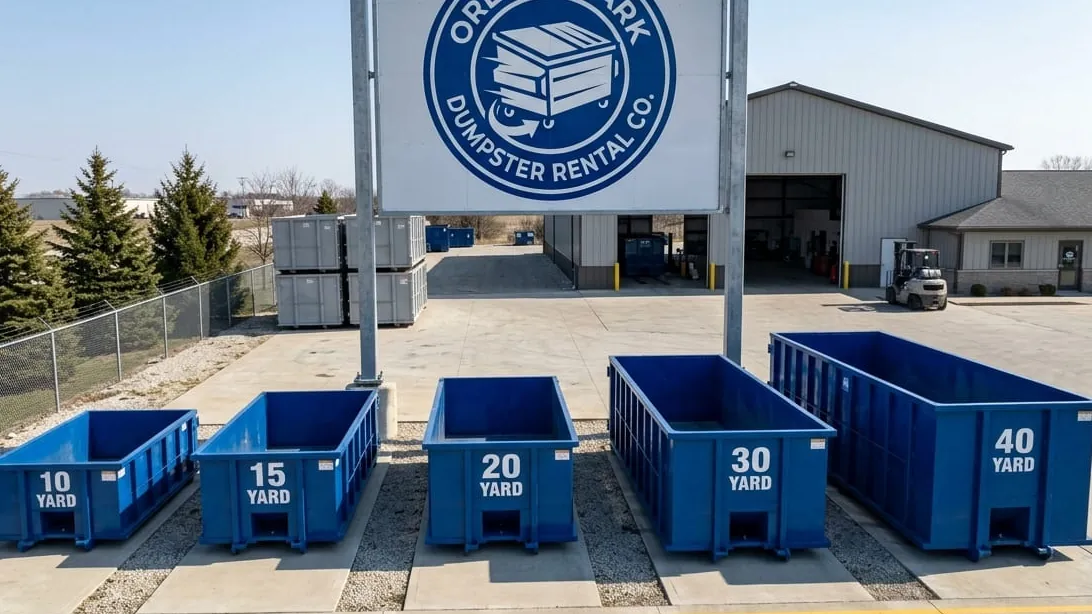
How it works
Four steps, from the call to a clear driveway
- 1
Tell us the job
Two minutes, and a street name and a nearest cross street is enough. Give us the address rather than the town, because in this village the address is what decides which of five governments answers your question. By the end of the call you have one figure, and the disposal is already inside it.
- 2
We set it down
The driver walks the run in on foot before the truck follows it, and plywood goes down under both rails and all four wheels. This is Wadsworth clay; it does not forgive a wet March. On private property, five feet clear of any lot line, which is the Village’s own rule and a real constraint on a suburban lot.
- 3
Fill it flat and low
Use the days in your window. Heavy on the bottom, nothing standing proud of the rail, and keep it covered — rain here runs three and a half to four and a half inches a month through the summer, and water is weight.
- 4
Say the word
One call and it goes. Metal and clean cardboard are pulled off the top first, and what remains travels to a facility permitted to receive it.
Picking a size in Orland Park — FAQs
Which dumpster size is most popular in Orland Park?
The 20 yard, and it is not a close-run thing. A whole-house declutter here defaults to it: the basement, the garage and a spare room all leaving inside the same two-week stretch, sides low enough to load across for much of their length, and a footprint that still sits on an ordinary suburban drive. It carries a second advantage that belongs to this village alone — it sits comfortably inside the Village’s own 768-cubic-foot residential ceiling, which converts to roughly 28.4 cubic yards, so nobody has to work anything out. Behind it comes the 15, which is the container this market quietly runs on: a single-layer tear-off on an average roof, one room taken back to the studs, a rental turned over between tenants. Anything with concrete, block, brick, mortar or trench spoil in it goes the other way instead, down to a 10 yard. There is a pattern behind that mix and it comes out of the Census rather than out of a sales ledger. Orland Park went from 6,391 people in 1970 to 23,045 in 1980, 35,720 in 1990 and 51,077 by 2000 — the 1970s alone up 260.6 percent — and it has been essentially full ever since, standing at 58,703 in 2020. 85.8 percent of occupied homes are owner-occupied and 24.8 percent of residents are 65 or over, across 23,256 households. That a village which filled up inside three decades now comes due in waves is an inference drawn from those figures rather than a housing statistic, and we label it as one: we hold no percentage of Orland Park housing built before any particular year, and we will not publish one.
What size do I need for a roof tear-off?
Count the squares and count the layers, and the answer follows. One layer coming off an ordinary Orland Park roof is 15 yard work. The moment a second course comes off with it, or the decking goes too, it is a 20. Past that the answer is another pull booked before the crew climbs the ladder — never a taller box, which in this village runs into the eight-feet-above-grade limit as well. And a tear-off does not go into a 30 or a 40 in Orland Park under any circumstances. Shingle is a weight job dressed up as a volume job: it is settled by squares and layers and never by the footprint of the house, and a large container loaded with it stops being lawfully movable while it still looks part-filled. Two things can halt a tear-off before it begins, and both are cheaper to settle beforehand. Asbestos turns up in old felt, in mastic and in cement-based shingle, and the two levels of government give answers that sound contradictory and are both correct. Illinois EPA administers the federal asbestos standard and publishes that a residential building of four units or fewer falls outside those regulations unless it has had or will have commercial or public use. Cook County then requires an asbestos abatement permit “for all asbestos projects (residential, commercial, institutional and industrial)” — a $200 filing fee, lodged at least ten working days before work starts, through the Department of Environment and Sustainability on (312) 603-8200, which is also the desk to confirm the current fee and lead time with, because both move. So your house can be exempt from the federal rule and still need a Cook County permit. None of that reaches the Will County side of this village, or the five Will County places on our list — and we could not establish what Will County asks for instead, so that question goes to Will County and not to us. Lead is the second one. The federal renovation, repair and painting rule bites on pre-1978 housing, and Illinois is not among the states authorized to administer that program, so a firm’s certification under it comes from EPA directly; lead abatement is the half Illinois does run for itself, through the Department of Public Health. Our tear-off sizing guide works the arithmetic through properly.
Is the 40 yard simply the biggest and therefore the best?
It is the biggest. It does not follow that it is the best, and treating it as though it did is one of the costlier assumptions available in this trade. The 40 is a volume container built for light bulk — framing, cabinetry, decking, packaging, a house emptied wholesale. Put anything dense into it and the lawful transport weight arrives with three quarters of the box still empty, and a tear-off should not be within sight of one. In this village there is a second reason to stop and think before ordering one. The Village caps a unit in a residential zoning district at 768 cubic feet, or roughly 28.4 cubic yards, at a maximum height of eight feet above grade. A 20 sits inside that with room to spare. A 30 is a genuine question against it and a 40 is a larger one — a conversation far better had before a truck is booked than after a box is standing on the drive. Those figures are the Village’s residential rule and we do not carry them onto a commercial job. The 40 needs more landing room than anything else on this list as well, which takes it off plenty of the older streets here, where drives are short and the five-foot lot line setback consumes what is left. A box of light material has to sit below the rails and stay sheeted, and with the summer months averaging close to four inches of rain apiece that is at least as much about water as it is about wind. Where room is genuinely tight, two smaller containers run through in sequence beat one large one wedged in.
Can I change size after I book?
Yes, right up to the point the truck is loaded and rolling. More to the point: where what you have described does not match what you have ordered, we would far rather settle that on the phone than in your driveway at seven in the morning. A size changed in conversation costs nothing at all. A size discovered to be wrong once the container is full and on a weighbridge is a different sort of afternoon entirely.
How much room does the truck actually need?
The container’s own footprint is the small half of that answer. What decides a delivery is the run up to it. Reckon on a straight, level approach of about 60 feet so that the truck can back in; alongside it, roughly eleven feet of working width; and, for as long as the hoist is up, 20 feet or more of clear air above. Surface counts for as much as room does. Say what the spot actually is: concrete, or asphalt, or gravel, or grass. Then say whether it is still soft a day after rain, because this is clay, and clay that is soft will not carry a loaded box. Then the boundaries. The Village’s own residential rule keeps the unit on private property and five feet clear of any lot line, and on a suburban lot those two between them settle most placements without further argument. The Village makes no provision whatever for standing a container in the street, so nobody should assume a street placement can be permitted here; the Village Code’s obstruction provisions forbid obstructing or encroaching on public streets, alleys, sidewalks and public places so as to interfere with passage, and forbid using streets, parkways and sidewalks for trade or business purposes. Separately, § 3-4-2-1 provides that nobody may construct or alter a driveway over, across or upon a public sidewalk or parkway without first obtaining a permit from the Building Department, and the Village’s fee schedule sets a $500 deposit and $25 inspection fees for opening or excavating a Village street. On fire clearance the honest answer for Illinois is a short one: we could not find a published separation distance for this village and we publish none. The office to ask is the Orland Fire Protection District at 9790 West 151st Street, a separate unit of government from the Village covering both counties, whose ordinance states it has adopted the 2018 International Fire Code with amendments. One further caution about the road itself: we did not establish who owns the road in front of any particular address. The Village’s own road-work page names three authorities — the Village, the county highway departments and IDOT — and says State and County projects are “out of the Village’s jurisdiction,” so we will not represent any given street as the Village’s. Ring the Village on 708-403-6100 and ask. And look up before you commit to a spot, because the obstruction that ends a delivery is almost never at ground level: a service drop feeding the house, a low gutter line, the edge of a porch roof, a mature limb standing over the only flat piece of the property. The arm has to come up through all of it.
When should I book, and does the season change the answer?
There are two stretches of the year when leaving it late costs you something, and neither has anything to do with sales pressure. March is the month the ground argues back — 5.5 inches of snow against a 47°F average high on the Chicago O’Hare 1991–2020 National Weather Service normals, which are O’Hare’s and not this village’s own — and clay that has frozen and thawed inside the same week is clay that takes an impression and keeps it. That is a plywood month rather than a turf month. Spring is the other, and the Village writes the calendar for it. Curbside yard waste runs weekly from April 1 through the second full week of December, in Kraft paper bags, with brush cut to four-foot lengths and bundled under 50 pounds — and the Village is blunt that “Unbundled brush will not be collected.” It is equally blunt about what falls outside that program: “sod, whole trees, stumps, and dirt are not part of the weekly yard waste program,” along with “limbs greater than 4 inches in diameter.” All four of those are ordinary roll-off loads. The Village also publishes a Curbside Spring Clean-Up, listed for the week of 6–10 April 2026 on the regular pick-up day, which takes furniture, textiles, carpets, washers, dryers and refrigerators, bagged, contained or bundled with no loose garbage, and requires that “Doors must be removed from all appliances.” It says in terms that “Electronics are NOT included in the Curbside Spring Clean-Up event.” Construction and remodeling debris is not on the list of what it takes. Those dates are as the Village published them and they move each year — confirm current dates with the Village on 708-403-6100. Summer is the busy stretch and also the wet one, with May through August averaging between 3.71 and 4.49 inches of precipitation a month on those O’Hare normals, so a sheet over the load is worth more to you than an extra yard of box. Storms belong in the same sentence: NWS Chicago confirmed an EF-0 tornado here on 27 July 2026 — “3 NW Orland Park” in its own event summary, a 2.9-mile path, 85 mph, 250 yards at its widest — and that week the phone does not stop. Winter is the quiet one, and the risk in it is ice on a sloping drive rather than depth of snow, though January and February together average about 22 inches. Ring (708) 928-8633 with a week in mind and you will get a straight answer about how full that week already is.
Services
What is actually going into these containers here
Residential Dumpster Rental
Orland Park’s cart takes three cubic yards a week. A bathroom gut is that on its own.
Learn more →Commercial Dumpster Rental
Shops, restaurants and tenant fit-outs along the LaGrange Road corridor.
Learn more →Construction Dumpster Rental
Mixed build waste in one box, swapped on call either side of the county line.
Learn more →Roofing Dumpster Rental
Squares and layers, never roof area — and never a 30 or a 40, whatever the roofer asks.
Learn more →Roll-Off Dumpster Rental
Five box sizes, and the two largest are worth a call to your own village before you order.
Learn more →Same-Day Dumpster Rental
What we can and cannot do today, said straight on the phone.
Learn more →Talk to a real person
Undecided between two sizes?
Say what is going in and give us the address — the address, because on this village the county changes underneath you. Size, one flat figure and a day, settled before you hang up. No form to fill in, and no queue.
Orland Park and seventeen more places across Cook, Will and DuPage · Mon–Fri 6:30am–5pm, Sat 7am–1pm