
Sizing Guide
Roof Tear-Off Dumpster Sizing in Orland Park
The Village charges $95 for a roof permit and requires no permit at all for the container, but it does cap a residential unit at 768 cubic feet. On a tear-off, weight settles the size long before that does.
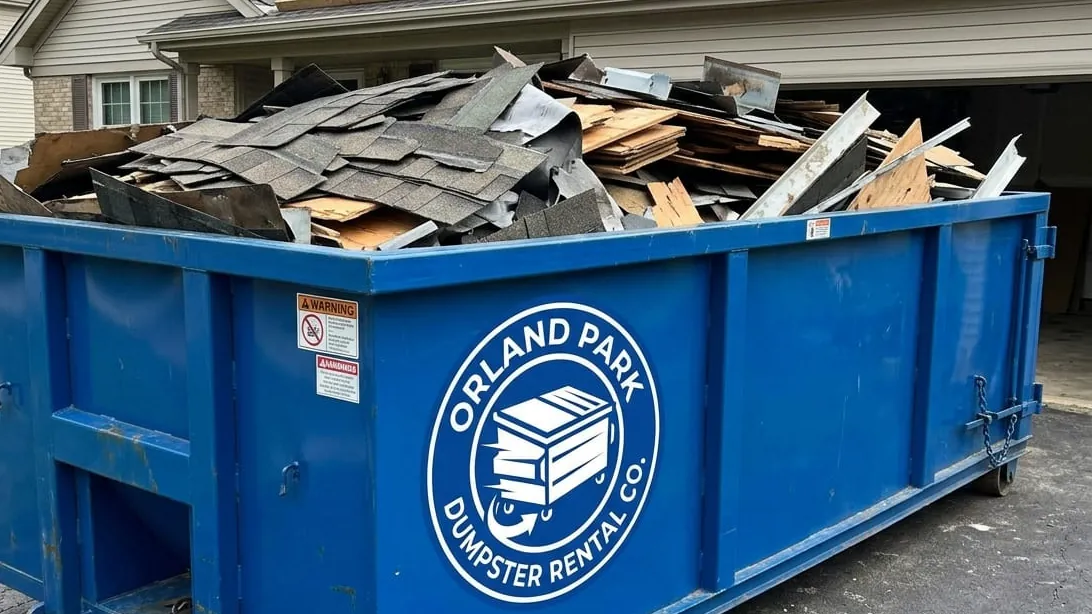
A roof job in Orland Park raises two separate permit questions, and people usually merge them into one and get both slightly wrong.
The roof needs a Village permit. The Village of Orland Park’s published fixed-fee schedule lists “Roof (New or reroof)” at $95.00. Siding is $95 and windows and doors are $95 on the same list, which is why those three so often get done in one season. Those are the fees as published; confirm current fees with the Village on (708) 403-6100.
The container does not need one. The Village maintains a permit page titled “Dumpsters and Storage Pods (Residential),” and the first thing it says is “Permits are not required.”
What the container has instead is four numbers, and one of them is going to matter to you before this page is finished.
The four rules that replace the permit
From that same Village page, for residential zoning districts:
- Thirty days — a maximum of “30 days from the day of placement on the site.”
- Private property — units “shall be located on private property.” The page makes no provision for a street placement, and we will not tell you one can be arranged.
- Five feet — “a minimum lot line setback of five (5) feet from any lot line.”
- 768 cubic feet, eight feet high — a maximum total unit size of “768 cubic feet for residential zoning districts” with “a maximum unit height of eight (8) feet above grade.”
The Village cites LDC § 6-304.C.12 as the authority. We have read the Village’s permit page, not the code section, so the page is what we cite.
Convert the headline number and it becomes useful: 768 cubic feet is roughly 28.4 cubic yards. That is a genuinely unusual thing for a municipality to publish, because it lands squarely inside the range of sizes a homeowner is choosing between. A 20-yard container is comfortably inside it. A 30-yard container is a real question against it, and a conversation worth having before delivery rather than after. Full detail on all four rules is in our Orland Park container rules guide.
Here is the good news for anyone reading this page specifically: on a roof tear-off, that question never arises, because a tear-off should not be going anywhere near a 30 in the first place. Which brings us to the actual subject.
Roofing is a weight problem wearing a volume costume
Every container has two limits. One is how much space is inside it. The other is how much mass the truck may lawfully carry away on a public road. On most residential debris — furniture, cabinetry, drywall offcuts, deck boards — you run out of space first, so volume is the number that feels real.
Asphalt shingle inverts that. Torn-off roofing is dense: mineral granule, saturated felt, embedded nails, and often forty or fifty years of accumulated weather. A tear-off reaches its lawful payload with the box looking two-thirds empty, and the extra volume above that line is capacity nobody is permitted to use.
Which produces the rule that governs every roofing container we place:
A roof tear-off does not go in a 30 or a 40.
Not because the shingle would not physically fit — it would. Because a 30 or a 40 loaded with tear-off is a container that cannot lawfully leave your driveway. Large boxes on roofing jobs produce exactly one reliable outcome: a half-filled container nobody can move, on a driveway that is now unusable, on a schedule that has stopped.
The sizes that are actually right
- A 10-yard container for a detached garage, a porch, a carport or a single-layer covering on a small addition. The 10 is right on roofing for the same reason it is right on concrete: dense material reaches weight while a bigger box would still look empty.
- A 15-yard container for the ordinary case — one layer, one house, a straightforward roof. This is the default for most of the tear-offs on most of the streets in this village.
- A 20-yard container for a large roof, for two layers, or where decking is coming off with the shingle. Board or plywood decking adds bulk fast even though it adds relatively little weight, and it is the one variable that genuinely pushes a job up a size.
- Past that, the answer is a second pull, not a bigger box. We take the full one away and set an empty one down, and the crew keeps working. On a big roof, two right-sized containers is the plan rather than a failure of planning.
Three things decide which of those you want, and a roofer can supply all three from the driveway: the rough footprint of the roof, whether it is a simple gable or cut up with dormers, valleys and additions, and how many layers are up there.
Why layers are a live question on these particular streets
Orland Park arrived almost all at once. The decennial series runs 6,391 people in 1970, 23,045 in 1980, 35,720 in 1990 and 51,077 by 2000. The 1970s alone were a 260.6% increase. Roughly three quarters of the people who live here now arrived across those three decades, and the houses arrived with them.
That is a population fact, and the housing conclusion drawn from it is an inference rather than a statistic — we hold no verified figure for the age of Orland Park’s housing stock and we are not going to invent one. But the inference is not a difficult one. A house that went up in 1978 has had roughly five decades of roofing decisions made about it, usually by a succession of owners, usually one at a time and usually under some pressure. Across a stretch of that period, going over the top of an existing covering rather than tearing it off was ordinary practice.
Two layers is not twice the inconvenience. It is twice the weight in the same volume — precisely the axis that constrains a roofing container. Somebody used to sizing boxes in a subdivision built after 2005, where nearly every roof is on its first covering, will undersize a job on a 1970s street every time.
Count the layers before you order. It takes thirty seconds at the rake edge and it changes the answer.
Eight feet above grade is a loading instruction
The Village’s eight foot height cap is worth reading as a rule about how the box gets filled, not only about which box arrives. A container sitting on a driveway with material heaped above the rails is a different height from the same container loaded level, and on a roofing job the temptation to heap is constant because material is arriving from above.
Load flat. Keep shingle below the rail line. It keeps you inside the Village’s number, it keeps the tarp usable, and on a dense material it costs you nothing, because you were going to hit weight before you hit the top anyway.
What else ends up in the box
A tear-off is rarely only shingle. Leave room for:
- Felt and underlayment, which comes off in heavy sheets and takes far more space than anyone budgets
- Flashing, drip edge, pipe boots, vents and ridge vent — light, awkward, bulky
- Rotten decking, which you find out about only once the covering is off. On a fifty-year-old roof, budget for some.
- Ice-and-water membrane stuck hard to the deck
- Gutters, downspouts and fascia trim, if they are going at the same time, which they often are
What stays out
Liquids of any kind. Roofing cement, solvent, primer, sealant, the half can of driveway coating from the garage. Illinois has a specific statute here as well — 415 ILCS 5/21.6 prohibits knowingly mixing liquid used oil with municipal waste intended for collection and landfill disposal — and its subsection (c) is worth knowing because it is unusually precise: “liquid used oil” does not include used oil filters, rags, absorbent material used to collect spilled oil, or empty containers that previously held oil. Liquids stay out; the greasy rag is a different question. The Village’s “At Your Door” special collection service covers paint products, flammable items and automotive products among its eleven categories, and is scheduled on 800-449-7587.
Solvent-soaked and oily rags. Not in the box, and not in a pile beside it. Spontaneous ignition in a heap of rags is a documented cause of job-site fires.
Tires. If the old set behind the garage is going at the same time, it goes separately. 415 ILCS 5/55, as reproduced by FindLaw, prohibits knowingly mixing used or waste tires with municipal waste.
Yard waste. The overhanging branches you trimmed to get the crew access do not go in with the shingle. 415 ILCS 5/22.22 is written as a container rule, and the reasoning is set out in full in why the yard-waste bags are made of paper.
The fire-code question, answered properly for Illinois
Somebody will eventually tell you the container has to sit a specific number of feet from the house, and cite the fire code. Here is the honest state of that question in this village.
Illinois has a statewide fire code, and it is NFPA 101, the Life Safety Code, adopted by rule at 41 Ill. Adm. Code 100.7 in its 2015 edition. But the State Fire Marshal’s own guidance sets out a three-way split, under which its rules reach only state-licensed facilities in a home-rule municipality without adopted equivalency. Orland Park has more than 25,000 residents, so under Article VII, Section 6 of the Illinois Constitution it is a home rule unit.
What reaches ordinary houses here is what is adopted locally — and locally, the International Fire Code is the document in play, not NFPA 101. The Village says it uses the IFC as the basis for its property maintenance regulations. Separately, the Orland Fire Protection District — a distinct unit of government, not a Village department, whose own ordinance is captioned for “Cook and Will Counties, Illinois” — states that it has adopted the 2018 International Fire Code with amendments.
We are not publishing a separation distance in feet. We could not verify the adopted text of the relevant section, and a number that is nearly right is worse than an honest gap. If clearance from a building matters on your job — and on a commercial building it may — the district is the desk that answers, at 9790 West 151st Street, Orland Park. Its pages are at orlandfire.org.
The calendar, and why water is the enemy on this job specifically
Using the National Weather Service’s 1991–2020 normals for Chicago O’Hare — which are the standard regional figures, not Orland Park’s own:
- May through August average between 3.71 and 4.49 inches of rain a month. That is the wettest stretch of the year and it is also peak roofing season. An open box catches water, and water is weight — the exact commodity a tear-off has none of to spare. Tarp it every night the crew is not loading, and before any weekend.
- January and February together average about 22 inches of snow, with highs in the low thirties.
- March averages 5.5 inches of snow against a 47°F average high. That combination — freezing and thawing in the same week — is the worst month of the year for putting concentrated weight on a driveway here, for reasons that are underneath your feet rather than in the sky. Our driveway protection guide explains the ground.
And a fair number of the roofs going on around here are not on a homeowner’s schedule at all. On 27 July 2026 the National Weather Service confirmed an EF-0 tornado at “3 NW Orland Park” in Cook County — a 2.9-mile path, 85 mph, 250 yards at maximum width — and recorded a 68 mph gust in the Oak Forest area in the same event. Storm roofing arrives all at once and everyone calls the same week; the storm debris guide covers how to sequence that.
The curb will not help you, and the Village is specific about why
Orland Park does collect residential refuse, through a Village contract billed like a utility. That service is generous for a household and irrelevant to a roof:
- “Waste Management will take up to three cubic yards of refuse per week” — the Village’s own sentence on its own page.
- “One (1) bulk item will be collected with the weekly pick-up. A bulk item is considered an item the resident would take with them if they moved out of the residence (e.g., couch, small tables, mattress, etc.).”
That bulk-item definition is the clearest line anybody has drawn between household waste and project waste, and the Village wrote it themselves. A sofa moves house with you. A pallet of torn-off shingle does not.
The Village’s Curbside Spring Clean-Up does not close the gap either. For 2026 the Village published the week of April 6–10, 2026, on regular pick-up days — confirm current dates with the Village. It publishes what it takes: furniture, textiles, carpets, washers, dryers and refrigerators, “bagged, contained or bundled, with no loose garbage,” and “Doors must be removed from all appliances.” It says in terms that “Electronics are NOT included in the Curbside Spring Clean-Up event.” Construction and remodeling debris is not on the list of what it takes.
There is also a state statute behind all of this that most people find surprising: under 65 ILCS 5/11-19-1, as reproduced by FindLaw, a municipality with a population of less than 1,000,000 “shall not award a franchise or contract to any private entity for the collection of general construction or demolition debris from residential or non-residential locations.” Orland Park’s 2020 population is 58,703. The Village could not put your tear-off into its refuse contract even if it wanted to. That argument is set out properly in three cubic yards a week and your remodel.
The part of the job that happens after the truck leaves
Nails. A tear-off scatters thousands of them across lawn, driveway, beds and gravel. A rolling magnet, run over every surface more than once and in more than one direction, is the only method that works — and the driveway has to be done before the container is pulled, not after, because the truck will press whatever is lying there into the surface.
Granules. Shingle grit ends up in gutter runs, window wells and landscaping stone, and it does not wash out. Budget an hour.
The leftover stack. Do not leave a pile of old covering beside the drive after the crew has gone. The Village’s obstruction provisions cap open storage of building materials in residential districts at seven days, or thirty days where it relates to construction. Load it before the street empties out.
The short version
- 10 for a garage, porch or small addition. 15 for an ordinary single-layer house. 20 for a large roof, two layers, or decking coming off.
- Never a 30 or a 40 on a tear-off. Past a 20, the answer is a second pull.
- Count the layers first. This village was built between 1970 and 2000 and a lot of these roofs are on their second covering.
- Load flat. The Village caps a residential unit at eight feet above grade and 768 cubic feet — about 28.4 cubic yards.
- Roof permit $95 at the Village, as published. No permit for the container.
- Tarp it. May to August is the wettest stretch of the year and water is weight.
- No liquids, no oily rags, no tires, no yard waste.
- No separation distance from us. Ask the Orland Fire Protection District.
Call (708) 928-8633 with the address, the rough roof size and the number of layers, and we will tell you the container and how many pulls it will take. More on roofing containers, on the 15 and the 20, and in the general sizing guide. The forecast office for Cook and Will Counties is NWS Chicago in Romeoville.
Questions this guide did not answer? Call (708) 928-8633. We would rather spend two minutes on the phone than have you order the wrong container.