
Permits
Do I Need a Dumpster Permit in Orland Park?
No permit. Four rules, in the words the Village itself published, plus the three questions a dumpster question is usually hiding: the work permit, whose road it is, and who to call before you dig.
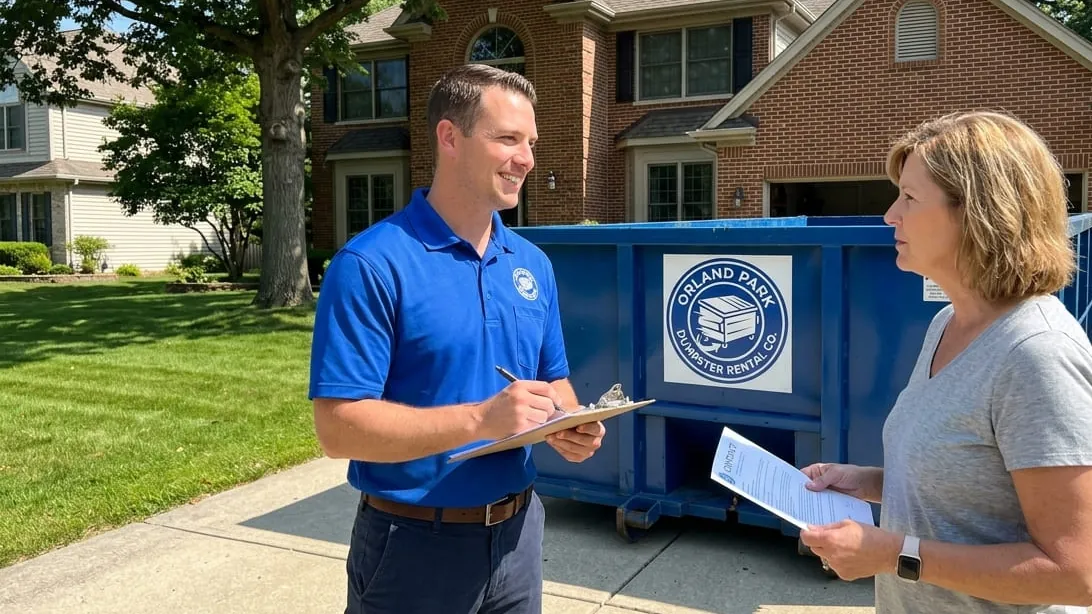
The answer to the question in the title is four words long and the Village of Orland Park wrote it, not us. On its permit page titled “Dumpsters and Storage Pods (Residential)”, the Village says: “Permits are not required.”
That is the whole answer to the permit question, and it is worth pausing on, because the reflex in this industry is to say “you might need one, call us and we will handle it.” Here you do not. What you do have is four hard rules, and they are more useful than a permit would have been, because they are numbers you can measure against a driveway before anyone books anything. Most people in this village have never heard them. They are below, in the Village’s own words, followed by the separate questions that a dumpster question usually turns out to be hiding.
The four rules
1. Thirty days
A maximum of “30 days from the day of placement on the site.” That is a hard stop rather than a rolling allowance, and it is measured from placement, not from when the work starts or from when you first put something in it. If the project is honestly going to run longer, the container comes out and a fresh one goes in. Plan the swap rather than improvise it.
2. Private property
The units “shall be located on private property.” The Village’s page describes dumpsters and storage pods as permitted on private property driveways for a one-month period, and it makes no provision at all for street or right-of-way placement. There is also no right-of-way obstruction permit and no street obstruction permit anywhere on the Village’s published permit list, which runs to some seventy items and includes everything from construction trailers to seasonal outdoor storage.
So, plainly: plan for the driveway. We are not going to tell you a street placement can be permitted in Orland Park, because nothing the Village publishes provides for one, and telling you otherwise would be doing you a disservice on the one morning it matters.
3. Five feet from any lot line
“A minimum lot line setback of five (5) feet from any lot line.” Any lot line — not just the one closest to the neighbor. In a village with 2,664.9 people per square mile, which is a fully built-out detached-house suburb rather than a rural township, that setback rules out the classic tight placement hard against a side fence and it frequently decides where on the drive the box actually sits. Measure it before delivery day. It is the rule most likely to change a plan.
4. 768 cubic feet, and eight feet above grade
A maximum total unit size of “768 cubic feet for residential zoning districts”, with “a maximum unit height of eight (8) feet above grade.”
Convert the first figure and it becomes genuinely useful. A cubic yard is twenty-seven cubic feet, so 768 cubic feet is roughly 28.4 cubic yards. A 20-yard container is comfortably inside that. A 30-yard container is a real question against it, since thirty cubic yards of nominal capacity is 810 cubic feet before you measure any outside dimension. We work that through properly, including what we do and do not know about how the Village measures it, on what size dumpster do I need in Orland Park.
Two qualifications, and they matter. First, the Village cites LDC § 6-304.C.12 as the authority for these numbers. We have not read that section of the Land Development Code, so the Village’s permit page is our citation and we will not quote LDC text we have not seen. Second, that page is titled “Residential” and the figures are written for residential zoning districts. Nothing here establishes the rule for a commercial or industrial site, and we are not going to stretch it to one. For a commercial job, call the Village at 708-403-6100.
The question underneath: does the work need a permit?
“Do I need a permit for a dumpster” is very often a different question in disguise, and the different question is whether the work needs one. In Orland Park a great deal of it does, and the Village publishes the fees. As published when we checked in September 2026 — confirm current fees with the Village — the fixed-fee schedule in Village Code § 5-2-7-1-2 puts a roof, new or reroof, at $95, siding and exterior finishes at $95, windows and doors at $95, a driveway at $95, a shed at $150, a fence at $100, and a deck, proposed or replaced, at $350. Under § 5-2-7-10, demolition or removal of a building or structure is $95, residential or non-residential.
The Village’s published permit list is long and specific. It includes basements, residential remodels, residential additions, detached garages, patios, concrete, retaining walls, tree removal and landscaping, and construction trailers. If your project is on that list, the container is the least of the paperwork. Contractors have their own gate to clear as well: the Village states that “Contractors are required to be licensed with the Village of Orland Park before any permits can be issued”. That is quoted from the Village’s own permits, licenses and inspections page, and it is a statement about the Village’s process rather than about any particular company. Registration runs through the Village’s Civic Access portal.
The question underneath that: whose ground is it?
If the box is on your driveway, this section does not apply to you. If anything about the job reaches past the property line, it does, and Orland Park has an unusually layered answer.
The Village Code’s obstruction section, § 6-2-2-5, has three parts. One deals with open building materials, prohibiting the storage or accumulation of materials such as “bricks, concrete blocks, lumber, iron, pipe” in residential districts for more than seven days, or thirty days where it relates to construction. One forbids using streets, parkways and sidewalks for trade or business purposes, including storing related supplies or equipment. And one prevents “obstruct[ing] or encroach[ing] upon public streets and highways”, sidewalks, parking lots and public places so as to interfere with vehicles or pedestrians. We could not get that section transcribed word for word, so those fragments are all we will quote of it.
Driveway work across the public sidewalk or parkway needs a permit. Village Code § 3-4-2-1 reads: “No person, firm or corporation shall construct or alter any driveway over, across or upon any public sidewalk or parkway without first obtaining from the Building Department a permit to do so.” If your project includes widening the apron so the truck can get in, that is a permit.
Opening or excavating a Village street carries a $500 deposit and $25 inspection fees under § 5-2-7-10 — again, as published in September 2026.
And a wrinkle almost nobody in this village knows about
The street in front of your house may not be the Village’s at all. Orland Park’s own engineering road-work page distinguishes projects by owning agency and says plainly that “administration of projects, construction timelines, and lane closures that are State or County administered are out of the Village’s jurisdiction.”
In practice that means four possible owners. IDOT owns the state routes — US 45 (La Grange Road), IL 7 (Southwest Highway), US 6 (159th Street) and IL 43 (Harlem Avenue). Cook County’s Department of Transportation and Highways owns several of the biggest local arterials, including 104th Avenue, 108th Avenue, Wolf Road, Will-Cook Road, 151st Street, 153rd Street and 80th Avenue. On the Will County side of the village a road may belong to the Will County Division of Transportation, which issues access, utility, right-of-way alteration, small cell wireless, special events and oversize or overweight permits. Everything else is the Village’s.
Do not assume the Village maintains your street. In Orland Park that is frequently untrue, and if anything about your job — a chute, a barricade, a boom lift — has to sit in a road rather than on a driveway, find out which of the four owns it first. The village straddles a county line, which makes this less academic than it sounds; see Cook County or Will County teardown costs.
Anything that digs: call JULIE
A container on a driveway is not an excavation. But the post for a temporary fence, the stake for a run of plywood, a skid-steer scraping a lawn to make a set-down pad and the footing you are about to dig all are, and Illinois runs a statewide one-call system for exactly this.
Dial 811, or use JULIE. Its own guidance for homeowners is to “request utilities locate their underground lines by contacting JULIE at least 3 days before you want to dig”, and we publish JULIE’s own number rather than a shorter one because the statute and JULIE’s page count the days slightly differently and we did not resolve it. For excavators, JULIE says to “physically pre-mark your job site using white paint, flags or chalk” before breaking ground and adds, in its own words, “It’s the law!” White-lining in Illinois is not a courtesy.
There is a specific local reason to take this seriously. The Village switched from well water to Lake Michigan water in 1985 and today runs seven elevated water towers, two underground reservoirs and multiple pump-station connections. That is a great deal of Village water infrastructure under and beside these streets.
The fire code question, and where we stop
Someone will eventually tell you there is a rule about how close a container may sit to a building. There is a separation requirement in the International Fire Code, and the International Fire Code is in force here — but by two different governments, and we could not read either adoption.
The Village’s own fire code chapter is Title 5, Chapter 5 of the Village Code, and the Village says it uses the IFC as the basis for its property maintenance regulations, maintained on the ICC’s three-year model code cycle. Separately, fire protection here is provided not by a village department but by the Orland Fire Protection District, a distinct unit of local government whose own published ordinance is captioned for “Cook and Will Counties, Illinois”, and whose current page states it has adopted the 2018 International Fire Code with amendments.
We are not going to publish a separation distance, because we could not verify which edition and which amendments govern, and a number that is wrong by a foot is worse than no number. The district is at 9790 West 151st Street, Orland Park, IL 60462 and its pages are at orlandfire.org. If your container is going close to a building, ask them. They are the office that answers.
The rules the Village does not write
Two constraints settle more placements in Orland Park than any ordinance does, and neither of them is enforceable by anybody at Village Hall.
The first is the shared driveway. This village was built quickly — the population went from 6,391 in 1970 to 51,077 by 2000 — and a good deal of it was laid out with paired drives, tight side yards and turnarounds that assume two cars and not a truck. If the approach is shared, tell the neighbor before delivery morning rather than after. The second is a homeowners association. An association can be stricter than the Village about how long a container sits and where, and the Village’s thirty days is a ceiling rather than a permission slip. Neither of those is our call to make, and both are far easier to settle on a Tuesday than at 7 a.m. on a Saturday.
One more thing about Saturdays. Orland Park has three Metra stations on the SouthWest Service — at 143rd Street, 153rd Street and 179th Street — which is a lot for a village of this size and a fair description of what it is: a place where a great many people work somewhere else. The practical consequence is that the tear-out happens at the weekend, which means the box has to already be on the driveway when it does.
The five governments, on one page
- Any Orland Park driveway — the Village, which says “Permits are not required” and then sets thirty days, private property, five feet and 768 cubic feet. Village Hall, 14700 S. Ravinia Avenue, 708-403-6100.
- A Cook County teardown — Cook County, with its own demolition permit, its own asbestos permit and a debris diversion plan. (312) 603-8200.
- A Will County teardown — we do not know, and we say so. Cook County’s rules do not reach there, and we could not establish what does. Call Will County.
- The road out front — the Village, a county department of transportation, or IDOT. Find out which before anything sits in it.
- Anything that digs — JULIE, statewide. Dial 811.
That is the honest map. Most residential jobs in this village touch only the first line of it, which is why the true answer to the question in the title is: no permit, four rules, put it on the driveway, and call (708) 928-8633 if you want the measurements checked before the truck rolls. See also residential dumpster rental and three cubic yards a week and your remodel.
Questions this guide did not answer? Call (708) 928-8633. We would rather spend two minutes on the phone than have you order the wrong container.