
Sizing Guide
What Size Dumpster Do I Need in Orland Park?
The Village published a size limit in cubic feet. Convert it and a 20-yard box is comfortably inside it while a 30 is a real question. Here is the arithmetic, and what each size is actually for.
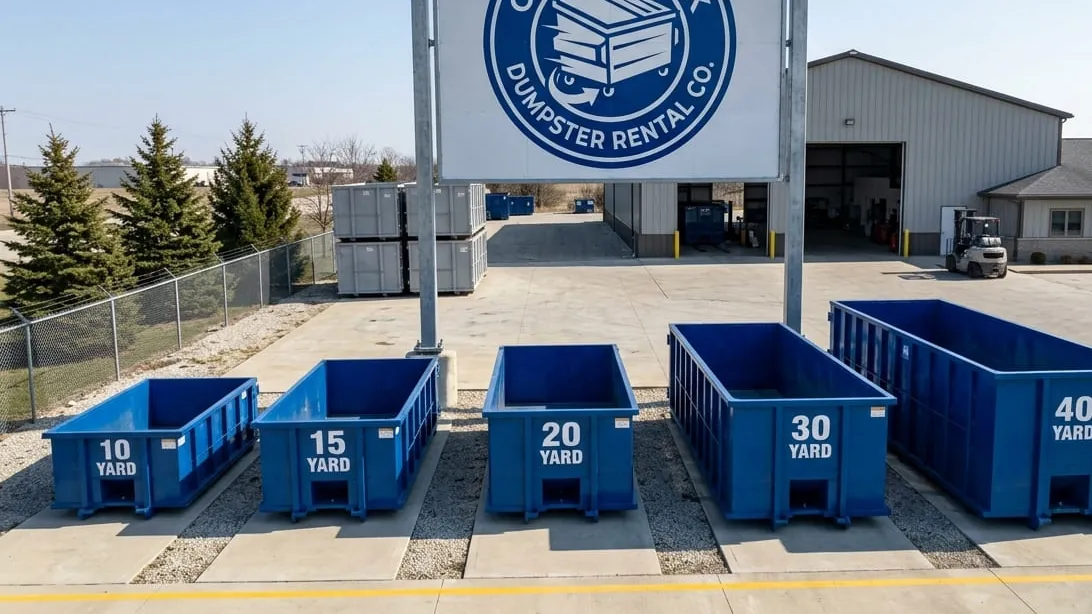
“What size dumpster do I need?” has a different answer in Orland Park than it has in most towns, and the reason is that the Village published a number. Most municipalities leave you to work the size out from the job alone. The Village of Orland Park sets a maximum size for a residential container, in cubic feet, on its own permit page. Convert that figure into the yardage the industry actually talks in and it lands somewhere genuinely useful: it rules nothing out at the small end, and it puts a real question mark over the big end.
So this page starts with the Village’s own limit, because that is the constraint you cannot negotiate with, and then works through what each size is actually good for here — on these lots, with this housing stock, on this ground. Where we could not establish something, we say so rather than filling the gap.
Start with the Village’s number, not with ours
Orland Park maintains a permit page titled “Dumpsters and Storage Pods (Residential)”. The first thing it says is the thing almost nobody expects: “Permits are not required.” The second thing it does is set four hard limits, and one of them is a size.
- A maximum total unit size of “768 cubic feet for residential zoning districts”
- A “maximum unit height of eight (8) feet above grade”
- Units “shall be located on private property”, with “a minimum lot line setback of five (5) feet from any lot line”
- A maximum of “30 days from the day of placement on the site”
The Village cites LDC § 6-304.C.12 as the authority for those numbers. We have not read that section of the Land Development Code, so we will not quote it — the Village’s own Dumpsters and Storage Pods (Residential) page is the source, and it is the page to read. The rest of the placement rules are covered on do I need a dumpster permit in Orland Park.
One qualification that matters and that we will repeat: the page is titled “Residential” and the 768-cubic-foot figure is written for residential zoning districts. Nothing on that page establishes the rule for a commercial or industrial site, and we are not going to extend it to one. If your job is on a commercial property, call the Village at 708-403-6100 and ask.
768 cubic feet is roughly 28.4 cubic yards
A cubic yard is twenty-seven cubic feet. Divide 768 by 27 and you get 28.4 cubic yards. That single piece of arithmetic is the most useful thing this page can give you, because it converts a zoning figure into the language every roll-off container is sold in.
Read plainly, it says this. A 20-yard box is comfortably inside the Village’s residential limit. A 30-yard box is a genuine question against it. Twenty cubic yards of nominal capacity is 540 cubic feet, well under the cap before you have measured anything. Thirty cubic yards of nominal capacity is 810 cubic feet, which is already past 768 before you measure a single outside dimension of the steel.
We are not going to pretend that settles it. The Village’s wording is a limit on the size of the unit, and the yardage in a container’s name describes what it is rated to hold, not the space the box occupies on your driveway. Those are two different measurements and the Village’s page does not spell out which one it wants. What we can tell you is the honest practical position: at 20 yards nobody has to think about it, and at 30 yards somebody should. Before a large box is delivered, ask for the outside length, width and height of the exact unit, and if the numbers are close to the line, put the question to the Village rather than to a hauler. That is a five-minute phone call and it is a great deal cheaper than a thirty-day argument.
The eight-foot rule works the same way. “A maximum unit height of eight (8) feet above grade” is a real constraint on a tall-sided box, which is exactly the shape used for light bulky debris. Low-side boxes are nowhere near it. And whatever the box measures empty, a load heaped above the rails is a problem in its own right — on the road, in the wind, and against a rule written in feet above grade.
The five sizes, and what each one is really for
The 10-yard
The 10-yard container is a weight box, not a volume box. Concrete, brick, dirt, sod, tile, plaster and asphalt reach lawful payload long before they reach the top rail, and the small box exists so that you can fill it out without ending up with a load nobody can legally lift. A single bathroom strip-out, a patio removal, a chimney, a small slab — that is 10-yard work. If your debris is dense, small is not a compromise. It is the correct answer. More on that on concrete and heavy debris.
The 15-yard
The 15-yard is the size people reach for when the job is mixed — some demolition, some furniture, some packaging — and the volume is real but not enormous. A kitchen, a large bath plus a hall closet, a garage that has been accumulating since the eighties. It also suits a driveway where the setback is going to be tight, which in a village at 2,664.9 people per square mile is a live consideration on plenty of lots.
The 20-yard
The 20 is the default here and the Village’s own rule is part of why. A 20-yard container handles a whole-house declutter, a multi-room remodel, a deck tear-out, a finished basement coming back out, or a full downsizing clear-out, and it sits comfortably inside the residential size limit with room to spare. In a village where 85.8 per cent of homes are owner-occupied and the work is overwhelmingly replacement rather than new build, the 20 is the size that fits the most jobs the most of the time.
The 30-yard
The 30-yard earns its place on genuinely bulky, genuinely light material: framing lumber, cabinetry, siding, insulation, ductwork, shelving, a large volume of furniture. It is also the size where the Village’s 768-cubic-foot residential figure stops being trivia and becomes a question to answer before delivery rather than after. On a commercial site the residential number does not govern — but we have not established what does, so that too is a call to the Village.
The 40-yard
The 40-yard is a commercial and light-bulky box: a tenant strip-out, a large-scale clear-out, a structure coming down where the debris is voluminous rather than dense. On a residential driveway in Orland Park the size question above is sharper still, and the height cap is a second reason to have the measurements in hand first.
And the one rule that overrides all of them
Roofing does not go in a 30 or a 40. Tear-off is dense — layers of asphalt shingle, felt, and often a second or third layer underneath — and a roof load reaches lawful payload long before it fills a large box. A big container full of shingles is not a bigger job done efficiently; it is a load that cannot legally leave. Sizing a tear-off is its own subject and it is covered on roof tear-off dumpster sizing in Orland Park and on roofing containers.
The number to measure your job against
There is a second published figure in this village that belongs in any sizing conversation, and it comes from the Village’s own waste page rather than its permit page. The residential collection service takes “up to three cubic yards of refuse per week” and “one (1) bulk item”, where a bulk item is defined as “an item the resident would take with them if they moved out of the residence (e.g., couch, small tables, mattress, etc.).”
Three cubic yards a week is generous for a household and hopeless for a project. A bathroom gut is three to five cubic yards on its own, arriving in a single afternoon. That is the honest measure of what a container is for: not that the Village’s service is inadequate, but that it is sized for the week rather than for the weekend you take the tile off. And a remodel does not produce couches. The full argument, including the state statute that stops the Village extending its contract to construction debris at all, is on three cubic yards a week and your remodel.
Weight decides more sizing arguments than volume does
Orland Park sits on the Valparaiso Morainic System. The Illinois State Geological Survey’s surficial geology report for the Mokena Quadrangle — a map sheet that names Orland Park in its own community list — describes the dominant surface unit here, the Wadsworth Formation, as an “extensive surficial clay-rich stratigraphic unit” more than 125 feet thick in places, over more than 185 feet of glacial sediment in the valley, over Silurian dolomite.
Clay is heavy, and it holds water. A yard of excavated soil, a yard of sod, a yard of wet clay from a footing or a drain-tile trench weighs a multiple of what a yard of cabinetry weighs. When you are estimating, sort your debris into two mental piles before you pick a size: dense (concrete, brick, dirt, sod, tile, plaster, shingles) and bulky (lumber, cabinets, furniture, siding, insulation, packaging). Dense material sizes down. Bulky material sizes up. A load that is genuinely both usually wants two containers or two pulls rather than one heroic box.
Three constraints that have nothing to do with the debris
Five feet from any lot line. This is the rule most likely to change your answer on a real driveway. It rules out the classic tight-suburban placement hard against a side fence, and in a village of detached houses at suburban density it can decide whether a longer box fits on the drive at all. Measure the drive, not the job.
Thirty days. The Village’s limit is “30 days from the day of placement on the site” — a hard stop, not a rolling allowance. That is worth knowing when you are choosing between one large box for the whole project and a smaller box swapped twice. The Village Code takes a similar view of building materials generally: its obstruction section caps open storage of materials such as “bricks, concrete blocks, lumber, iron, pipe” in residential districts at seven days, or thirty days where it relates to construction. Orland Park thinks in month-long windows for construction clutter, and it is consistent about it.
Private property. The Village’s guidance says the unit “shall be located on private property”, and there is no street-obstruction permit on its published permit list. Plan for the driveway. If the driveway genuinely will not take it, that is a conversation to have before you book, not on delivery morning.
Two things about the calendar
The National Weather Service’s 1991–2020 normals for Chicago O’Hare — which are the standard regional station and are not Orland Park’s own numbers — put May through August at 4.49, 4.10, 3.71 and 4.25 inches of rain a month. That is the busiest part of the working season and also the wettest. Rain in an open container is weight you pay to carry, and on dense debris it is weight that can matter to whether the load can leave. Cover the box whenever nobody is loading it.
At the other end, the same normals give January and February a combined 22 inches of snow, and March 5.5 inches of snow with an average high of 47 °F. March is the freeze–thaw month, and freeze–thaw on clay-rich ground is the worst combination of the year for putting a loaded box on a driveway. That is a protection question rather than a sizing one, and it is covered on driveway protection on Orland Park clay.
Getting it right in one phone call
Sizing is not a form. It is four questions, and they take about two minutes: what is coming out, how much of it, how dense is it, and how much room is there on the driveway once you allow five feet from every lot line. Tell us those four things and we will tell you the size, and tell you plainly if we think a smaller box swapped twice beats a larger box that sits at the limit.
Call (708) 928-8633. Ask for Dave Kolar if you want the long version. If your job is a whole-building or detached-garage demolition, read Cook County or Will County teardown costs first, because in this village the county line changes the paperwork. And if you are not sure what is allowed in the box at all, what can go in a dumpster in Illinois works through the six materials that Illinois keeps out of a landfill container by statute.
A last word on scope. We can tell you what the Village publishes and what the statutes say. We cannot tell you what your homeowners’ association, your shared driveway or your neighbor thinks, and those settle more placements in Orland Park than any ordinance does. Settle them first. Then call about the size.
Questions this guide did not answer? Call (708) 928-8633. We would rather spend two minutes on the phone than have you order the wrong container.