
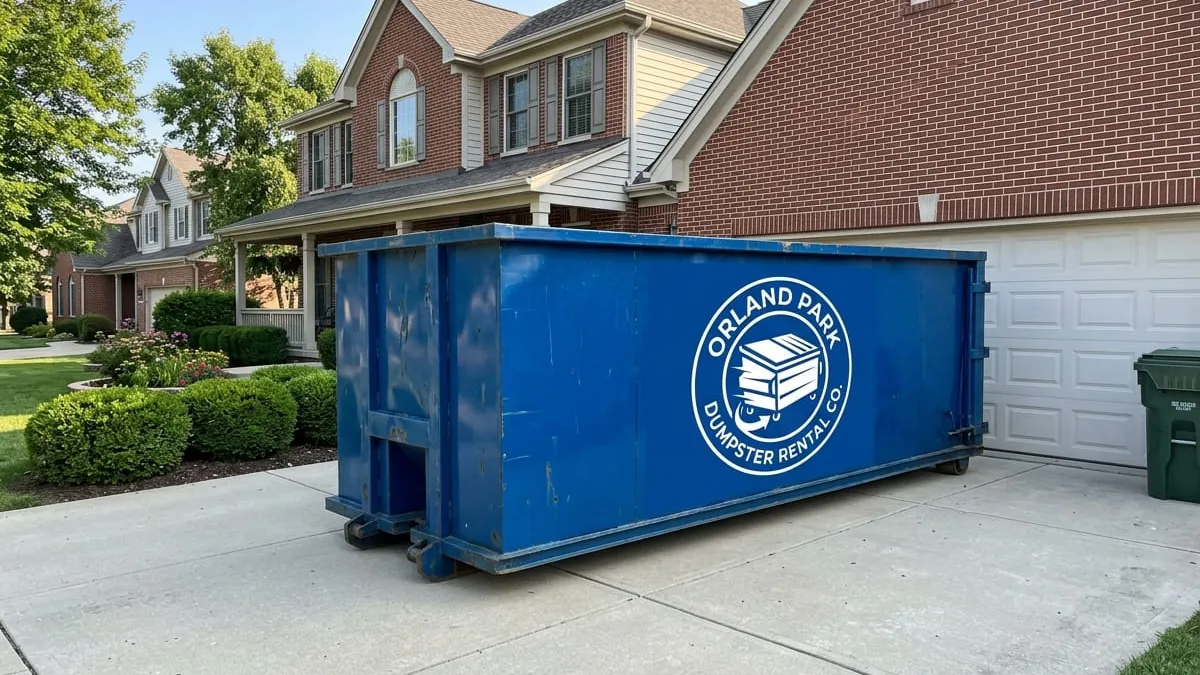
Orland Park, IL · Cook and Will Counties
Roll-Off Dumpsters in Orland Park — and a Straight Answer About Whose Rules Apply
Containers from 10 through 40 yards, across a village that lies in two counties at once, quoted as one figure with the disposal already inside it. Naming the box is the easy half of the call. The harder half is that five separate governments could own the answer to your question, and it is the street address rather than the postal town that says which. You will be told which, and given its number. Locally owned since 2011.
- One figure, disposal already in it
- Boards down before the box lands
- The right desk, with its number
- Checked against the Village’s own ceiling
Flat-rate, all-in pricing· Disposal in the price· Cook and Will Counties since 2011
Why Orland Park Dumpster Rental
Why the phone gets picked up in Orland Park
Nobody dials a container company in a quiet week. There is a closing in July and a garage that has to be empty before the movers arrive. There is a bathroom taken to the studs on Saturday and a heap on the drive by Sunday lunchtime. There is oak lying across the apron after a storm that was not on anybody’s calendar, or a house lived in for thirty-five years, a family, two weeks and a set of keys. Every one of those weeks gets worse if the figure quoted on the telephone is not the figure that gets billed, or if the box comes to rest five feet from where it needed to be.
The first truck went out in 2011, and 15 years on the rule behind it has not moved: say the true number while the customer can still change their mind, then turn up on the day it was promised for. Dave Kolar still handles most of the morning calls and still keeps the dispatch board, and no driver on this fleet reverses onto a drive he has not walked first.
Everything runs from 11601 183rd Pl, in the south-west corner of the village, so a box wanted on a driveway this week does not have to be routed in from somewhere else. And the gate itself is the tidiest illustration of what this entire site is about. The yard is inside the Orland Park village limits and it is in Will County, in Frankfort Township, while most of the village around it is Cook. The line runs a short distance north of us. The Census geocoder puts this address in Will; so does the Orland Fire Protection District, whose own fire-code ordinance is captioned “Cook and Will Counties, Illinois”; and so, best of all, does the National Weather Service, which prints “Orland Park (small part)” in its Northern Will County forecast zone list. One village, two counties, four townships. Which side of the line you are on changes real answers, and we will tell you plainly when it changes yours.
Start with the thing most people here have backwards. The Village does collect residential refuse. It does it through a contract, and it bills the charge the way it bills water — the arrangement sits in Village Code Title 4, Chapter 12, alongside water and sewer rather than in the health and nuisance title where you would look for it. The Village sets the charge, bills it, allocates part payments and runs an appeal process. That service is generous for a household and hopeless for a project, and the Village publishes exactly why: it takes “up to three cubic yards of refuse per week” and one bulk item — and the Village defines it: “A bulk item is considered an item the resident would take with them if they moved out of the residence (e.g., couch, small tables, mattress, etc.).” That is a beautifully clear line, and construction debris falls on the wrong side of it. Drywall does not move house with you. A sofa does. A single bathroom gut is three to five cubic yards on its own, which is the whole week’s allowance before anybody has taken a cabinet out.
And here is the part nobody in this market publishes: the Village could not put your remodel into that contract even if it wanted to. Illinois law forbids it. 65 ILCS 5/11-19-1 — the same section of the Municipal Code that lets a town contract for garbage collection in the first place — carries this sentence, in the current text reproduced by FindLaw: “A municipality with a population of less than 1,000,000 shall not award a franchise or contract to any private entity for the collection of general construction or demolition debris from residential or non-residential locations.” Orland Park is 58,703 people at the 2020 Census. So is every other place on this site — all of them a very long way under a million. That is not a marketing claim, it is a statute, and it is why construction and demolition debris is a separate arrangement here and always will be.
So there are five desks in this market, and we publish all five rather than pretending there is one. A container on an Orland Park driveway is the Village, on 708-403-6100 — and the Village’s answer is friendlier than most people expect. A teardown on the Cook County side brings in the County in its own right, on (312) 603-8200, with its own permit, its own fees and a diversion plan attached. A teardown on the Will County side is the one we will not pretend about: Cook County’s rules do not reach there, and we could not establish what Will County requires instead, so the honest answer is the county’s own number rather than ours. The road out front can belong to the Village, to a county highway department or to IDOT — three different owners on the same map, and the Village’s own engineering page says State and County work is “out of the Village’s jurisdiction.” And anything that digs belongs to JULIE, statewide, on 811. Five governments, one question, and the street address is what sorts them.
The Village’s own dumpster page is the best municipal page in this market, and it opens with three words most people expect to be a maybe. Under the heading “Dumpsters and Storage Pods (Residential)” it says: “Permits are not required.” Then it sets four hard numbers that most people have never heard of. A maximum of “30 days from the day of placement on the site” — a stop, not a rolling allowance. The unit “shall be located on private property” with “a minimum lot line setback of five (5) feet from any lot line,” which rules out the classic tight-suburban placement hard against a side fence, and at 2,664.9 people per square mile these are suburban lots rather than rural ones. And a maximum total unit size of “768 cubic feet for residential zoning districts” with “a maximum unit height of eight (8) feet above grade.” 768 cubic feet is roughly 28.4 cubic yards — which means a 20 yard box sits comfortably inside the limit, a 30 is a genuine question against it, and eight feet above grade is a real constraint on a loaded high-sided container. Two cautions we repeat every time: those numbers are for residential zoning districts and we never carry them across to a commercial job, and the citation is the Village’s permit page. The Village cites LDC § 6-304.C.12, and we stop there, because we have not read the Land Development Code text ourselves. Read the permit guide for the whole of it.
The state layer above all of that points in the opposite direction from what most people assume. Illinois has no mandatory statewide building code for private construction. The agency that would own such a code says so itself: the Illinois Capital Development Board states in its own codes FAQ that “a municipality or county is not required to adopt building codes.” The Board’s codes reach state-owned buildings. Everybody else adopts their own or adopts nothing — and Orland Park, being a home rule village of more than 25,000 people, adopts its own, right down to a published fee schedule. Fire runs the same way and catches people out worse. The State Fire Marshal’s rule adopts the NFPA 101 Life Safety Code. Orland Park adopts the International Fire Code instead. Those are two different documents from two different publishers, both in play at once, because Illinois lets a home rule village write its own and this one did. And the office that will actually come and look at a container standing tight against a building is neither the Village nor the State: it is the Orland Fire Protection District, a separate unit of government spanning both counties, which says its fire code is the 2018 International Fire Code with amendments. We do not publish a separation distance, in feet or otherwise, because we could not verify one for this village. Ask the district.
Where Illinois is strict is disposal, and there are six statutory bans rather than the one most template sites carry. Landscape waste comes first and it is the one that explains something visible on every street here: 415 ILCS 5/22.22 is written as a container rule, providing that no person may knowingly put landscape waste “into a container intended for collection or disposal at a landfill, unless such container is biodegradable.” That is why the Village’s yard-waste bags are made of Kraft paper and not of anything else, and it is why grass and leaves do not belong in a roll-off. Then lead-acid batteries (415 ILCS 5/22.23), which the statute keeps out of any container bound for a municipal waste landfill. Then white goods (415 ILCS 5/22.28), and this one is almost always misstated: it is not a flat ban, it is a component-removal rule — no one may offer white goods for collection for landfill disposal “unless the white good components have been removed,” those components being refrigerant gas, mercury switches, PCB capacitors and mercury lamps. Connect that to the Village’s own page, which says a fridge may go to the curb but “please call Customer Service… prior to collection,” and a rule stops being arbitrary and becomes an explanation. Then tires (415 ILCS 5/55), which no one may knowingly mix with municipal waste. Then used oil (415 ILCS 5/21.6), where the useful half is the definition: “liquid used oil” expressly does not include used oil filters, rags, absorbent material or empty containers. And electronics, which under the Consumer Electronics Recycling Act (415 ILCS 151/) do not go in the trash at all. The statutory text for the middle four is quoted here from FindLaw’s current reproduction, and the landscape-waste text from the General Assembly’s own page. The full working list is in what can go in a dumpster in Illinois.
One Illinois word is worth learning properly, because people use it wrongly to their own cost. CCDD — clean construction or demolition debris — is a defined term here, and Illinois EPA defines it as “uncontaminated broken concrete without protruding metal bars, bricks, rock, stone, or reclaimed asphalt pavement generated from construction or demolition activities.” That is all it is. Drywall is not CCDD. Wood is not CCDD. Shingles are not CCDD. Illinois EPA’s Bureau of Land permits the facilities that take the rest, and the state does not use the Class I / Class II vocabulary imported from elsewhere — the Pollution Control Board’s landfill standards divide the world into inert waste landfills and putrescible and chemical waste landfills. And Illinois has an institution most states do not: under 415 ILCS 5/39.2, a new landfill or transfer station has to win local siting approval from its host municipality or county board before the state will even consider a permit. That is the mechanism behind the squeeze, and Cook County states the consequence plainly in its own 2024–2029 solid waste plan: “based on current disposal rates, Illinois’ Region 2 has less than five years of landfill capacity available.” Loads from here travel. That is why “just run it to the dump” is not a sentence that means anything in this county.
The Village’s curbside program is worth knowing in detail, because the gaps in it are exactly where a container earns its keep. Households get a 96-gallon refuse cart; overflow goes in bags or containers “no greater than 45-gallon in size” that “do not exceed 50 pounds”; the weekly cap is three cubic yards and one bulk item. Carpet counts as that bulk item and has its own arithmetic: “cut and rolled into 4-foot lengths,” under 50 pounds a roll, secured with tape or string, up to eight rolls a week. Paint “must be dried out in the can in order to be collected,” and only latex. Yard waste runs weekly from April 1 through the second full week of December, in Kraft paper bags; brush must be cut to four-foot lengths and bundled under 50 pounds, and the Village is blunt about the alternative — “Unbundled brush will not be collected.” Then the refusal list, verbatim, and every item on it is a classic roll-off load: “sod, whole trees, stumps, and dirt are not part of the weekly yard waste program,” along with “limbs greater than 4 inches in diameter.” The Curbside Spring Clean-Up for 2026 is published for the week of April 6–10, on your regular pick-up day: it takes furniture, textiles, carpets, washers, dryers and refrigerators, bagged or bundled with no loose garbage, and “Doors must be removed from all appliances.” It says in terms that “Electronics are NOT included in the Curbside Spring Clean-Up event.” Construction and remodeling debris is not on the list of what it takes — we put it that way deliberately, because that is what the Village published and we are not going to put words in its mouth. Dates move; confirm the current ones with the Village. For hazardous material there is the “At Your Door” collection, scheduled on 800-449-7587, and for the television nobody wants there is a genuinely excellent local answer: the Road District of Orland Township runs an electronics site on Wolf Road that Cook County lists as one of only two permanent county drop-offs, open forty hours a week, on (708) 403-5148. The Township is a different government from the Village, which is worth saying out loud, and the whole program is walked through in the Village collection guide.
The housing here arrived all at once, which is why it is all coming due at once. The population series is unambiguous: 6,391 in 1970, 23,045 in 1980, 35,720 in 1990, 51,077 in 2000 and 58,703 in 2020. The 1970s alone were +260.6 percent. Orland Square Mall opened in March 1976, in the middle of it, and the Village switched from well water to Lake Michigan water in 1985 — which is why “documentation that water has been turned off or that existing wells have been capped” is still on the Village’s demolition checklist today. There really are capped wells under Orland Park. We do not publish a percentage of local housing built before any particular year, because we could not source one and we are not going to invent it; what we will say, as an inference drawn from the population figures, is that a village which filled up between 1970 and 2000 is a village whose roofs, kitchens, baths, siding, windows and first-generation mechanicals all come due in the same twenty-year stretch. Set that beside 85.8 percent owner-occupancy, 24.8 percent of residents aged 65 and over, a median owner-occupied value of $367,200 and 23,256 households across 22.03 square miles, and the work here writes itself: second renovations, downsizing, and the clear-out of a house somebody has lived in since it was new. One more number matters and almost nobody notices it: the village is now shrinking — down 1.3 percent to the 2025 estimate — while every Will County neighbor grows. New houses go up to the south-west. Old ones get re-done here. All of it from Census QuickFacts.
Last, the weather and the ground, which between them decide when a container can safely stand on a driveway. The forecast office is NWS Chicago (LOT), in Romeoville, and it covers both our counties. On 27 July 2026 it confirmed an EF-0 tornado here — “3 NW Orland Park” in its own event summary, a 2.9-mile path, 85 mph, 250 yards at its widest. The same system put an EF-1 with an 11.4-mile track and 110 mph winds through Country Club Hills, Hazel Crest and Homewood, produced a 104 mph gust at Bult Field and dropped 3.95 inches of rain in Bridgeview; locally the paper reported nearly 9,000 ComEd customers in the village without power, uprooted oaks and sewer back-ups. It is not a freak year, either: 15 July 2024 produced 32 tornadoes, a record for the NWS Chicago forecast area, and the historic one for this corner is 21 April 1967 — an F4 whose path the Weather Service prints as “Palos Hills to Oak Lawn…” with 33 deaths. For the ordinary year, the normals are Chicago O’Hare, 1991–2020, National Weather Service, and they are not this village’s own: January and February together average about 22 inches of snow; March averages 5.5 inches of snow against a 47°F high, which makes it the freeze-thaw month and the worst of the year to put weight on a driveway; and May through August average between 3.71 and 4.49 inches of rain a month, which is the busy season and the wet one at the same time. One myth we can put down: lake-effect snow is essentially a non-event here — in a January 2026 event that gave Porter County, Indiana 11 inches, Midway recorded 0.9. Underneath is the Valparaiso Morainic System. The Illinois State Geological Survey maps the surface here as the Wadsworth Formation, an “extensive surficial clay-rich stratigraphic unit” exceeding 125 feet, over more than 185 feet of glacial sediment, over Silurian dolomite. Clay-rich is the operative word, and it is why plywood goes down under every set. We publish no bearing capacity, no frost depth and no water-table depth, and we will not tell you whether your property is in a flood zone; none of those is ours to answer.
There is more on how this started in 2011, or go straight to the eleven services.

- Trading since2011
- Container sizes10 to 40 yd³
- Village size limit768 ft³ ≈ 28.4 yd³
- Places on the board17
- Governments that could answerFive
What we haul
Dumpster rental services in Orland Park and the south-west suburbs
Eleven sorts of load, all priced the same way, and all preceded by the same question: which county the address falls in, and whether the box is going anywhere other than onto private ground. The disposal is inside the figure you are quoted.
Residential Dumpster Rental
Orland Park’s cart takes three cubic yards a week. A bathroom gut is that on its own.
Learn more →Commercial Dumpster Rental
Shops, restaurants and tenant fit-outs along the LaGrange Road corridor.
Learn more →Construction Dumpster Rental
Mixed build waste in one box, swapped on call either side of the county line.
Learn more →Roofing Dumpster Rental
Squares and layers, never roof area — and never a 30 or a 40, whatever the roofer asks.
Learn more →Roll-Off Dumpster Rental
Five box sizes, and the two largest are worth a call to your own village before you order.
Learn more →Same-Day Dumpster Rental
What we can and cannot do today, said straight on the phone.
Learn more →Junk Removal Dumpsters
Clear a garage, a basement or a rental unit at whatever pace the week allows.
Learn more →Estate Cleanout Dumpsters
Patient work in a village where a quarter of the residents are over sixty-five.
Learn more →Demolition Debris Removal
Decks, garages and strip-outs — and in Cook County the County wants a permit too.
Learn more →Concrete & Heavy Debris
Its own low box for slab and apron concrete, loaded flat in one layer.
Learn more →Yard Waste & Brush Removal
Stumps, sod, dirt and anything over four inches — all of it off the curbside route.
Learn more →Choose your size
Five boxes, and one of them argues with the Village
Describe what the heap is made of and the box gets named, usually within two minutes. The opening question is never how much room the debris occupies. It is what the debris weighs, because weight is what finishes a load early. Masonry makes the point fastest: a slab lifted, an apron replaced, a retaining wall pushed over, tile still bedded in mortar, footing spoil, sod and soil. Each of those hits lawful transport weight while the container still looks half used, so it belongs in a small box, and there is nothing negotiable about that. A roof makes it a second way, and this is the conversation that comes up most. Tear-off is measured in squares and layers, not by the footprint of the house, and on a ranch or a split-level out of the middle of the build-out there is very often a course still nailed to the deck under the one being stripped — which quietly doubles the tonnage on a roof somebody had priced as one box. Shingle never goes into a 30 or a 40. What earns the two big containers is the opposite kind of load: a house emptied out completely, a multi-room remodel of cabinets, carpet, insulation and trim, a deck and a fence line that will not stack flat. Volume with barely any weight in it. Then the local arithmetic nobody else bothers with. The Village’s residential rule caps a unit at 768 cubic feet, which is roughly 28.4 cubic yards — so a 20 sits comfortably underneath it, a 30 becomes a real question against it, and eight feet above grade is a genuine limit on a high-sided box loaded proud. The 20 leaves this yard more often than the other four put together. Keep the weather in the reckoning as well: May through August run between 3.71 and 4.49 inches of rain a month on the Chicago O’Hare 1991–2020 National Weather Service normals, and an uncovered box collects weight nobody chose to load — drywall, carpet, insulation and cardboard gaining the most from it.
10 Yard Dumpster
Broken slab, apron and block. Dense material is full by weight long before the box looks it.
View this size → 15yd³15 Yard Dumpster
A single-layer tear-off, or one room of a 1970s split-level taken back to the studs.
View this size → 20yd³20 Yard Dumpster
What leaves the yard most weeks. Rated volume sits inside the Village’s rule; the outside of the box is a question worth asking.
View this size → 30yd³30 Yard Dumpster
A whole-floor gut, or fifty years of one family’s storage. Check it against the Village rule first.
View this size → 40yd³40 Yard Dumpster
Light, bulky commercial material only, and it needs the longest straight approach on this list.
View this size →How it works
Four steps, and nothing to put your name to
- 1
Say the address, then the job
Two minutes is enough. Here the number and the road carry as much weight as the debris does, because between them they fix the county and therefore which of five desks has anything to say about the placement. You put the phone down holding a flat figure with the disposal inside it.
- 2
The drop gets walked before it gets made
Nothing reverses until the approach has been covered on foot. Then boards under the wheels and both rails, on private ground, five feet clear of every lot line — the Village’s figure rather than ours, and a real constraint on a lot in a village running at 2,664.9 people per square mile.
- 3
Load it low, load it heavy-first
Use the days in your window, and inside Orland Park keep the Village’s thirty-day stop in sight. Dense material underneath, nothing standing proud of the rail, and a cover over it — summer rain here runs close to four inches a month and water weighs what water weighs.
- 4
Ring when you are finished
We pull it. Metal and flattened corrugated come out on the way through, the yard waste and the tires were never in it, and what is left travels to a facility permitted to receive it.
Local knowledge
What makes hauling in Orland Park different
Clay, five feet of setback, and one call before anybody digs
More deliveries are spoiled by what is under the wheels than by anything else, and in this village that surface has a name on a state map. The Illinois State Geological Survey’s surficial geology work for this area is centered on the Valparaiso Morainic System, and the unit sitting at the top of it is the Wadsworth Formation — an “extensive surficial clay-rich stratigraphic unit” more than 125 feet thick in places, over more than 185 feet of glacial sediment, over Silurian dolomite. Nobody in Orland Park is setting a container on bedrock. They are setting it on clay, and clay is why plywood goes under the wheels and both rails on every residential set, why March is the hardest month of the year to put weight on a driveway, and why a lawn that felt solid on a dry Thursday will not be solid after a wet week. We publish no bearing capacity, no frost depth and no water-table figure for any address, because we could not verify one, and a number invented for a website is worse than no number at all.
What the truck wants is a straight run of around sixty feet, something like eleven feet of working width, and better than twenty feet of clear sky so the box can stand up as it comes off the rails — with the drop itself kept away from the service drop, the mature limb, the meter and the walkout. On top of that sits the Village’s own geometry, which is tighter than people expect on a suburban lot: the unit “shall be located on private property” with “a minimum lot line setback of five (5) feet from any lot line,” for a maximum of “30 days from the day of placement,” at no more than “768 cubic feet” and “eight (8) feet above grade” in residential zoning districts. Five feet from any lot line takes the classic placement tight against a side fence off the table on a lot of ordinary width. The Village cites LDC § 6-304.C.12 for it, and that is as far as we go, because we have not read the code text ourselves — the permit page is the source we rely on. And the Village makes no provision at all for standing a container in the street: we will never tell you a street placement can be permitted here, and the Village Code’s obstruction section separately forbids obstructing or encroaching on public streets and forbids using streets, parkways and sidewalks for business purposes. It also caps open building-material storage in a residential district at seven days, or thirty where it relates to construction — the same month-long thinking as the dumpster rule.
Anything that breaks ground in the course of the work — a footing, a post, a fence line, a drainage run, a stump, even the stake pinning the plywood down — goes to JULIE first, on 811. The Illinois Underground Utility Facilities Damage Prevention Act puts the notice at not less than 2 days and no more than 10 days ahead of the work, gives a normal notice request a life of 25 days, and sets a tolerance zone of one and one-half feet on either side of the marks, inside which you hand-dig. JULIE’s own homeowner page asks for at least three days, so give it three. And note the difference from most states: here the white paint is the law, not a courtesy. JULIE tells excavators to “physically pre-mark your job site using white paint, flags or chalk” before breaking ground and adds, in its own words, “it’s the law!” — and says it holds true “for everything from planting a single tree to adding all new landscaping.” There is a specific local reason to take it seriously: the Village runs seven elevated water towers and two underground reservoirs on a system it converted to Lake Michigan water in 1985, so there is a great deal of Village pipe under and beside these streets.
A village that arrived in thirty years, and two dates that change a schedule
Orland Park went from 6,391 people in 1970 to 51,077 by 2000, with the 1970s alone up 260.6 percent, and it has been essentially full since — 58,703 at the 2020 Census, and now edging down 1.3 percent while the Will County towns south-west of here keep growing. That is a Census fact, and the housing conclusion we draw from it is an inference rather than a statistic: a village that filled up in three decades is a village whose roofs, kitchens, baths, decks, siding and windows come due in waves rather than one at a time. We do not publish a percentage of Orland Park housing built before any year, because it is not in anything we could source. What we do publish is the shape of the demand: 85.8 percent owner-occupied, 24.8 percent of residents 65 and over, median value $367,200, 23,256 households, and a median monthly owner cost without a mortgage of $978 — which is to say a great many people here own the house outright, have lived in it a long time, and are choosing between remodeling it and leaving it. Both of those are container jobs, and the second one deserves patience rather than a sales script. There is a guide for it: downsizing and estate cleanouts.
Two obligations come with dates attached, neither of them ours, and both of them capable of moving your schedule — so raise them on the first call. Lead attaches to housing built before 1978: the federal renovation, repair and painting rule reaches paid work that disturbs painted surfaces in pre-1978 homes and child-occupied facilities, and the Illinois wrinkle most sites get wrong is that Illinois is not one of the states authorized to run that program — a firm certifies with US EPA directly. Illinois does run lead abatement, through the Department of Public Health, which is a different program for different work. Given the population curve, some of this village’s housing sits on the older side of 1978 and some does not, which is exactly why a contractor checks the year rather than assuming it. Asbestos is where the state answer and the county answer point opposite ways, and getting it right is the whole point. Illinois EPA, which holds delegated authority for the federal NESHAP, publishes that “a privately owned home or an apartment with four or less units is exempt from the regulations” unless the building has had or will have commercial or public use. Cook County then requires an asbestos abatement permit “for all asbestos projects (residential, commercial, institutional and industrial)” — a $200 filing fee, applied for at least ten working days before the start. Both are true at once. Your house can be exempt from the federal rule and captured by the county one. That is a suburban Cook County statement and we label it as one, and no container this company owns takes asbestos under any circumstances. One last note while an old house is open, and it is EPA’s line rather than ours: every home is worth testing for radon, “regardless of zone designation.” More in asbestos and lead in an Orland Park remodel.
Where a load goes, and the six things Illinois will not landfill
Illinois does not use the Class I, II and III vocabulary you may have brought from another state. Illinois EPA’s Bureau of Land permits the facilities, and the Pollution Control Board’s landfill standards divide them into inert waste landfills and putrescible and chemical waste landfills. Sitting above that is a rule with no real equivalent elsewhere: under 415 ILCS 5/39.2, a new landfill or transfer station must first obtain local siting approval from the county board or the municipality that would host it, before the state will consider a permit at all. That is the reason the nearest place to take a load keeps getting further away, and Cook County states the result in its own 2024–2029 solid waste plan: “based on current disposal rates, Illinois’ Region 2 has less than five years of landfill capacity available.” The same plan records the county’s recycling rate in the high teens against a statutory county target of 25 percent, which is the fair, non-preachy explanation of why a Cook County demolition comes with a diversion plan attached. We name no landfill, transfer station or recycler on this site, and we publish no gate rate or tipping fee, because those are not ours to publish.
What we will be precise about is the six materials Illinois keeps out of landfills by statute, because five of the six turn up in ordinary household loads. Landscape waste — 415 ILCS 5/22.22, written as a container rule, which is why the Village’s bags are Kraft paper and why grass, leaves and brush do not ride in a roll-off. Lead-acid batteries — 415 ILCS 5/22.23, which names “any container intended for collection and disposal at a municipal waste sanitary landfill” expressly. White goods — 415 ILCS 5/22.28, a component-removal rule rather than a flat ban, which is the reason the Village asks residents to phone before a refrigerator goes to the curb. Tires — 415 ILCS 5/55, which forbids knowingly mixing used or waste tires with municipal waste; they never ride with us. Used oil — 415 ILCS 5/21.6, and its definition is the useful part, since “liquid used oil” expressly excludes filters, rags, absorbent material and empty containers. And electronics, under the Consumer Electronics Recycling Act at 415 ILCS 151/. The Village publishes its own device list for that one — televisions, monitors, printers, computers of every shape, keyboards, fax machines, VCRs, portable digital music players, DVD players, video game consoles, small-scale servers, scanners, electronic mice, digital converter boxes, cable receivers, satellite receivers and DVD recorders — and the practical answer sits on Wolf Road at the Road District of Orland Township’s site, one of only two permanent Cook County drop-offs, open Monday to Friday, on (708) 403-5148. Televisions and monitors there need a prepurchased coupon, so call first. The statutory text for four of the six is quoted from FindLaw’s current reproduction, and the landscape-waste text from the General Assembly’s own page; the fuller working list is in what can go in a dumpster in Illinois, and the paper-bag question has a page of its own at why yard waste bags are made of paper.
The two loads that run out of weight before they run out of room
Masonry rubble is the heaviest thing this fleet carries, and we are not going to send you to a published density table we cannot stand behind. Take the following as a rule of thumb read off our own scale tickets rather than as a sourced figure: something in the region of 2,400 to 2,800 pounds per cubic yard. The precise number barely matters, because the consequence never changes — lawful transport weight arrives while the box still looks part used, so the answer is a 10 yard twice over rather than a 30 once. See concrete and heavy debris. In this village that material shows up as a driveway apron replaced, a patio lifted, a stoop rebuilt, a foundation repair, a retaining wall pushed over — and, far more often than people anticipate, as the tile and mortar bed coming out of a bathroom nobody has touched since the house went up. Where it is genuinely clean, meaning broken concrete with no rebar standing proud, brick, rock, stone or reclaimed asphalt, it answers to Illinois EPA’s definition of CCDD and travels a different road from mixed debris, which is a second reason it goes in a box of its own. A roof is the other case. Tear-off is counted in squares and layers, never by the area of the house, and a course left on the deck is common enough here to be worth checking before anybody orders steel. Shingle is dense enough that the payload gives out long before the room does, which is precisely why a tear-off never goes into a 30 or a 40. See roofing dumpsters and the tear-off sizing guide.
What becomes of a load after it leaves is the second half of the job, and there it is sorting rather than any statute that decides what the ticket reads. Corrugated gets flattened and scrap metal gets pulled before either goes over a scale, because both have a buyer and neither should be paid for by the ton. Clean brush and limbs move better on their own than folded into a mixed remodel load — and the Village’s curbside yard-waste round will not take “sod, whole trees, stumps, and dirt” or “limbs greater than 4 inches in diameter,” so all four of those are container jobs by default and always were. Covered electronic devices come out for the township site; tires never went in; landscape waste never went in either, and it is the statute rather than our preference that decides it. After that the loading order is the ordinary one, and it matters here because of the rain: dense underneath, light above, nothing standing proud of the rail so the box can be sheeted, insulation bagged, absorbent material kept out of the weather. On the Chicago O’Hare 1991–2020 National Weather Service normals, May through August run 4.49, 4.10, 3.71 and 4.25 inches of rain — the wettest stretch of the year is also the busiest — and an uncovered container is a bill you have written yourself. Winter is the other constraint, and not in the way people expect: lake-effect snow barely reaches this corner, but January and February together average about 22 inches of ordinary snow and March pairs 5.5 inches of snow with a 47°F high, which is freeze-thaw on clay and the single worst combination in the year for a loaded box on a driveway. Those are Chicago O’Hare 1991–2020 normals from the National Weather Service, not this village’s own. See yard waste removal, the storm debris guide and driveway protection on Orland Park clay.
- 15+Years hauling out of the 11601 183rd Pl yard
- 17Villages and cities on the board, across two counties and a bit
- 13Local guides written for this village
- 5Container sizes, 10 yard through 40
What customers say
Four jobs, and two counties between them
We gutted the kitchen and both bathrooms and I had genuinely assumed the Village cart would absorb some of it. The man on the phone read me the three-cubic-yard figure off the Village’s own page before he quoted me anything, and explained that a bulk item means something you would take with you if you moved. Cabinets do not move with you. Saved me two weeks of arguing with a bin.
Our place is in Mokena, so Will County, and every other outfit I rang either did not know that mattered or pretended it did not. This lot told me straight that the Cook County demolition rules do not reach us, that they had not established what Will County wants instead, and gave me the county’s number. Then they turned up Tuesday with exactly the box we agreed.
Clearing my parents’ house of thirty-eight years, and I was dreading being hurried. I was not. They talked me through the carpet rule, told me where the township takes the old television, and left the box two weeks while my brother and I worked weekends. Not once did anyone make me feel like a job on a list.
After the July storm there were oak limbs across the drive and half the soffit in the garden. What I did not know was that whole trunk wood and anything over four inches is off the curbside route entirely, so it was never going to be collected. They explained that, sized it right first time, and put boards down before the box touched the drive.
Printed here as they reached us, word for word. Where a star rating or a review count appears elsewhere on this site it is illustrative, and stays that way until live syndication is turned on.
Service area
Dumpster delivery across Orland Park and the south-west suburbs
Trucks leave 11601 183rd Pl on every working day. Open the page for your own area to find the placement notes, the landmarks, and the single answer that really does move from one page to the next — which county the address answers to, and what a demolition there drags along behind it. Or take the whole service area on one page.
Dumpster Rental FAQs
How fast can you deliver a dumpster in Orland Park?
Ring early and we will tell you what the day actually looks like rather than promise something we then have to move. You are talking to the people who run the job rather than to a booking desk, and the answer you get is at 11601 183rd Pl, in the south-west corner of the village, so nothing is waiting on a dispatcher in another state to release it. Mokena is 2.0 straight-line miles from the gate, Orland Hills 4.0, New Lenox 4.5, Homer Glen 4.6 and Frankfort 4.8; the far end of the board — Hickory Hills, Alsip, Palos Hills — is a scheduled run and we would rather give you a window we can hold. What is worth planning around is the local rush. Spring is the first: the Village’s Curbside Spring Clean-Up is published for the week of April 6–10, 2026, the whole village empties its garages in the same few days, and the material the Clean-Up does not take is exactly the material a remodel makes. Weekends are the second, and that is structural — this is commuter country with three Metra stations in one village, so the tear-out happens on Saturday, which means the box wants to be on the drive on Friday. Storm weeks are the third, and they arrive without notice, as 27 July 2026 demonstrated. And March is the fourth, for the opposite reason: freeze-thaw on clay is the worst driveway condition of the year. Name the dates in advance and the slot is held for them.
What is inside the flat figure, and what is not?
The delivery, the collection, an agreed number of days standing on your ground, and a stated tonnage with the disposal already paid for inside the figure. There is nothing bolted on underneath it for fuel, for administration or for an environmental surcharge. Two things and only two can move it afterwards: the load going over the tonnage that was stated, or the container staying past the days that were agreed — and both of those limits are said out loud on the telephone before a truck is loaded rather than turning up on an invoice two weeks later. No price list, tipping fee or gate rate is published anywhere on this site; the figure is built for your load, your address and your days, and it is given to you in conversation.
Do I need to be home for delivery or pickup?
No, and a great many customers never are. Send a photograph of the spot taken from the street, say we may be on the property, and get on with your day. What a driver needs is a way in, a patch clear of parked cars and low limbs, and an unambiguous idea of where the rails are meant to finish. Raise it at booking if the approach is tight, if it runs a long way round the side of the house, if it crosses grass, if the drive is shared with a neighbor whose truck will be sitting in it, or if it turns hard enough that the arm has to swing wide — each of those moves the schedule rather than the figure. Two things are worth saying out loud in this village in particular. One is the Village’s five-foot setback from any lot line, which on an ordinary width of lot makes the placement decision for you. The other is the ground: this is clay, and after a wet week the firm-looking corner of a lawn is not a bearing surface. And say so if the house is standing empty, because an unattended box is better off under a cover than under a week of open sky.
Will the dumpster damage my driveway?
Boards go under the wheels and both rails on every residential set, which spreads the load rather than leaving it standing on a handful of narrow contact patches. What is underneath the slab is a different question, and we would rather decline it than answer it badly: that is a geotechnical investigation, nobody has surveyed your driveway, and anybody answering it from a web page is guessing. What we can tell you is what the state’s own geologists say about this ground in general. The Illinois State Geological Survey maps the surface here as the clay-rich Wadsworth Formation, part of the Valparaiso Morainic System, more than 125 feet thick in places. Clay heaves and clay softens, and the month it does both is March — 5.5 inches of snow against a 47°F high on the Chicago O’Hare 1991–2020 National Weather Service normals. We publish no bearing capacity, no frost depth and no water-table depth, because we could not verify any of them for this village. What we do instead is put the box where you ask, on boards, on the firmest surface the property has; photograph the condition it was found in; and lay extra boards under older flatwork carrying hairline cracks and under anything poured recently. The placement guide takes the whole question apart.
Do I need a permit for a dumpster in Orland Park?
For a residential driveway in Orland Park, the Village answers that itself, and the answer is no. Its “Dumpsters and Storage Pods (Residential)” page says in terms: “Permits are not required.” What it does instead is set four numbers. Thirty days maximum “from the day of placement on the site.” The unit “shall be located on private property” with “a minimum lot line setback of five (5) feet from any lot line.” And a maximum unit size of “768 cubic feet for residential zoning districts” at “a maximum unit height of eight (8) feet above grade” — which converts to about 28.4 cubic yards, so a 20 is comfortably inside it and a 30 is a real question. Three cautions travel with that. Those figures are for residential zoning districts and we never carry them onto a commercial job. The Village cites LDC § 6-304.C.12 and we stop there, because the permit page is what we read. And the Village makes no provision for a container in the street, so nobody should be telling you a street placement can be permitted here. Outside Orland Park the honest answer is different: nothing we read establishes the container rules of any other village or city on this site, so we give you their number rather than a guess. And before anything is dug, JULIE on 811 — not less than two days and no more than ten days ahead, a ticket good for 25 days, a tolerance zone of one and one-half feet either side of the marks, and white paint on the ground first, which here is the law rather than a courtesy. Longer version: the permit guide.
What can I not put in the dumpster?
Nothing that pours, nothing holding pressure, nothing with asbestos in it — and, in Illinois, six materials the state keeps out of landfills by statute. Landscape waste is the one that catches people, because 415 ILCS 5/22.22 was written around the container: landscape waste may not go “into a container intended for collection or disposal at a landfill, unless such container is biodegradable.” A roll-off is not biodegradable. That is why the Village’s yard-waste bags are Kraft paper, and why grass, leaves and brush travel separately. Then lead-acid batteries (22.23), white goods (22.28, a component-removal rule rather than a flat ban, which is why the Village asks you to phone before a refrigerator goes to the curb), tires (415 ILCS 5/55), used oil (21.6 — and note that filters, rags, absorbent material and empty containers are expressly not “liquid used oil”), and electronics under the Consumer Electronics Recycling Act at 415 ILCS 151/. Beyond the statute: wet paint, stain, solvent and adhesive; tar, fuel and antifreeze; weedkiller and pool chemicals; propane bottles, aerosols and cylinders of any other kind; medical waste; and sealed refrigeration that has not been evacuated. The domestic hazardous end has the Village’s “At Your Door” service on 800-449-7587; the electronics have the Road District of Orland Township site on Wolf Road, (708) 403-5148, one of only two permanent Cook County drop-offs. Asbestos rides with us on no terms at all.
Rather just ask?
Two minutes on the telephone will beat twenty minutes of reading. Say the street address and one line about the load, and it comes back sized, priced flat and on the board.
(708) 928-8633Helpful Local Resources
A fair share of what arrives on this telephone line was never really a container question at all — it is a question about a code edition, a permit, a disposal rule, a collection date that shifted, or a locate that has to come first. Below are the desks that answer each of those, with the reason you would pick up the phone to them. In this village five separate governments could be the correct answer for your address, so it is worth knowing which door you are knocking on before you knock.
- Village of Orland ParkWaste Management and the curbside program, the permit pages, the demolition checklist, and the “Dumpsters and Storage Pods” page that says permits are not required — and then sets four rules.
- Orland Park Village CodeTitle 4 Chapter 12 on refuse collection, and the obstruction provisions that govern public streets, parkways and sidewalks.
- Cook CountyThe demolition permit, the asbestos abatement permit that reaches single-family homes, the 70% demolition debris diversion ordinance, and the county solid waste plan.
- Will CountyThe other county this village sits in, and the one our own yard is in. Its demolition and asbestos requirements are its own — ask them, not us.
- Orland Fire Protection DistrictA separate government spanning both counties, and the people who will actually look at a container standing tight against a commercial building.
- Orland TownshipA different government from the Village, with a different boundary — health, senior, youth and assessor services, and no waste role.
- Road District of Orland TownshipOne of only two permanent Cook County electronics drop-offs, open forty hours a week.
- Illinois EPAThe Bureau of Land permits Illinois landfills, and the Agency runs asbestos NESHAP — which exempts four units and under, where Cook County does not.
- Illinois General AssemblyWhere the six landfill bans live, and 65 ILCS 5/11-19-1 — the sentence that stops a village franchising your remodel away.
- Illinois Capital Development BoardIllinois has no mandatory statewide building code for private construction; the Board’s codes reach state-owned buildings.
- Illinois State Fire MarshalThe state rule adopts NFPA 101 — but Orland Park adopts its own fire code, which is why the Fire District is the desk to call.
- IDOTSome of the biggest roads here are the State’s, not the Village’s — and the Village says State and County work is out of its jurisdiction.
- JULIE / Illinois 811Two working days before you dig, a ticket good for twenty-five days, an eighteen-inch tolerance zone — and here the white paint is the law.
- National Weather Service ChicagoThe Romeoville office covers both our counties — and it is the office that writes “Orland Park (small part)” into its Northern Will County zone.
- Illinois State Geological SurveyThe Valparaiso Morainic System and the clay-rich Wadsworth Formation — the reason plywood goes down under every container here.
- MWRDThe Cal-Sag Channel watershed, which most of this service area drains into.
- Forest Preserves of Cook CountyOrland Grassland and the Tinley Creek preserves — 750-plus acres of prairie that break the street grid on the village’s west and south sides.
- MetraThe SouthWest Service line, and the three stations inside this one village.
- US EPAWhere a pre-1978 lead renovation certification is actually issued, because Illinois never took the RRP program over.
- US Census QuickFactsPopulation, tenure and household figures for the village and for both counties.
Talk to a real person
Describe it once and the box gets named
The street address, one line on what is going in, and the number of days you want it standing. Back comes a size, a single figure carrying the disposal, and a delivery window — plus, if the placement answers to anybody besides you, the number of the desk that governs it.
Orland Park, Mokena, Orland Hills, New Lenox, Homer Glen, Frankfort and eleven more · Mon–Fri 6:30am–5pm, Sat 7am–1pm