
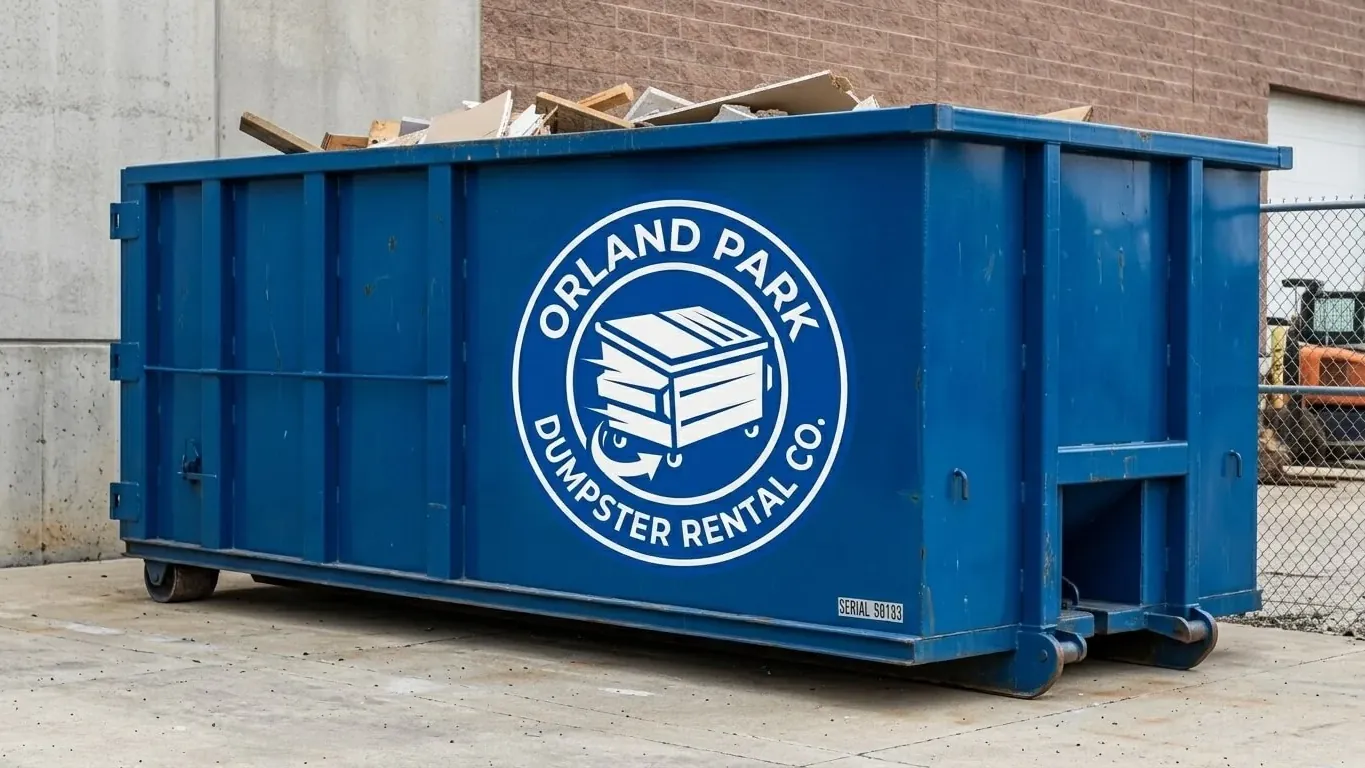
Concrete and heavy debris
Concrete and Heavy Debris Hauling in Orland Park, IL
Slab, apron, walk, block, brick, tile in mortar, sod and trench spoil — the loads where weight arrives long before volume does, and where a smaller box is the correct answer rather than the cheap one.
Here is the sentence that governs everything below, and in Orland Park it arrives with an extra twist on it. Mineral debris is limited by tonnage, and the tonnage runs out while the box still looks unfinished. The Village’s own dumpster page caps a residential unit at 768 cubic feet — about 28.4 cubic yards — and that is a rule about volume. On a slab job the Village’s figure never gets a chance to bite, because the axle weight is gone long before 28 cubic yards of anything is sitting on the floor. Broken concrete, block, brick, stone, tile set in a mortar bed, stripped sod, topsoil, decorative rock and clay spoil out of a footing all behave that way. So the container that suits an Orland Park driveway is the 10 yard, and it is chosen against a truck scale rather than against a cubic-foot figure. Order a 30 for an apron and what you own is a box a third loaded that no truck can lawfully lift, and the remedy for that is your own hands, on your own driveway, on a Saturday.
The second reason to run a dedicated heavy box is that in Illinois a clean mineral load is a genuinely different thing from a mixed one, and the state has a precise definition to prove it. Illinois EPA defines clean construction or demolition debris — CCDD, a term people use loosely and the state does not — as “Uncontaminated broken concrete without protruding metal bars, bricks, rock, stone, or reclaimed asphalt pavement generated from construction or demolition activities.” That is the whole list. Drywall is not CCDD. Timber is not CCDD. Shingles are not CCDD. The governing rule is 35 Ill. Adm. Code Part 1100. A homeowner who has heard the phrase and assumes their mixed remodel debris qualifies is going to be surprised, and one bag of plaster dropped on top of a clean concrete load changes what the load is.
Third, why this village produces so much of this work. Orland Park is fully built out — 2,664.9 people per square mile across 22.03 square miles, hemmed in on its western and southern edges by Forest Preserve land including the 750-plus acres of Orland Grassland, which is a designated Illinois Nature Preserve. There is very little left to build on. What there is instead is 23,256 households worth of driveways, aprons, front walks, stoops, patios and garage slabs poured in a build-out that ran from the early 1970s to the late 1990s, all reaching the end of their service lives inside the same fairly narrow band of years. Flatwork replacement is a standing category of work here rather than an occasional one.
Fourth, the ground under it, which is the reason this material behaves the way it does locally. The Illinois State Geological Survey’s surficial geology report for the Mokena Quadrangle — a sheet whose own community list names Orland Park — puts this area on the Valparaiso Morainic System and describes the surface unit, the Wadsworth Formation, as an “extensive surficial clay-rich stratigraphic unit” exceeding 125 feet in thickness, over more than 185 feet of glacial sediment in the valley, over Silurian dolomite and limestone. Clay-rich is why the drives here crack the way they do, why a spring lawn will not carry a loaded box, and why nobody in Orland Park is setting a container down on bedrock. What we will not do is publish engineering numbers for what this ground will carry, how deep it freezes or where the water sits — none of that is established for your property and we are not going to invent it.
Fifth, and this is the one that stops work: if the job digs, JULIE comes first. Dial 811 or use illinois1call.com. JULIE’s homeowner guidance is to contact them “at least 3 days before you want to dig”; the ticket is “valid for 25 days from the date of the initial request”; the tolerance zone is one and one-half feet either side of the marks and you hand-dig inside it; and pre-marking the dig area in white paint, flags or chalk is a legal requirement here, not a nicety — JULIE’s excavator page says “It’s the law!” in those words, and adds that it applies to everything “from planting a single tree to adding all new landscaping.” There is a local reason to take it seriously: this village runs seven elevated water towers and two underground reservoirs and has been on Lake Michigan water since 1985, so there is a great deal of Village pipe beside these streets. Ring (708) 928-8633.
The Heavy Loads This Ground Produces
Driveway, Apron And Front Walk Replacement
The staple heavy job in this village, and the Village publishes a driveway permit at $95 as published. Note the separate rule if the work crosses public ground: altering a driveway “over, across or upon any public sidewalk or parkway” needs a Building Department permit.
Patio, Stoop And Step Demolition
Small in footprint, heavy for its size, and reliably under-estimated. A patio slab is more tonnage than it looks from the back door. Load it flat across the whole floor rather than piling it at the tailgate.
Chimney And Masonry Removal
Brick, block, mortar and the occasional steel lintel. Keep it separate from the framing load if the chimney is coming out as part of a wider demolition — a clean masonry stream is worth more and costs less to handle.
Tile Set In A Mortar Bed
Older bathroom and entry floors in houses of this era are frequently tile over a thick mortar bed, and that combination is far heavier than the same area of modern thinset tile. Say which you have when you book, because it changes the size.
Sod, Topsoil And Landscape Excavation
Stripped turf, root balls and topsoil, all of it dense and all of it heavier after rain. Note the distinction that matters legally: soil and sod are not landscape waste in the statutory sense, but clean brush and clippings are, and those are banned from a landfill-bound container.
Trench Spoil From Footings And Drainage
Clay spoil out of a footing, a lateral or a drainage run. It weighs more than people expect and it loads badly wet. This is also the classic case where JULIE has to come before the digging rather than after the first strike.
Failed Base Course And Decorative Rock
Old driveway gravel, decorative stone and failed sub-base. Mineral, clean, and ideal single-material loads — which is exactly the sort of load worth keeping uncontaminated all the way to the tailgate.
Gravel Ballast Off A Flat Roof
A commercial roofing job that starts with tons of loose ballast before anything else comes off. It belongs in its own low box rather than mixed with membrane and insulation. See the roofing page for the rest of that sequence.
Why The Smallest Box Is The Right One
For anything mineral, the answer is the 10 yard, and it is the right answer rather than the small one. Low sides mean you can load over them by barrow or by hand without a ramp; a wide floor means the material can be spread in one even layer rather than piled at the tailgate; and the capacity is matched to the weight so that a full flat layer of masonry is a legal load rather than an over-weight one. Where the job produces both rubble and bulky debris — a demolition, a whole-house remodel, a patio job that also strips a deck — run the 10 alongside a 20 yard and keep the streams apart. That sounds like more and it is nearly always less, because a clean mineral load is a simpler thing to move than a mixed one, and because a big box with masonry in it stops being legal long before it stops looking empty. If the mineral job is genuinely large — a full driveway plus a patio plus footings — the normal, lawful answer is two 10 yard loads rather than one larger box. Tell us the area and the thickness on (708) 928-8633 and we will do the arithmetic with you rather than guessing from a photograph.
10 Yard Dumpster
Broken slab, apron and block. Dense material is full by weight long before the box looks it.
View this size →15yd³15 Yard Dumpster
A single-layer tear-off, or one room of a 1970s split-level taken back to the studs.
View this size →Clean Loads, Clay Ground And Calling 811
This is the heaviest thing we put on a property, so placement gets more attention here than anywhere else on the site. Surface first. Concrete, a well-compacted drive, or timber plating over something firm — with plywood or mats under the wheels and both rear rollers as standard. Not turf, not made ground, not a recent pour, and not the soft corner of the yard that has been soft since you moved in. Orland Park’s surface unit is the clay-rich Wadsworth Formation on the Valparaiso Morainic System, and clay does two inconvenient things: it holds water rather than shedding it, and it heaves and settles with the freeze-thaw cycle. On the National Weather Service’s Chicago O’Hare, 1991–2020 normals, January and February together average 22 inches of snow and March averages 5.5 inches against a 47 °F average high — thaw by day, freeze by night. March is the month we are most likely to ask you to move the box six feet onto better ground, and the month it matters most. Second, the things the driver cannot see. A shallow irrigation or drain line, a culvert under the apron, a recently poured section, a sprinkler manifold, a sewer clean-out. Tell us at booking. Third, JULIE, properly. A container standing on a driveway is not an excavation, but almost everything else on a heavy job is — the footing, the drainage run, the post, the stake, the skid-steer scraping a pad. Dial 811, allow JULIE’s own “at least 3 days”, mark the dig area in white, and hand-dig inside the eighteen-inch tolerance zone either side of the marks. The ticket runs 25 days. Fourth, keep the load clean and keep it flat. Clean means mineral only — Illinois EPA’s definition of clean construction or demolition debris is “Uncontaminated broken concrete without protruding metal bars, bricks, rock, stone, or reclaimed asphalt pavement”, and nothing else. Flat means spread across the whole floor, level with or below the rail, with nothing proud of the top. A heaped heavy box cannot lawfully leave, and a re-load on your driveway is a day nobody gets back.
Landed on the wrong service? Describe the job out loud and we will name the container that actually fits it — quite often that means pointing you at a different page here, or at the Village’s own collection, which costs you nothing at all. Ring (708) 928-8633.
One figure, one call
The address first — it settles Cook or Will — then what is going in. Size, figure and day, in about two minutes.
(708) 928-8633Sizes that suit it
How it works
Concrete & Heavy Debris, from the phone call to the collection
- 1
Tell us the job
Two minutes, and a street name and a nearest cross street is enough. Give us the address rather than the town, because in this village the address is what decides which of five governments answers your question. By the end of the call you have one figure, and the disposal is already inside it.
- 2
We set it down
The driver walks the run in on foot before the truck follows it, and plywood goes down under both rails and all four wheels. This is Wadsworth clay; it does not forgive a wet March. On private property, five feet clear of any lot line, which is the Village’s own rule and a real constraint on a suburban lot.
- 3
Fill it flat and low
Use the days in your window. Heavy on the bottom, nothing standing proud of the rail, and keep it covered — rain here runs three and a half to four and a half inches a month through the summer, and water is weight.
- 4
Say the word
One call and it goes. Metal and clean cardboard are pulled off the top first, and what remains travels to a facility permitted to receive it.
Concrete & Heavy Debris FAQs
Why is the smallest container the one for the heaviest job?
Because on this material the scale runs out well before the box does. Concrete, block, brick, stone, tile set in a mortar bed, stripped sod, clay spoil and decorative rock are dense enough that a truck reaches its legal axle weight with two thirds of the container still showing, so the figure that picks the size is tonnage and never cubic yards. It is also why the Village’s 768 cubic feet stays out of the conversation on flatwork: nothing here gets near 28.4 cubic yards of masonry before the weight has already stopped you. A 10 yard carrying one even course of broken slab travels; the identical tonnage lying in the bottom of a 30 yard is a load nobody can legally pick up off your apron. Low sides are the second argument — you barrow over the rail of a 10 instead of building a ramp to reach one. Where the same job is also shedding deck boards, cabinets or drywall, that is a separate stream in a separate container rather than a corner of this one. Ring the yard on (708) 928-8633 with the square footage and the slab thickness and we will do the sum with you.
How much concrete actually fits?
Less than the walls of it would suggest, and the shortfall is on purpose. Load it as one even course over the whole floor, worked back from the tailgate end, and stop when it is level rather than trying to use the last few inches of side. Two local variables move the answer more than anything else does. The first is thickness: a four-inch drive poured behind a 1970s split-level and a six-inch commercial apron off La Grange Road weigh very differently over the same square footage, and mesh or bar adds weight and awkwardness on top. The second is water. This is Wadsworth clay, it holds rather than sheds, and a sod or spoil load left open through one of the 3.71 to 4.49 inch summer months on the National Weather Service’s Chicago O’Hare 1991–2020 normals weighs measurably more on the Friday than it did on the Monday. So give us dimensions instead of a description — a heap in a photograph reads the same at four tons as at eight. Where the total runs past one container, the answer is a second 10 yard rather than a larger box. No gate rate, tipping fee or price appears anywhere on this site; dense material is handled by weight everywhere it goes, so “how big” is really area multiplied by thickness.
Can a little timber or drywall ride along with the concrete?
It can, and the moment it does the load stops being the narrow thing Illinois keeps a legal name for. The defined term is tighter than almost anyone assumes: Illinois EPA describes clean construction or demolition debris as “Uncontaminated broken concrete without protruding metal bars, bricks, rock, stone, or reclaimed asphalt pavement generated from construction or demolition activities”, under 35 Ill. Adm. Code Part 1100. Drywall is not on that list. Timber is not on that list. Shingles are not on that list. One bag of plaster on top of a clean concrete load changes what the load is. Where a teardown sheds rubble and bulk together, stand a 20 or a 30 next to this one and keep the two streams apart. In suburban Cook County that separation earns its keep twice over, because a demolition permit there comes with a 70 percent diversion plan attached and clean separated streams are how that gets demonstrated.
Will it damage my driveway?
Not when the spot is chosen properly, and this is the container we are fussiest about, because ten yards of broken slab outweighs twenty yards of household furniture by a long way. Plating goes down before the box does: plywood or timber under all four wheels and under both rear rollers, every delivery, no exceptions. What we want beneath that is concrete or a well-built base — not turf, not a soft shoulder, and not ground that was made up when the subdivision went in. The reason is a local one. The Illinois State Geological Survey maps the surface unit under this village as an “extensive surficial clay-rich stratigraphic unit” exceeding 125 feet in thickness on the Valparaiso Morainic System, and clay that carried a loaded truck through a dry August is not the same material after a wet week, or through a March of thaw by day and freeze by night. Tell us whatever the driver has no way of seeing: a section poured last month, a shallow irrigation run, a culvert beneath the apron, a clean-out lid. And where the only sound surface sits well away from the work, barrowing the extra distance beats dropping a loaded container into soft ground — we would far rather say so on the phone than on the morning.
Do I need to call 811 for a driveway replacement?
If any part of the job breaks ground, yes — and driveway work usually does, at the edges if nowhere else. Dial 811 or use illinois1call.com. JULIE’s own homeowner guidance is “at least 3 days before you want to dig”; the statute as reproduced requires notice “not less than 2 days but no more than 10 days in advance”, and we publish JULIE’s figure rather than the tighter one. The ticket runs 25 days, the tolerance zone is one and one-half feet either side of the marks, and inside it you hand-dig. The part people miss: pre-marking your dig area in white paint, flags or chalk is required in Illinois, and JULIE says so in three words on its own excavator page. It applies to landscaping as well as to footings — JULIE’s wording covers everything “from planting a single tree to adding all new landscaping.”
More services
Other things we haul
Residential Dumpster Rental
Orland Park’s cart takes three cubic yards a week. A bathroom gut is that on its own.
Learn more →Commercial Dumpster Rental
Shops, restaurants and tenant fit-outs along the LaGrange Road corridor.
Learn more →Construction Dumpster Rental
Mixed build waste in one box, swapped on call either side of the county line.
Learn more →Roofing Dumpster Rental
Squares and layers, never roof area — and never a 30 or a 40, whatever the roofer asks.
Learn more →Roll-Off Dumpster Rental
Five box sizes, and the two largest are worth a call to your own village before you order.
Learn more →Same-Day Dumpster Rental
What we can and cannot do today, said straight on the phone.
Learn more →Junk Removal Dumpsters
Clear a garage, a basement or a rental unit at whatever pace the week allows.
Learn more →Estate Cleanout Dumpsters
Patient work in a village where a quarter of the residents are over sixty-five.
Learn more →Demolition Debris Removal
Decks, garages and strip-outs — and in Cook County the County wants a permit too.
Learn more →Yard Waste & Brush Removal
Stumps, sod, dirt and anything over four inches — all of it off the curbside route.
Learn more →Where we deliver
Concrete & Heavy Debris across Cook and Will Counties and the south-west suburbs
Seventeen places, one crew, one flat figure. Each has a page of its own, and the first thing that page settles is which county answers for the address — Cook, Will, or in Lemont’s case three at once.
Talk to a real person
Need concrete & heavy debris in Orland Park?
Say what is going in and give us the address — the address, because on this village the county changes underneath you. Size, one flat figure and a day, settled before you hang up. No form to fill in, and no queue.
Orland Park and seventeen more places across Cook, Will and DuPage · Mon–Fri 6:30am–5pm, Sat 7am–1pm