
Roll-off containers
Roll-Off Dumpster Rental in Orland Park, IL
The whole line, from a low-sided 10 for concrete to a 40 for light bulk on a commercial lot — and a plain explanation of the one Village number that decides which of them can stand on a residential driveway.
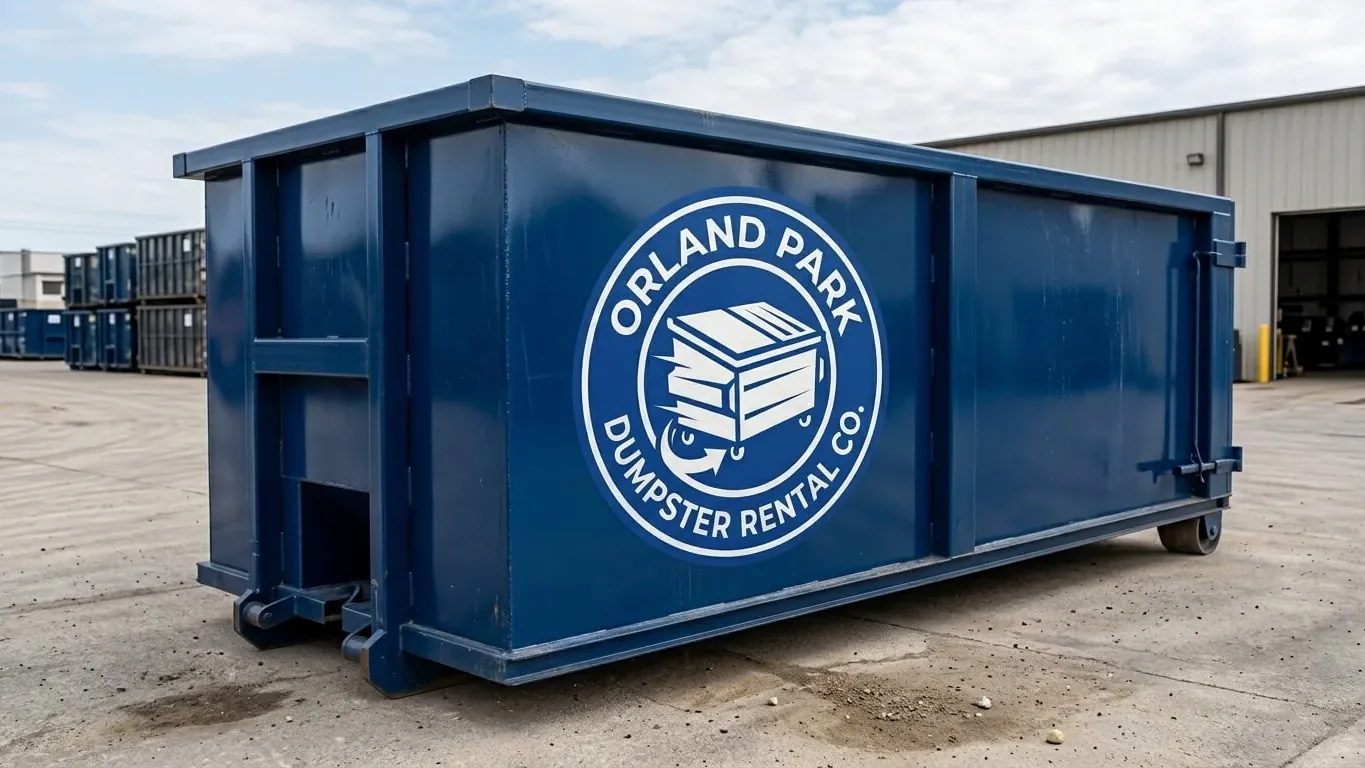
A roll-off is the container that arrives on a truck, sits where you put it, and leaves full. In Orland Park it exists for a very specific reason: the Village will collect your household refuse and it cannot collect your project. The Village’s contracted residential service, established under Title 4, Chapter 12 of the Village Code and billed like a utility, takes “up to three cubic yards of refuse per week” and one bulk item, where the Village defines a bulk item as “an item the resident would take with them if they moved out of the residence.” Three cubic yards a week is a good household allowance. Against a single bathroom gut it is nothing. And the gap between the two is not something the Village chose — 65 ILCS 5/11-19-1, in FindLaw’s current reproduction, forbids a municipality under 1,000,000 people from awarding a franchise or contract for the collection of general construction or demolition debris at all. Orland Park is 58,703.
The second thing to understand about roll-offs in this village is the one number that shapes the whole product line. The Village’s own permit page for “Dumpsters and Storage Pods (Residential)” caps a residential unit at “768 cubic feet for residential zoning districts”, with “a maximum unit height of eight (8) feet above grade.” 768 cubic feet is roughly 28.4 cubic yards. Convert it and the product line sorts itself: a 10, a 15 and a 20 are comfortably inside the rule; a 30 is a genuine question against it; and a 40 is not a residential driveway box in this village. That is the single most useful piece of arithmetic on this site, and as far as we can tell nobody else in this market has published it. Note the scope: residential zoning districts. We do not apply it to a commercial parcel.
Third, the other three rules that come with the Village’s “Permits are not required”. A container may stand for a maximum of “30 days from the day of placement on the site”. It “shall be located on private property”. And it needs “a minimum lot line setback of five (5) feet from any lot line.” The Village cites LDC § 6-304.C.12 as its authority; we have read the permit page and not the code section, so that is where our citation stops. Those four rules are the entire regulatory content of putting a box on an Orland Park driveway, which is genuinely simpler than most markets — and much simpler than the competitor instinct of “you might need a permit, call us”.
Fourth, weight, which is what actually limits a container far more often than volume does. Every roll-off has a lawful road payload behind it, and dense material reaches that payload long before it reaches the rail. Concrete, brick, block, tile set in a mortar bed, sod, soil, trench spoil and roofing shingle are all dense in that sense. That is why the smallest box on this site is the one for the heaviest job, and why a roof tear-off never goes in a 30 or a 40. It is also why we would rather send two containers to a job that produces both rubble and bulk than one that arrives back heaped, mixed and un-haulable.
Fifth, where the load goes afterwards, because in this region that is not a trivial question. Cook County’s own 2024–2029 solid waste plan says “Based on current disposal rates, Illinois’ Region 2 has less than five years of landfill capacity available”, and that “most materials from Cook County are disposed of in landfills primarily located in central and northeastern Illinois and northwest Indiana.” There is a structural reason behind that: under 415 ILCS 5/39.2, a new landfill or transfer station in Illinois has to win local siting approval from its host county or municipality before the state will even consider a permit. We name no facility on this site and we publish no gate rate. What we will say is that “just take it to the dump” is not a sentence that means very much around here, and that keeping a load clean and flat is worth real money. Ring (708) 928-8633.
What A Roll-Off Is Actually For Here
Whole-House Declutter Or Pre-Sale Clear-Out
The commonest reason a roll-off comes to an Orland Park driveway, in a village that is 85.8 percent owner-occupied across 23,256 households. Usually a 20 yard, which sits comfortably inside the Village’s residential size rule.
Remodel, Addition Or Gut
Drywall, plaster, cabinetry, flooring, trim and packaging, arriving in bursts rather than evenly. This is the case for a swap schedule rather than one box standing idle for four weeks. See the construction page.
Roof Tear-Off
Weight-limited rather than volume-limited, which is why it is sized down rather than up. A single-layer tear-off wants a 15; a two-layer wants a 20; and it never goes in a 30 or a 40.
Concrete, Masonry And Trench Spoil
The heaviest thing we set on a property and the one that wants the smallest box. Broken slab, apron, walk, block, brick and stripped sod all belong in a 10 yard loaded in one flat layer across the floor.
Storm And Tree Debris
A confirmed EF-0 crossed the village on 27 July 2026 and the Village’s own yard waste program will not take “sod, whole trees, stumps, and dirt” or “limbs greater than 4 inches in diameter.” That is a roll-off job by elimination.
Estate And Downsizing Clear-Outs
A quarter of the village is 65 or over, and emptying a house held for thirty-five years is a different order of problem from a spring clean. It usually runs across weeks rather than a weekend. See estate cleanouts.
Commercial Fit-Out And Tenant Improvement
Ceiling grid, shelving, carpet tile and packaging on a commercial parcel — bulky and light, which is the profile that wants a 30 or a 40. Different rules than a driveway; see the commercial page.
Demolition, Whole Building Or Interior
Taking a structure down brings a county layer with it on the Cook County side of the village that an interior strip-out does not. Read the demolition page before you set a date, because the clock starts at the county rather than at the yard.
Choosing Between The Five Boxes
Five boxes, and in this village the choice runs through two questions rather than one. First: is the material dense or bulky? Dense material — concrete, brick, block, tile in mortar, sod, soil, shingle — goes in a 10 yard, because weight arrives long before volume does. Bulky light material — furniture, cabinetry, packaging, ceiling grid, decking — wants volume, so it climbs the range. Second: is the job on a residential driveway? If it is, the Village’s 768 cubic foot cap converts to about 28.4 cubic yards, and that sorts the line: the 15 for a single-trade phase or a single-layer tear-off, the 20 yard as the default whole-house box and comfortably inside the rule, the 30 yard as the size where that number becomes a real question you have to answer, and the 40 yard as a commercial-lot box rather than a driveway box here. Two firm rules cut across all of it. Roofing never goes in a 30 or a 40. And on a job producing both rubble and bulk, two containers nearly always beat one badly loaded one. Describe the job on (708) 928-8633.
10 Yard Dumpster
Broken slab, apron and block. Dense material is full by weight long before the box looks it.
View this size →20yd³20 Yard Dumpster
What leaves the yard most weeks. Rated volume sits inside the Village’s rule; the outside of the box is a question worth asking.
View this size →30yd³30 Yard Dumpster
A whole-floor gut, or fifty years of one family’s storage. Check it against the Village rule first.
View this size →40yd³40 Yard Dumpster
Light, bulky commercial material only, and it needs the longest straight approach on this list.
View this size →Delivery, Placement And The Four Rules
Delivery day goes well or badly depending on four things, and all of them are decided before the truck leaves the yard. The approach. A roll-off truck needs a straight run to back in, working room down each side and real clearance overhead for the hoist. Orland Park’s subdivision streets curve, its driveways often flare at the apron and its mature trees hang low over the drop point in high summer — a service drop or an overhanging limb stops a delivery as effectively as a locked gate. Tell us at booking. The surface. This village is built on the Valparaiso Morainic System; the Illinois State Geological Survey describes the surface unit, the Wadsworth Formation, as an “extensive surficial clay-rich stratigraphic unit” exceeding 125 feet in thickness, sitting over more than 185 feet of glacial sediment in places. Clay holds water and moves with the frost. Plywood or timber goes under the wheels and both rear rollers as standard; we want concrete or a well-built base rather than turf, a soft shoulder or a recent pour. On the National Weather Service’s Chicago O’Hare 1991–2020 normals, January and February together average 22 inches of snow and March averages 5.5 inches against a 47 °F high — freeze and thaw on clay, and the month we are fussiest about placement. The rules. Five feet from any lot line, on private property, eight feet maximum above grade, thirty days. We will not put a box in the street: the Village’s dumpster page makes no provision for it, there is no street obstruction permit on the Village’s published permit list, and the Village Code separately forbids obstructing or encroaching on public streets and using streets, parkways and sidewalks for business purposes. It is also worth remembering that the street may not be the Village’s: IDOT owns US 45 (LaGrange Road), IL 7, US 6 (159th Street) and IL 43, and Cook County owns arterials including 104th Avenue, 108th Avenue, Wolf Road, Will-Cook Road, 151st Street, 153rd Street and 80th Avenue. The load. Flat and level with the rail, dense material low and spread, nothing proud of the top and nothing that can blow off it. A heaped box cannot lawfully leave, and a re-load on your driveway costs everybody a day.
Landed on the wrong service? Describe the job out loud and we will name the container that actually fits it — quite often that means pointing you at a different page here, or at the Village’s own collection, which costs you nothing at all. Ring (708) 928-8633.
One figure, one call
The address first — it settles Cook or Will — then what is going in. Size, figure and day, in about two minutes.
(708) 928-8633Sizes that suit it
How it works
Roll-Off Dumpster Rental, from the phone call to the collection
- 1
Tell us the job
Two minutes, and a street name and a nearest cross street is enough. Give us the address rather than the town, because in this village the address is what decides which of five governments answers your question. By the end of the call you have one figure, and the disposal is already inside it.
- 2
We set it down
The driver walks the run in on foot before the truck follows it, and plywood goes down under both rails and all four wheels. This is Wadsworth clay; it does not forgive a wet March. On private property, five feet clear of any lot line, which is the Village’s own rule and a real constraint on a suburban lot.
- 3
Fill it flat and low
Use the days in your window. Heavy on the bottom, nothing standing proud of the rail, and keep it covered — rain here runs three and a half to four and a half inches a month through the summer, and water is weight.
- 4
Say the word
One call and it goes. Metal and clean cardboard are pulled off the top first, and what remains travels to a facility permitted to receive it.
Roll-Off Dumpster Rental FAQs
What sizes do you actually run?
Five: 10, 15, 20, 30 and 40 cubic yards. The useful way to choose between them here is to ask two questions in order. Is the material dense — concrete, masonry, tile in mortar, sod, soil, shingle? If so the answer is the 10, because weight gets there before volume does. If the material is bulky and light, is the box going on a residential driveway? If so, the Village’s 768 cubic foot cap, which is about 28.4 cubic yards, means the 20 is the comfortable default and the 30 is a question rather than a free upgrade. The 40 is a commercial-lot box in this village. Describe the job on (708) 928-8633 and we will pick with you rather than sell you the largest one.
Do I need a permit for a roll-off in Orland Park?
For a residential unit on private property the Village answers this itself, in three words: “Permits are not required.” What it does impose are four rules — a maximum of 30 days from placement, location “on private property”, a five-foot minimum setback from any lot line, and a maximum size of 768 cubic feet at no more than eight feet above grade — and it cites LDC § 6-304.C.12 for them. Two things to keep straight. Those figures are written for residential zoning districts and we do not extend them to a commercial job. And a container permit is not a work permit: a roof, siding, windows or a demolition each carry a separate Village permit, published at $95, and you should confirm current fees with the Village on 708-403-6100. Our permit guide covers the sequence properly.
Can a roll-off go on the street or in the parkway?
Not on anything the Village has published. Its dumpster guidance says the unit “shall be located on private property”; there is no street obstruction or right-of-way permit anywhere on the Village’s published permit list; and the Village Code’s obstruction section forbids obstructing or encroaching on public streets and forbids using streets, parkways and sidewalks for business purposes. We could not find a route to a permitted street placement here and we will not invent one. There is also a practical reason to stay off the road in this village: the street in front of you may belong to IDOT, to Cook County, to Will County or to the Village, and the Village’s own engineering page says State and County projects are “out of the Village’s jurisdiction.” Keep it on the drive and the question disappears.
What cannot go in the box, in Illinois specifically?
Six materials are kept out of a landfill-bound container by Illinois statute, and several are written about the container rather than the landfill. Landscape waste — 415 ILCS 5/22.22: no landscape waste “into a container intended for collection or disposal at a landfill, unless such container is biodegradable”, which is why the Village’s yard waste bags are Kraft paper. Lead-acid batteries — 22.23, same container language. White goods — 22.28, a component-removal rule rather than a flat ban, which is why the Village asks residents to phone before a fridge goes to the curb. Tires — 415 ILCS 5/55. Used oil — 21.6, which bans liquid used oil and expressly excludes filters, rags, absorbent and empty containers from that definition. And electronics, under the Consumer Electronics Recycling Act. Then the ordinary list: liquids, paint that is not dried out, solvents, fuel, pool chemicals, pressurized tanks, asbestos-containing material. Full detail in our materials guide.
How long can I keep the container?
The Village sets the outer limit at 30 days from the day of placement on the site, and that is a hard number rather than a rolling allowance. Inside that window it is your call, and the practical constraints are weather and weight. The wet months are the busy months — on the National Weather Service’s Chicago O’Hare 1991–2020 normals, May through August average 3.71 to 4.49 inches of rain — and an open box left standing through a wet two weeks gains water weight you will pay to haul. Load dense material low and flat so the top sheds. At the other end of the year, a loaded container standing on clay through March’s freeze-and-thaw is the placement we are most careful about. Ring (708) 928-8633 when you want it collected and we will route it.
More services
Other things we haul
Residential Dumpster Rental
Orland Park’s cart takes three cubic yards a week. A bathroom gut is that on its own.
Learn more →Commercial Dumpster Rental
Shops, restaurants and tenant fit-outs along the LaGrange Road corridor.
Learn more →Construction Dumpster Rental
Mixed build waste in one box, swapped on call either side of the county line.
Learn more →Roofing Dumpster Rental
Squares and layers, never roof area — and never a 30 or a 40, whatever the roofer asks.
Learn more →Same-Day Dumpster Rental
What we can and cannot do today, said straight on the phone.
Learn more →Junk Removal Dumpsters
Clear a garage, a basement or a rental unit at whatever pace the week allows.
Learn more →Estate Cleanout Dumpsters
Patient work in a village where a quarter of the residents are over sixty-five.
Learn more →Demolition Debris Removal
Decks, garages and strip-outs — and in Cook County the County wants a permit too.
Learn more →Concrete & Heavy Debris
Its own low box for slab and apron concrete, loaded flat in one layer.
Learn more →Yard Waste & Brush Removal
Stumps, sod, dirt and anything over four inches — all of it off the curbside route.
Learn more →Where we deliver
Roll-Off Dumpster Rental across Cook and Will Counties and the south-west suburbs
Seventeen places, one crew, one flat figure. Each has a page of its own, and the first thing that page settles is which county answers for the address — Cook, Will, or in Lemont’s case three at once.
Talk to a real person
Need roll-off dumpster rental in Orland Park?
Say what is going in and give us the address — the address, because on this village the county changes underneath you. Size, one flat figure and a day, settled before you hang up. No form to fill in, and no queue.
Orland Park and seventeen more places across Cook, Will and DuPage · Mon–Fri 6:30am–5pm, Sat 7am–1pm