
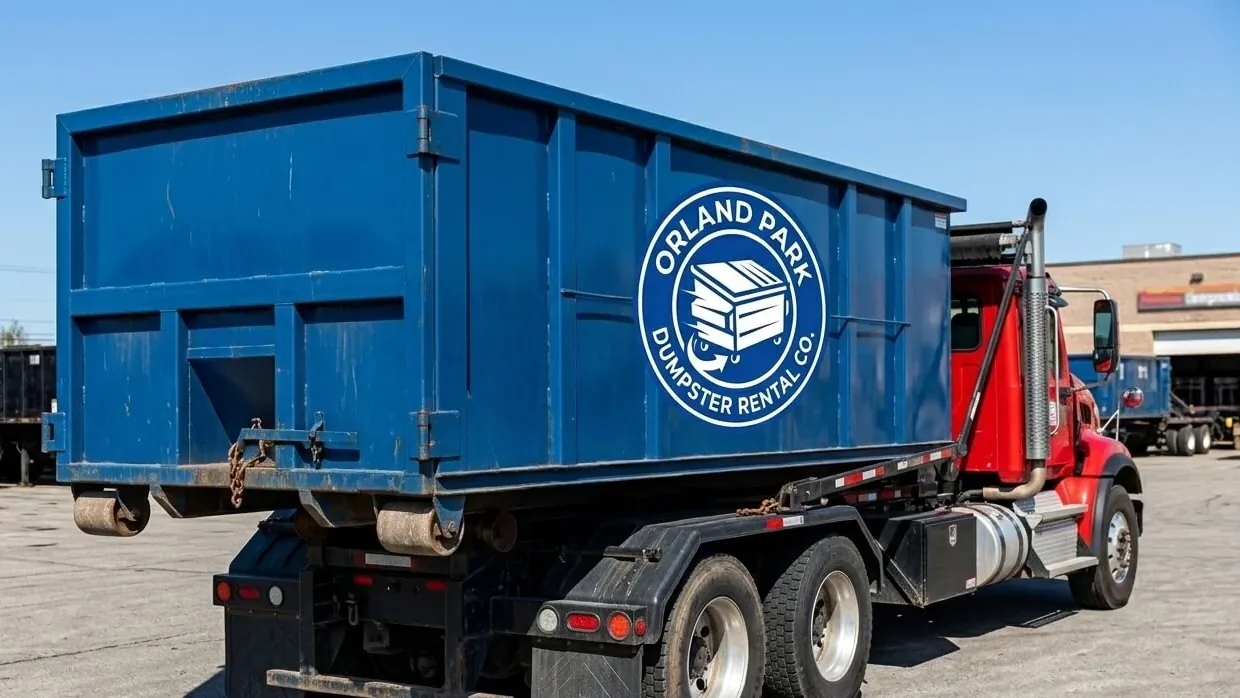
Worth, IL · Cook County
Dumpster Rental in Worth, IL
Roll-off containers run out to Worth from our yard at 11601 183rd Pl in Orland Park — 10.8 straight-line miles north of the yard, up on the Metra line. One flat number with the disposal inside it, plywood under the rails on every drop, and a straight answer about which county governs the job.
Roll-off containers for Worth homes and jobsites
Worth, Illinois — and we write it that way every time, because “Worth” on its own is a common noun and a bare search for it returns everything except this village. It is a Cook County village of 10,970 people at the 2020 Census, estimated at 10,696 by 2025, on 2.37 square miles. That is the smallest land area of any municipality on this site, which makes it the tightest place we work and the one where container size is most often decided by the drive rather than by the job.
Worth has one of the Metra SouthWest Service stations. That line runs thirteen stops between Union Station and Manhattan, and six of the thirteen are inside this service area — Worth, Palos Heights, Palos Park, the three inside the Village of Orland Park, and New Lenox Laraway Road further out. The line is very nearly a map of where we work, and it tells you something real about the customer: this is commuter country, which means the tear-out happens at the weekend, which means the container needs to already be on the drive on Friday. That single scheduling fact is worth more than most sizing advice.
Worth is also in the Cal-Sag Channel watershed, the Metropolitan Water Reclamation District’s stormwater area for this half of the market, and it is one of the eleven communities served by Consolidated High School District 230 — a list which, as it happens, maps this site’s inner service area better than a radius does.
The work here is ordinary suburban work on small lots: kitchens, baths, basements, garages, roofs and clear-outs — ordinary residential container work. Sizes are at the sizing guide.
What we know about working in Worth
The village layer, which is the Village of Worth’s. Container rules, placement setbacks, duration limits, right-of-way process, hauler licensing and collection program: not established, not published here. This site quotes the Village of Orland Park’s permit page in detail because it is genuinely good, and it applies to genuinely one village. On private property you control the right-of-way question does not arise; for a street or a public space, ask the village.
The county layer, which does apply and which we can set out. Worth is suburban Cook County. On a demolition that means a Cook County permit in addition to the village’s: $300 for the first residential structure, $150 each additional, $750 per structure for commercial and five-plus-unit residential; applications “10 business days before the work start date”; a plat of survey by an Illinois registered surveyor not more than five years old; an asbestos inspection report or abatement permit number; a notarized electrical disconnection affidavit; and a registered demolition contractor for residential structures above 625 square feet. Plus the Demolition Debris Diversion Plan demonstrating 70% by weight recycled and, on residential, a further 5% by weight for reuse.
And the Cook County asbestos abatement permit: $200 residential filing fee, required “for all asbestos projects (residential, commercial, institutional and industrial),” applied for at least ten working days ahead. Illinois EPA, administering the federal NESHAP, exempts privately owned homes and buildings of four units or fewer. The exemption is from the federal rule. It is not from the county’s.
The commuter point, made practical. Six of the thirteen Metra SouthWest Service stops are in this service area, and a village with a station is a village where a large share of the households work somewhere else all week. What that means for us is scheduling rather than sizing: if the demolition is happening on Saturday morning, the container has to be set on Friday, and the pull should be booked at the same time so a full box does not sit on a small drive through the following week. On a village of 2.37 square miles a full box on a drive is not a private matter for long.
The state layer. The six statutory landfill bans apply. 65 ILCS 5/11-19-1 keeps construction and demolition debris outside any municipal franchise in a town under a million people. And anything that digs — a fence post, a stake for a plywood pad, a machine scraping a set-down area — starts with JULIE on 811: request the locate “at least 3 days before you want to dig,” a normal ticket is “valid for 25 days,” the tolerance zone is a foot and a half either side of the marks, and pre-marking in white paint is, in JULIE’s own words, “the law.”
- CountyCook County
- Distance from base10.8 straight-line miles north of the yard, up on the Metra line
- Main routesthe run north out of the yard toward the channel
- BookingBy phone, one call
Getting a truck to you
Worth is a scheduled run north and the smallest municipality on our list, so the placement conversation is short and specific. Measure the drive at its narrowest point, look up, and tell us both numbers. A 20-yard box wants roughly sixty feet of straight approach, eleven feet of working width and better than twenty feet of clear overhead; on a good many drives here a 15 is the honest answer and a 10 is the answer on anything heavy. Then tell us the day. This is commuter country and most of the work happens at weekends, which means the set wants to be Friday and the pull wants to be booked at the same time rather than negotiated on the Monday. Plywood goes under the rails as standard: the damage on an older apron is the point load under the rails, not the weight overall, and on 2.37 square miles of close-set houses a cracked apron is a conversation with a neighbor as well as with us. Weather sets the calendar — March, at 5.5 inches of snow and a 47°F average high in the O’Hare 1991–2020 normals, is the freeze-thaw month. (708) 928-8633.
Routes we run: the run north out of the yard toward the channel, IL 7 (Southwest Highway), IL 43 (Harlem Avenue), the Cook County DOTH arterials on the way up, the local streets around the Metra corridor.
Landmarks and neighborhoods we work around
Local landmarks
- 2.37 square miles — the smallest land area of any municipality on this site
- 10,970 residents at the 2020 Census
- a Metra SouthWest Service station
- the Cal-Sag Channel watershed and Consolidated High School District 230
- a village name that is also a common noun, so always Worth, Illinois
- the tight residential grid that fills nearly all of it
Neighborhoods & communities
- the residential streets around the station
- the post-war grid that fills most of the village
- the blocks nearest the channel
- streets with short drives and close lot lines
- the commercial frontage and the yards behind it
- properties where a small container is the only container
Permits, streets and placement in Worth
Start with the question that changes every other answer on this page, because in this market it is not which town you are in. It is which county. Worth is in suburban Cook County, which is the half of this market where the county government does not merely plan and report but issues permits, charges for them and sets its own clock — all of it stacked on top of whatever the municipality asks for. That is an unusual amount of verified, checkable machinery to be able to put in front of a homeowner, and it is the reason the Cook County pages on this site run longer than the Will County ones.
One practical reason we write Worth, Illinois in full every single time: “worth” on its own is a common noun. Give a bare place name to a county permit desk or a utility locate operator and you will be asked to repeat yourself; give the street address first time and you will not. That is not a style note. It is the same discipline that decides which county answers for your demolition.
Two structural points before the figures. First, Worth is an incorporated municipality, and that decides which county door you go through: Cook County’s own page reserves its Department of Building and Zoning for property in unincorporated Cook County, which makes the Department of Environment and Sustainability the route for property inside a town. All eleven Cook County places on this site are incorporated, so it is DES every time. Second, the county publishes a turnaround alongside the deadline: applications go in “10 business days before the work start date” and applicants “will typically receive their permit within 3-7 business days.” Those are two different numbers and people routinely plan against the wrong one.
The stack itself, set out as a list rather than as prose, because it is a checklist and people need to work down it. Every line of this is Cook County’s, verified from the county’s own pages, and every line of it is on top of whatever Worth asks:
- Cook County DES demolition permit — $300 on a first residential structure, then $150 a structure after that; $750 a structure once the property is commercial or residential of five units and up; and $55 to release a fee hold
- Ten business days — applications “must be submitted 10 business days before the work start date”
- A plat of survey, sealed by an Illinois registered surveyor, no more than five years old — an old survey in a drawer is the single commonest cause of a stalled application
- A registered demolition contractor — “residential structures above 625 square feet and all properties zoned commercial or industrial must have a registered demolition contractor”
- A notarized electrical affidavit — from the owner or the electrical contractor, stating the electric has been safely disconnected and no hazardous condition exists
- An asbestos inspection report, or an abatement permit number where abatement has already happened
- A Demolition Debris Diversion Plan — 70% of debris by weight recycled on all demolition projects, and on residential properties a further 5% by weight diverted for reuse, across “suburban and unincorporated Cook County”
- A Cook County asbestos abatement permit — $200, required “for all asbestos projects (residential, commercial, institutional and industrial),” at least ten working days before the project starts — which runs directly against the state answer, because Illinois EPA, administering the federal rule, treats an owner-occupied house or a four-unit-or-smaller building as outside it. What Springfield exempts you from is Washington’s rule. Cook County’s ordinance was never part of that bargain, and the county ordinance is the one that stops a truck at the curb
On the asbestos side, the county has tightened what it will accept rather than what it charges. Effective 15 October 2025, an asbestos survey report submitted with a Cook County demolition application must include a “Sampling Methodology,” a “Sample Area Identification & Scaled Drawing,” “Precise Sample Locations” and “Contextual Photographs.” On the commercial side the $200 filing fee is joined by inspection fees of $6 per square foot or $2 per linear foot, capped at $2,000, and the county states that “all fees are non-refundable and credits will not be given.” Since 1 March 2024, municipal demolition projects involving residential structures are exempt from permit fees. Where an industrial or commercial zoned property is involved, a separate Illinois EPA NESHAP notification also comes into play — a $150 fee with the notification form ten working days ahead. The desk for all of it is the Cook County Department of Environment and Sustainability on (312) 603-8200. Digital submissions go to intake.bnz@cookcountyil.gov at 25 MB or under.
And one question this page deliberately leaves open. A 2012 county article describing the Demolition Debris Diversion Ordinance puts its scope at “all demolition projects (excluding sheds and garages)”; a municipal permit page in this same market sends applicants to the county for “entire building and detached garage demolition permits.” Those two statements pull in opposite directions, and settling a conflict between county-side sources is not a job for a hauler’s website. So plan on the basis that a detached garage falls inside the diversion requirement until the county itself says otherwise, and put the question to the Cook County Department of Environment and Sustainability on (312) 603-8200 before it costs you a week.
Then one more feature of the landscape — and note carefully that it is a statement about the landscape and not about this company. The Cook County Solid Waste Ordinance requires waste haulers operating in suburban Cook County to report their collected waste, recycling and yard-waste tonnages to the county quarterly, by municipality. That reporting duty is the machinery behind every municipal recycling figure the county has ever published. We set it out as a feature of the landscape this trade operates in, and we assert nothing whatever, in either direction, about our own position under it — nothing anywhere on this site should be read as a statement about our licensing, registration, certification or regulatory standing. Why the county mandates 70% diversion at all is answered by its own numbers: Cook County reported a 17% recycling rate and a 26% diversion rate for 2024, against the Solid Waste Planning and Recycling Act’s target that a county program recycle 25% of municipal waste by its fifth year. That gap is the whole justification, and it is a fairer way to explain the paperwork than a lecture.
The placement question is shorter, and the safe half of it covers nearly everything we set. On private property you control — your driveway, your lot, a contractor’s staging area — no right-of-way permission is in play at all. Not the county’s, not the municipality’s, not the State’s. What can still apply on private ground is a deed restriction, an association covenant, a landlord’s consent, and on a commercial building the fire code — and none of those is a permit counter.
The street case belongs to the Village of Worth, and this is the line the county section must not be allowed to blur. Everything above is Cook County’s and it is verified. Nothing above is Worth’s. The county permit does not replace a municipal one, and the municipal rules on containers, setbacks, duration, streets, parkways and right-of-way are Worth’s own. We did not establish a single one of them and this page states none. Put that question to the Village of Worth before the truck is booked rather than after — to them, not to us, because it is their street. We did not establish a published phone number for the Village of Worth that we are willing to reprint. What a search returns for a suburban Illinois municipality is aggregator listings as often as the town’s own page, and a wrong number printed confidently is worse than no number at all — so take these questions to the hall directly.
And the ground the truck stands on before it ever stands on your driveway. The Village of Orland Park’s own road-work page names three road authorities in one village — the Village, the county transportation departments and IDOT — and says in terms that State and County projects are “out of the Village’s jurisdiction.” That is a useful thing to know before you ring anybody about a street: the pavement in front of a house in this market has three or four possible owners and the town is only one of them. We did not establish who owns the road in front of our own yard, and we are not going to tell you who owns the one in front of yours.
Anything that digs starts with JULIE, and it is worth being clear why a container company keeps saying so. Nobody excavates anything by parking a steel box on a slab. The fence post going in beside it does. So does the stake pinning the plywood down. So, emphatically, does a skid-steer shaving a lawn flat to build a set-down pad. And the person hiring the box this week is very often the person putting a footing in next week. Dial 811, or (800) 892-0123, any hour of any day. JULIE’s own homeowner page asks you to “request utilities locate their underground lines by contacting JULIE at least 3 days before you want to dig”; the Act as reproduced says not less than two. We publish JULIE’s own number rather than splitting the difference, because it is JULIE’s system. A standard ticket runs 25 days before it lapses, and around every mark sits a tolerance zone reaching eighteen inches to each side — inside that band the only acceptable tool is a hand tool. And in Illinois white paint is not a courtesy — JULIE tells excavators to “physically pre-mark your job site using white paint, flags or chalk” before breaking ground, and its own words for that are “It’s the law!”
One layer follows the container rather than the address, and Illinois arranges it the opposite way to most states. There is no mandatory statewide building code for private construction in Illinois. The Capital Development Board sets codes for state-owned buildings; municipalities adopt their own, and they do not all adopt the same ones. On fire, the State Fire Marshal’s rule adopts NFPA 101, the Life Safety Code — while the Village of Orland Park adopts the International Fire Code itself. Two different documents from two different publishers, in force at once, because Illinois lets a municipality write its own. When somebody quotes you “the fire code” about a box standing against a building, the first question is which one they mean. In Orland Park itself, fire protection is not a village department — the Orland Fire Protection District is a separate unit of government at 9790 West 151st Street, on the 2018 International Fire Code with amendments. Which fire district or department covers Worth, and which fire code it has adopted, we did not establish. Ask the village hall, and do not assume the answer matches ours. And we publish no separation distance between a container and a building anywhere on this site. The section everyone reaches for is one we could not read, and a clearance invented for a commercial wall is the kind of number that gets somebody hurt.
What a municipal contract collects here, and what it cannot
That is one village’s contract, in a different municipality, and none of it is Worth’s. We set it out on a Worth page for a reason that is not padding: it is the clearest picture available of what a municipal refuse program in this county actually covers and where it stops — and the sentence underneath it is state law that applies to Worth identically.
The Village of Orland Park does collect residential refuse, through a contracted hauler, billed like a utility under Title 4, Chapter 12 of its code. We say that plainly because it is the thing every customer compares a container to, and because the comparison is where the argument for a container is actually won. What the contract takes is published, and it is worth reading in the Village’s own words: a 96-gallon cart, with overflow in bags or containers no greater than 45 gallons and under 50 pounds; “up to three cubic yards of refuse per week”; and one bulk item — where “a bulk item is considered an item the resident would take with them if they moved out of the residence (e.g., couch, small tables, mattress, etc.).” Read that definition twice, because it settles more arguments than any rule on this site. A sofa moves house with you. A mattress moves house with you. Drywall does not. Cabinet carcasses do not. Half a deck does not. Carpet sits right on the line and the Village draws it: cut and rolled into 4-foot lengths, under 50 pounds a roll, up to eight rolls a week. Paint “must be dried out in the can in order to be collected. Only latex (water based) paint is allowed in regular trash once dried out.” Yard waste runs weekly from 1 April to the second full week of December in Kraft paper bags, with brush cut to 4-foot lengths and bundled under 50 pounds — “Unbundled brush will not be collected” — and the refusal list is written out rather than left to be discovered: “sod, whole trees, stumps, and dirt are not part of the weekly yard waste program,” along with “limbs greater than 4 inches in diameter.” Every one of those four is a classic roll-off load. The Curbside Spring Clean-Up for 2026 ran the week of 6–10 April 2026 on the regular pick-up day, taking furniture, textiles, carpets, washers, dryers and refrigerators, bagged, contained or bundled with no loose garbage, and “Doors must be removed from all appliances.” It says in terms that “Electronics are NOT included in the Curbside Spring Clean-Up event.” Construction and remodeling debris is not on the list of what it takes, and we will put no further words in the Village’s mouth than that. Those dates move, so confirm current ones with the Village of Orland Park rather than trusting a page read in another season.
And one number in that same rulebook is worth converting, because nobody else in this market does it. The Village’s permit page caps a residential unit at “768 cubic feet for residential zoning districts” with “a maximum unit height of eight (8) feet above grade.” 768 cubic feet is roughly 28.4 cubic yards. Convert it and the rule stops being trivia: a 20-yard box is comfortably inside it and a 30 is a genuine question against it. The eight feet is measured above grade, which is a real constraint on a high-sided box once it is loaded. The Village cites LDC § 6-304.C.12 as its authority and we stop there — we did not read the Land Development Code text and we quote none of it. Those figures are also for residential zoning districts and we never stretch them to a commercial job. The Village also publishes its permit fees, and they are among the very few municipal fee figures in this market we actually read: roof $95, siding $95, windows $95, demolition $95, as published. Confirm current fees with the Village.
And now the sentence the whole site rests on, which is neither the Village’s nor Worth’s but the General Assembly’s. As FindLaw reproduces the current text of 65 ILCS 5/11-19-1, “a municipality with a population of less than 1,000,000 shall not award a franchise or contract to any private entity for the collection of general construction or demolition debris from residential or non-residential locations.” Not one of the seventeen municipalities on this site comes within an order of magnitude of a million residents, Worth included. So whatever curbside arrangement Worth has — and this page does not describe it, because nobody here read it — the General Assembly has placed your remodel debris outside the reach of it. That is a statute rather than a pitch, and it is the reason an independent container trade exists in Illinois at all.
Two questions travel with the load rather than with the address, and neither is settled at a village hall. The first is where it may lawfully go, and Illinois answers that with permit classes rather than with distance. Illinois EPA’s Bureau of Land permits waste activities “including those involving municipal waste, landscape waste, composted material, construction and demolition debris” and more, and the real division in the landfill standards is between inert waste landfills and putrescible and chemical waste landfills — not the Class I, II, III vocabulary imported from other states. One term deserves particular care, because people use it loosely and a fill operator will not. “Clean construction or demolition debris” — CCDD — is a defined Illinois term, and it is much narrower than the trade uses it: Illinois EPA defines it as “uncontaminated broken concrete without protruding metal bars, bricks, rock, stone, or reclaimed asphalt pavement generated from construction or demolition activities.” Drywall is not CCDD. Wood is not CCDD. Shingles are not CCDD. A mixed remodel load is not CCDD. Which is exactly why we ask what is going in the box while we are quoting it, rather than finding out at a gate.
The second is a piece of Illinois machinery that explains the whole economics of this market in one sentence. Under 415 ILCS 5/39.2, a new landfill or transfer station has to win local siting approval from its host municipality or county — against nine statutory criteria, including need, floodplain, traffic and consistency with the county solid waste plan — before the state will consider permitting it. A disposal site in Illinois needs a local political vote before it needs an engineer. That is a large part of why “just take it to the dump” is not a sentence that means anything here, and it is why the honest answer to “what size?” sometimes runs downward: on dense material, take the smaller box twice. Roof tear-off is the standard case and it is not close — shingle reaches lawful payload while there is still room above the rails, so it never belongs in a 30 or a 40. We name no landfill, no transfer station and no recycler on this site, and we publish no gate rate or tipping fee.
Two more things worth having straight before an older house is opened up, because Illinois splits them in a way that catches people out. On lead, Illinois is not an EPA-authorized RRP state. A firm doing paid renovation work that disturbs pre-1978 paint certifies with US EPA directly rather than with Springfield. What Illinois does run is lead abatement — work whose purpose is removing the hazard rather than renovating around it — through the Illinois Department of Public Health. Two different programs, two different agencies, and getting the split right is the difference between sounding local and sounding imported. On radon, we publish no zone as a risk finding for any address here. The zone map is a 1993 screening product and EPA’s own position is the one that travels: “all homes should be tested, regardless of zone designation.”
Ground, weather and the working year
Now the ground, and here is a limit we would rather state than let a reader assume past. The geological source this site quotes everywhere — the Illinois State Geological Survey’s surficial geology report for the Mokena Quadrangle — is one 7.5-minute map sheet, and it was drawn for the Will County end of this market. Its boundary falls short of Worth, and no sheet covering Worth was read for this site. What the report describes is regional rather than parcel-specific: the Valparaiso Morainic System and its clay-rich Wadsworth Formation, an “extensive surficial clay-rich stratigraphic unit” exceeding 125 feet, over more than 185 feet of glacial sediment, over Silurian dolomite and limestone. The behavior of clay does carry across a map sheet boundary perfectly well: it holds water instead of shedding it, and a freeze–thaw cycle lifts and drops whatever is sitting on top of it. That is the whole reason a driver here lays boards before a rail touches concrete. But we are not going to describe what is under a specific Cook County street on the strength of a sheet drawn for somewhere else, and there are four numbers we will never put in writing for a property here: a bearing capacity, a frost depth, a depth to water, and whether the lot sits in a flood zone.
Weather here comes from one office and we never name another: NWS Chicago, at 250 George J Michas Dr., Romeoville, on (815) 834-1435. It covers both of the counties this site works in. What that office keeps is a surveyed record with dates and ratings on it rather than a general sense that storms happen. Its summary of 27 July 2026 carries seven confirmed tornadoes across the whole forecast area. One of them is filed under the heading “3 NW Orland Park” — EF-0, path length 2.9 miles, peak winds 85 mph, maximum width 250 yards. Another, an EF-1 running 110 mph, tracked 11.4 miles through Country Club Hills, Hazel Crest and Homewood the same afternoon, and a gust of 104 mph was measured at Bult Field. On 15 July 2024 the same office confirmed 32 tornadoes in a single event — a record for its forecast area, 11 in Cook County and 6 in Will. We publish those figures with the office’s own scope attached rather than a local headline count, and nothing on this site should be read as a claim that we are a partner of any emergency management, insurance or federal agency. We are a hauler. The climate normals we quote are always Chicago O’Hare, 1991–2020, National Weather Service — that station sits on the far north-west side of Cook County and those numbers are not this town’s own. What they say about the working year is worth planning around: January and February together average 22 inches of snow; March carries 5.5 inches of snow under a 47°F average high, which is the definition of a freeze–thaw month and makes it the least forgiving four weeks of the year for standing a loaded box on clay; and May through August each average between 3.71 and 4.49 inches of rain, so the busiest part of our season is also the wettest. Cover the load. Water is weight and disposal is billed on weight. And one myth worth killing, because people plan winter jobs around it: lake-effect snow is essentially a non-event this far inland. In the National Weather Service’s own write-up of the lake-effect event of 30–31 January 2026, Dune Acres in Porter County, Indiana recorded 11.0 inches. Midway Airport — the nearest reporting station to these suburbs — recorded 0.9, and Will County does not appear in the totals at all. What stops work here is ordinary snow, frozen ground and freeze–thaw on clay.
One more thing about that office, because it is worth knowing which warning is yours. On 3 March 2020 NWS Chicago subdivided both counties into smaller forecast zones — Cook into three, Will into three — so a warning that names a county is naming a piece of it rather than the whole. Southern Cook County is ILZ105; Northern Will County is ILZ106, and in the municipality list for that Will County zone the office wrote “Orland Park (small part)” — a parenthesis in a federal list to handle one village straddling a county line, which is also the line our own yard sits on the far side of. Which zone Worth falls in we have not published, because we only verified the municipality lists for two of the six. Check the office’s own zone page rather than assuming.
Sizes we deliver to Worth
10 Yard Dumpster
Broken slab, apron and block. Dense material is full by weight long before the box looks it.
View this size → 15yd³15 Yard Dumpster
A single-layer tear-off, or one room of a 1970s split-level taken back to the studs.
View this size → 20yd³20 Yard Dumpster
What leaves the yard most weeks. Rated volume sits inside the Village’s rule; the outside of the box is a question worth asking.
View this size → 30yd³30 Yard Dumpster
A whole-floor gut, or fifty years of one family’s storage. Check it against the Village rule first.
View this size → 40yd³40 Yard Dumpster
Light, bulky commercial material only, and it needs the longest straight approach on this list.
View this size →Getting a container to Worth
This end of the range is planned ahead rather than dropped in on the day, and we would rather give you a window we can hold.
(708) 928-8633Nearby places
Popular in Worth
Services in Worth
What we haul in and out of Worth
Construction Dumpster Rental
Mixed build waste in one box, swapped on call either side of the county line.
Learn more →Commercial Dumpster Rental
Shops, restaurants and tenant fit-outs along the LaGrange Road corridor.
Learn more →Demolition Debris Removal
Decks, garages and strip-outs — and in Cook County the County wants a permit too.
Learn more →Roll-Off Dumpster Rental
Five box sizes, and the two largest are worth a call to your own village before you order.
Learn more →Concrete & Heavy Debris
Its own low box for slab and apron concrete, loaded flat in one layer.
Learn more →Residential Dumpster Rental
Orland Park’s cart takes three cubic yards a week. A bathroom gut is that on its own.
Learn more →How it works
Delivering to Worth in four steps
- 1
Tell us the job
Two minutes, and a street name and a nearest cross street is enough. Give us the address rather than the town, because in this village the address is what decides which of five governments answers your question. By the end of the call you have one figure, and the disposal is already inside it.
- 2
We set it down
The driver walks the run in on foot before the truck follows it, and plywood goes down under both rails and all four wheels. This is Wadsworth clay; it does not forgive a wet March. On private property, five feet clear of any lot line, which is the Village’s own rule and a real constraint on a suburban lot.
- 3
Fill it flat and low
Use the days in your window. Heavy on the bottom, nothing standing proud of the rail, and keep it covered — rain here runs three and a half to four and a half inches a month through the summer, and water is weight.
- 4
Say the word
One call and it goes. Metal and clean cardboard are pulled off the top first, and what remains travels to a facility permitted to receive it.
Dumpster Rental in Worth — FAQs
Do you mean Worth, Illinois?
We do, and we write it out every time for exactly that reason — the name is a common noun and a bare search for it returns anything but the village. This is the Village of Worth, Cook County, Illinois: 10,970 residents at the 2020 Census on 2.37 square miles, which is the smallest land area of any municipality on this site. It has a Metra SouthWest Service station and sits in the Cal-Sag Channel watershed.
We both commute. When should the box arrive?
Before the work starts, which in this village usually means Friday. Six of the thirteen Metra SouthWest Service stops are inside this service area, and a commuter household does its tear-out at the weekend — so a Monday delivery for a Saturday job is a wasted week and a Saturday delivery is a morning spent waiting. Book the set and the pull together at the same time: the container arrives before you start and leaves when you finish, rather than sitting full on a small drive until somebody remembers to call. Tell us the finish date when you book and we will hold it.
What does Cook County want for a teardown here?
More than the village does, and on a longer clock. Cook County’s demolition permit is $300 for the first residential structure, submitted ten business days before the work start date, with a plat of survey not more than five years old, an asbestos inspection report or abatement permit number, a notarized electrical disconnection affidavit, a registered demolition contractor for anything over 625 square feet, and a diversion plan showing 70% by weight recycled plus 5% reused on residential work. On top of that, the county’s asbestos abatement permit is $200 and is required for all projects including single-family homes. Start with Cook County and ask the village about its own permit separately.
Do I need to call JULIE for a dumpster?
Not for the box itself — a container sitting on a driveway is not an excavation. Call for what goes with it. JULIE is Illinois’s 811 service: dial 811 or use illinois1call.com. JULIE’s homeowner guidance is to request the locate “at least 3 days before you want to dig”; a normal ticket is “valid for 25 days from the date of the initial request”; the tolerance zone runs one and a half feet either side of the marks; and pre-marking the dig area in white paint is described by JULIE as “the law.” Fence posts, deck footings, a stake for a protection pad and a machine scraping a set-down area all count. We make no statement about our own membership in any program — place your own locate.
What is the smallest job worth a container?
Smaller than most people assume. A 10-yard handles a single bathroom, a small deck, a garage clear-out or a heavy load of broken concrete, brick or tile, and on a 2.37-square-mile village of close-set drives it is frequently the only box that fits comfortably anyway. Below that, the honest answer is sometimes that you do not need us at all — and where that is the case we will say so on the phone rather than send a truck. Where it is not, a 15 covers most kitchens and roofs and a 20 covers a whole-house declutter.
Do Orland Park’s rules apply in Worth?
No, and the distinction is the most useful thing on this page. The Village of Worth is a separate municipality with its own government, its own building department and its own rulebook. Every Village of Orland Park figure carried anywhere on this site — the “Permits are not required” line, the thirty-day cap, the private-property requirement, the five-foot lot-line setback, the 768 cubic feet and eight feet above grade, the $95 permit fees, the three-cubic-yard weekly refuse allowance and the bulk-item definition — is Village of Orland Park material and reaches inside Orland Park only. We did not establish Worth’s equivalents and we will not publish a rule we did not read. We did not establish a published phone number for the Village of Worth that we are willing to reprint. What a search returns for a suburban Illinois municipality is aggregator listings as often as the town’s own page, and a wrong number printed confidently is worse than no number at all — so take these questions to the hall directly. What is the same is the county layer, and that we can state: Worth is in suburban Cook County, so the county demolition permit, the $200 asbestos permit that reaches single-family homes and the 70% plus 5% diversion mandate all apply here. The desk is the Cook County Department of Environment and Sustainability on (312) 603-8200. On your own driveway, none of the municipal questions arise at all.
How quickly can you get a container to Worth?
Worth is 10.8 straight-line miles north of the yard, up on the Metra line, so it is a run we make without thinking about it. Call before nine and same day is often live; otherwise it is the next morning, and at the outer edge of the range we book the set and the pull together rather than promising a slot we might not hold. Three things reliably take a day off the board here. Freeze–thaw, because the Chicago O’Hare 1991–2020 normals give March 5.5 inches of snow under a 47°F average high, and no month treats a clay driveway worse. The week after a severe storm, when every roofer in the region is dialing the same numbers before eight — the event summary for 27 July 2026 alone carries seven confirmed tornadoes across the forecast area. And the spring and early-summer renovation rush, when May through August each average between 3.71 and 4.49 inches of rain and the busiest weeks of the year are also the wettest. Ask for the honest day rather than the hopeful one and the honest day is what you get. (708) 928-8633.
Do you charge extra to deliver to Worth?
No. Worth sits inside the standard service area and the number is the one we would quote for the same job at home. The delivery, the days you keep it, the pull and the disposal up to the agreed tonnage all sit inside one figure — no fuel line, no environmental line, no administration line underneath it. What genuinely moves a price is the material, because disposal is billed by weight and density beats volume every time: a box of household contents and a box of tile, mortar and broken concrete are the same steel and not remotely the same job. Tell us what is going in and you will get a number that holds.
Nearby
Places we serve around Worth
Talk to a real person
Need a dumpster in Worth?
Give us the job and the street address — the address, not the mailing town, because in this market the two do not always sit in the same county. It gets sized, priced flat, and put on the board.
Worth, IL · Cook County · delivered from 11601 183rd Pl, Orland Park, IL 60467