
Roofing
Roofing Dumpster Rental in Orland Park, IL
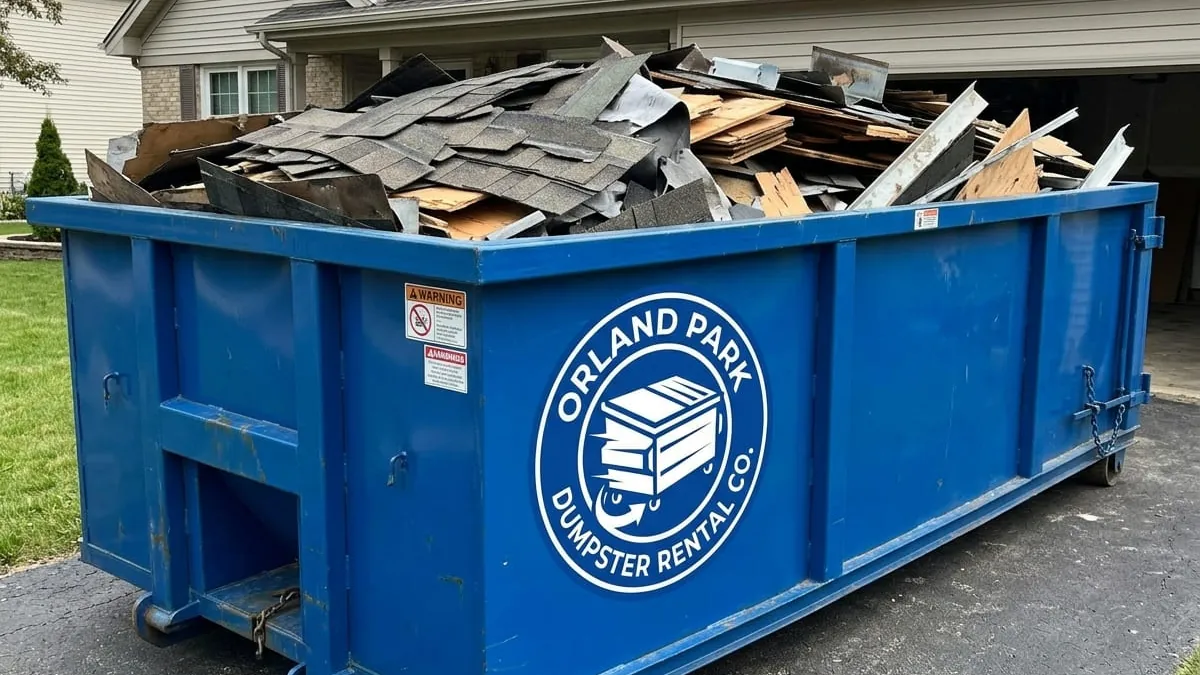
Tear-off containers for Orland Park roofs — sized to the weight of the shingle rather than to the footprint of the house, and set where a crew can throw to it without wrecking the drive underneath.
Roofing is the one service on this site where the sizing rule runs backwards, so it goes first. Torn shingle is a weight load, not a volume load. Asphalt shingle is dense, it packs, and a container full of it reaches a lawful road payload long before it reaches the rail. That is why the ceiling on this page is firm and why we will argue with you about it if we have to: a roof tear-off never goes in a 30 or a 40. A bigger box on a tear-off is not more capacity. It is a box you cannot legally move, sitting on your driveway, with a crew standing around it. What decides the size is squares and layers — how many hundred square feet of roof, and how many courses of old material are coming off — not the footprint of the house or the number of bedrooms in it.
The second thing is that Orland Park is a village full of roofs that are all due at roughly the same time, and the population record shows why. The village went from 6,391 people in 1970 to 23,045 in 1980, 35,720 in 1990 and 51,077 by 2000. Roughly three quarters of the people who live here now arrived inside those thirty years, and the houses arrived with them. We do not publish a percentage of housing built before any particular year, because that figure is not in anything we have read and we are not going to estimate one. What the population series does support is a plain inference: a village built out between the mid-1970s and the late 1990s is a village whose roofs have been replaced once and are coming up for the second time, all within a fairly narrow band of years.
Third, the paperwork, which is refreshingly light. The Village of Orland Park’s fixed-fee permit schedule lists “Roof (New or reroof)” at $95 — the same figure it publishes for siding, for windows and doors, and for a demolition permit. That is as published; confirm current fees with the Village on 708-403-6100, and note that the Village also states contractors must be licensed with it before any permit can be issued. The container itself needs no permit at all on residential private property: the Village’s own dumpster page says “Permits are not required”, subject to 30 days, private property, five feet from any lot line and 768 cubic feet at eight feet maximum above grade. On a tear-off none of those dimensional limits will ever be the binding constraint — weight gets there first — but the five-foot setback is worth knowing before you decide the box goes tight against the side fence under the eave.
Fourth, the weather, because roofing here is scheduled around it twice a year. On the National Weather Service’s Chicago O’Hare, 1991–2020 normals, the wettest stretch of the year is also the busiest: May 4.49 inches, June 4.10, July 3.71, August 4.25. That is the season a tear-off has to be buttoned up nightly and the box has to already be on the drive when the crew arrives at seven, not arriving at ten. At the other end, January and February together average 22 inches of snow and March averages 5.5 inches with a 47 °F average high — thaw and refreeze on clay, which is the worst combination of the year for standing a heavy box on a driveway.
Fifth, storms, which in this village are not hypothetical. The National Weather Service confirmed an EF-0 tornado on 27 July 2026 with the summary line “3 NW Orland Park” — a 2.9-mile path, 85 mph, 250 yards at its widest — one of seven confirmed across the forecast area that day, alongside an EF-1 with an 11.4-mile track through Country Club Hills and Hazel Crest and a 104 mph gust at Bult Field. Nearly 9,000 ComEd customers in the village lost power. Roof work after an event like that is a different job from a planned reroof: it is partial, it is urgent, and it usually arrives mixed with fascia, soffit, gutter and tree debris. We are a container company and nothing more — we are not part of anybody’s emergency management, insurance or recovery program — but we can get a box on the drive. Ring (708) 928-8633.
The Roofs This Village Is Replacing Now
Single-Layer Asphalt Tear-Off
The commonest roofing job in the village and the reason the 15 yard exists. One layer of three-tab or architectural shingle plus felt, loaded flat across the floor rather than heaped at the tailgate so the weight sits over the axles.
Two-Layer Tear-Off Down To The Deck
Double the material at the same roof area, which is exactly the case where people order the wrong size. Step up a box rather than up two — a 20 yard is usually the answer, and the ceiling still holds.
Ranch Or Split-Level Reroof
The archetypal Orland Park roof: long, low, simple runs with a big footprint and modest pitch. Easy to throw to, easy to load evenly, and easy to under-estimate because the house looks small from the street and the roof is not.
Storm Repair And Partial Replacement
Wind-lifted courses, hail bruising, a section peeled off a rake. Mixed debris arrives with it — fascia, soffit, gutter, screens, limbs — and mixed debris loads badly with shingle. Where the storm work is substantial, a second box is usually the tidy answer.
Flat And Low-Slope Commercial Roofing
Torn membrane, insulation board, adhered ballast and old flashing. Gravel ballast in particular is a weight load in its own right and belongs in a 10 yard rather than mixed into a bulky box.
Cedar Shake Or Tile Removal
Shake is lighter than asphalt for its volume and tile is far heavier, so neither behaves like a standard tear-off. Say which you have when you book, because the sizing changes and so does the way we want it loaded.
Reroof Plus Gutters, Soffit And Fascia
The common package job on a house of this era. Metal, vinyl and timber trim are bulky and light against a dense shingle load, so tell us the split and we will pick between one box loaded in the right order and two boxes run side by side.
Detached Garage Or Shed Roof
A small, edged job that suits the smallest box on the site rather than the cheapest-looking one. If the garage is being taken down rather than reroofed, that is demolition, and on the Cook County side it brings a county permit with it.
Sizing A Tear-Off By Weight, Not By Roof Area
Count squares and layers, then pick the box. For an ordinary single-layer tear-off on a house of this size, a 15 yard is the right container and it costs less to run than anything larger. For a two-layer tear-off, or a large or complicated single-layer roof, step up to a 20 yard. For a small edged job — a garage, a porch roof, a shed, a partial — a 10 yard is plenty, and it is also the box for gravel ballast off a flat roof, which is a weight load in its own right. And the ceiling: a tear-off never goes in a 30 or a 40. The reason is not caution, it is arithmetic — a large box loaded with dense shingle reaches lawful road payload while it still looks half empty, and at that point the only ways out are unloading by hand or splitting the load. If the reroof comes with gutters, soffit, fascia or storm debris, that material is bulky and light and it fights the shingle for space; the usual answer is a second smaller box for the trim rather than one badly loaded container. Our tear-off sizing guide works through the numbers.
10 Yard Dumpster
Broken slab, apron and block. Dense material is full by weight long before the box looks it.
View this size →15yd³15 Yard Dumpster
A single-layer tear-off, or one room of a 1970s split-level taken back to the studs.
View this size →20yd³20 Yard Dumpster
What leaves the yard most weeks. Rated volume sits inside the Village’s rule; the outside of the box is a question worth asking.
View this size →Placement Under A Working Roof
A roofing box gets loaded from above, fast, by people who are not looking at your driveway, so placement matters more here than on almost any other job. Start with the surface. Orland Park sits on the Valparaiso Morainic System, and the Illinois State Geological Survey’s Mokena Quadrangle report describes the surface unit — the Wadsworth Formation — as an “extensive surficial clay-rich stratigraphic unit” exceeding 125 feet in thickness. Clay does not drain, and a driveway over clay behaves differently in March than in July. Plywood or timber goes under the wheels and both rear rollers on every delivery. We would rather set the box on concrete or a well-built base than on turf or the soft strip beside a drive, and we will say so if the only spot you like is the wrong one. Then the throw. A container backed square to the eave with the tailgate toward the work halves the amount of shingle that lands on the lawn, and the run between the ladder and the box matters more than the exact distance from the house. Ask the crew where they intend to work first; we will place to it. Then the setback. The Village asks for five feet from any lot line, which on a suburban lot rules out the instinctive placement hard against the side fence directly under the eave — on a tear-off that is usually the only Village rule that actually binds, because 768 cubic feet and eight feet above grade will never be reached by a shingle load that hits weight first. Then the overhead. Service drops, mature limbs and low branches over the drop point stop a delivery as effectively as a locked gate, and this is a village with a lot of large oaks — the July 2026 storms left “numerous overturned oak trees” in the City of Palos Heights nearby. Tell us at booking. And then the clean-up. Nails and shingle grit travel further than anybody expects. Run the magnet before the box leaves rather than after, and keep the last course of the load below the rail so nothing blows off it on the way out.
Landed on the wrong service? Describe the job out loud and we will name the container that actually fits it — quite often that means pointing you at a different page here, or at the Village’s own collection, which costs you nothing at all. Ring (708) 928-8633.
One figure, one call
The address first — it settles Cook or Will — then what is going in. Size, figure and day, in about two minutes.
(708) 928-8633Sizes that suit it
How it works
Roofing Dumpster Rental, from the phone call to the collection
- 1
Tell us the job
Two minutes, and a street name and a nearest cross street is enough. Give us the address rather than the town, because in this village the address is what decides which of five governments answers your question. By the end of the call you have one figure, and the disposal is already inside it.
- 2
We set it down
The driver walks the run in on foot before the truck follows it, and plywood goes down under both rails and all four wheels. This is Wadsworth clay; it does not forgive a wet March. On private property, five feet clear of any lot line, which is the Village’s own rule and a real constraint on a suburban lot.
- 3
Fill it flat and low
Use the days in your window. Heavy on the bottom, nothing standing proud of the rail, and keep it covered — rain here runs three and a half to four and a half inches a month through the summer, and water is weight.
- 4
Say the word
One call and it goes. Metal and clean cardboard are pulled off the top first, and what remains travels to a facility permitted to receive it.
Roofing Dumpster Rental FAQs
What size dumpster do I need for a roof tear-off?
Count squares and layers first. An ordinary single-layer asphalt tear-off on a house of this size wants a 15 yard. A two-layer tear-off, or a large or cut-up single-layer roof, wants a 20 yard. A garage, a porch or a partial wants a 10 yard. What you do not want is a bigger box for safety’s sake: shingle is dense enough that a large container reaches a lawful road payload long before it fills, so a tear-off never goes in a 30 or a 40 — a heaped 30 of shingle is a box that cannot lawfully leave your driveway. If the job also produces gutters, soffit, fascia or storm debris, that is bulky light material and it does not share a box well with shingle; two containers usually beat one. Ring (708) 928-8633 with the squares and the layers and we will size it in a couple of minutes.
Do I need a permit to reroof a house in Orland Park?
The Village publishes “Roof (New or reroof)” at $95 on its fixed-fee permit schedule — the same figure it lists for siding, for windows and doors and for a demolition permit. That is a Village permit for the work, and it is separate from the container, which needs no permit at all: the Village’s own dumpster page says “Permits are not required” for a residential unit on private property. Two cautions. Fees as published move, so confirm the current figure with the Village on 708-403-6100 rather than budgeting from a web page. And the Village states that “Contractors are required to be licensed with the Village of Orland Park before any permits can be issued”, which is worth confirming with your roofer before the tear-off date rather than on it.
Can the container go under the eave?
Usually yes, and that is where a crew wants it — but two things constrain the exact spot. The first is the Village’s five-foot minimum setback from any lot line, which on a typical Orland Park lot rules out sliding the box hard into the side yard against a neighbor’s fence. The second is the surface: under the eave is often the narrowest, softest part of the drive, and on clay that is exactly where a loaded box will leave a mark. We plate under the wheels and both rear rollers as standard and we would rather back a little further out onto firm concrete and let the crew carry an extra few feet than sink a container in a soft strip. The other thing to raise at booking is what is above the drop point — a service drop, a low limb, a mature oak over the driveway — because that stops a delivery just as surely as a parked car.
What about the old shingle itself — can it all go in?
Torn asphalt shingle and roofing felt are ordinary container content. What has to stay out of the box is the ordinary Illinois list, and two items on it turn up on roofing jobs more often than you would expect. Landscape waste is banned from a landfill-bound container by 415 ILCS 5/22.22, which is written as a container rule — no landscape waste “into a container intended for collection or disposal at a landfill, unless such container is biodegradable” — so the limbs you cut back to get the ladder up do not go in with the shingle. And used oil is banned by 415 ILCS 5/21.6, which is worth knowing because the statute bans liquid used oil and expressly says that filters, oily rags, absorbent material and empty containers are not that. Everything else — paint that is not dried out, solvents, fuel, pressurized cylinders, batteries, asbestos-containing material — stays out as a matter of course.
When is the best time of year to reroof here?
Late spring through early autumn is the working season, and inside it the trade-off is rain against heat. On the National Weather Service’s Chicago O’Hare, 1991–2020 normals, May averages 4.49 inches of rain, June 4.10, July 3.71 and August 4.25 — there is no dry month in the roofing season, so a tear-off has to be buttoned up nightly and the container has to be on the drive before the crew starts rather than after. September is drier at 3.19 inches and still mild, which makes early autumn the most comfortable window if the roof will wait. What we would avoid is putting a loaded box on a driveway in March: 5.5 inches of snow against a 47 °F average high is thaw by day and freeze by night, on clay, and that is the worst month of the year for weight on a drive. Ring (708) 928-8633 and we will work around the forecast.
More services
Other things we haul
Residential Dumpster Rental
Orland Park’s cart takes three cubic yards a week. A bathroom gut is that on its own.
Learn more →Commercial Dumpster Rental
Shops, restaurants and tenant fit-outs along the LaGrange Road corridor.
Learn more →Construction Dumpster Rental
Mixed build waste in one box, swapped on call either side of the county line.
Learn more →Roll-Off Dumpster Rental
Five box sizes, and the two largest are worth a call to your own village before you order.
Learn more →Same-Day Dumpster Rental
What we can and cannot do today, said straight on the phone.
Learn more →Junk Removal Dumpsters
Clear a garage, a basement or a rental unit at whatever pace the week allows.
Learn more →Estate Cleanout Dumpsters
Patient work in a village where a quarter of the residents are over sixty-five.
Learn more →Demolition Debris Removal
Decks, garages and strip-outs — and in Cook County the County wants a permit too.
Learn more →Concrete & Heavy Debris
Its own low box for slab and apron concrete, loaded flat in one layer.
Learn more →Yard Waste & Brush Removal
Stumps, sod, dirt and anything over four inches — all of it off the curbside route.
Learn more →Where we deliver
Roofing Dumpster Rental across Cook and Will Counties and the south-west suburbs
Seventeen places, one crew, one flat figure. Each has a page of its own, and the first thing that page settles is which county answers for the address — Cook, Will, or in Lemont’s case three at once.
Talk to a real person
Need roofing dumpster rental in Orland Park?
Say what is going in and give us the address — the address, because on this village the county changes underneath you. Size, one flat figure and a day, settled before you hang up. No form to fill in, and no queue.
Orland Park and seventeen more places across Cook, Will and DuPage · Mon–Fri 6:30am–5pm, Sat 7am–1pm