
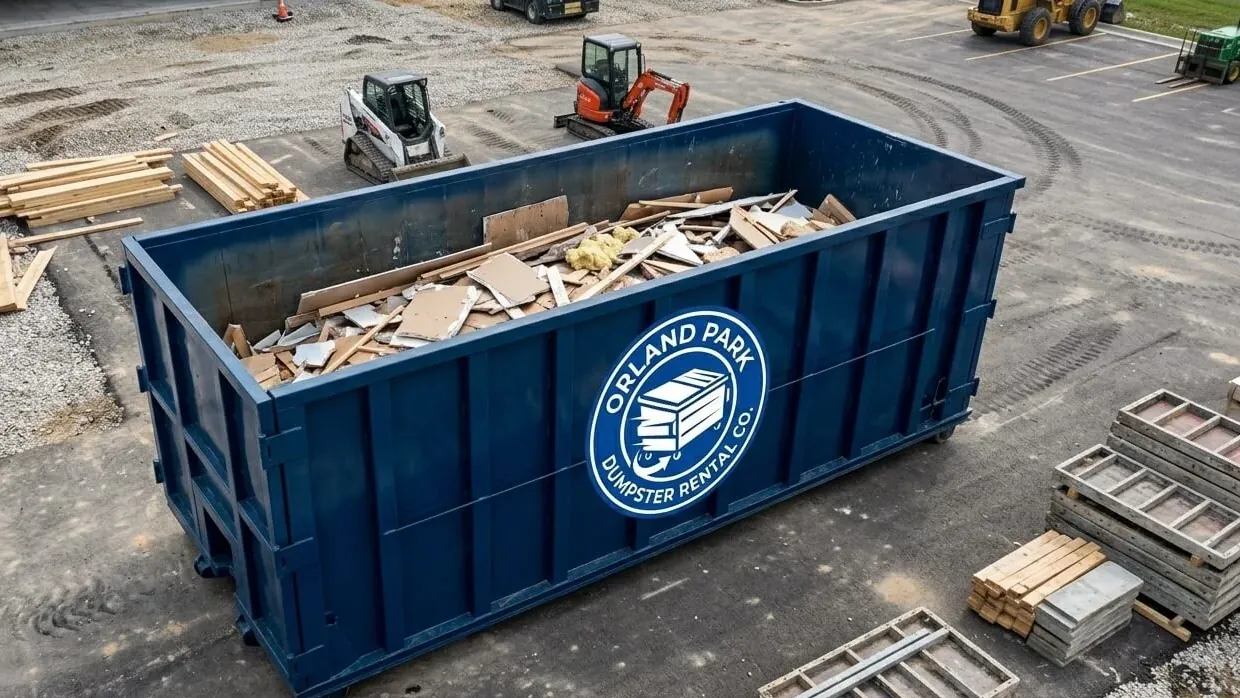
The Orland Park default
20 Yard Dumpster Rental in Orland Park, IL
The container that leaves our yard most often — the default for a whole-house declutter or a serious remodel, and the size where the Village’s 768-cubic-foot residential rule is worth one phone call, because rated volume and outside dimensions do not give the same answer.
A 20 yard roll-off is roughly twenty-two feet by eight on the ground and stands about four and a half feet at the rail — six to eight pickup loads of room, with the side low enough along much of its length to load across rather than only through the tailgate. It is the size most households need and the size most households under-estimate, and in this village it has a second thing going for it that no other market in this portfolio can claim.
- Capacity20 cubic yards
- Box size22 x 8 x 4.5 feet
- Rated volume540 cubic feet
- Weight allowance3 to 4 tons
- Roughly equal toaround 6 to 8 pickup loads
What the 20 is actually for on these streets
The 20 is the default here first because of what an Orland Park clear-out actually is. This is a village of 23,256 households at 85.8 percent owner-occupancy, on lots at 2,664.9 people per square mile — suburban detached housing where the volume is not in the rooms, it is in the garage, the basement and the closets. A job that starts as “the spare room” turns out to be four spaces going out in the same two weeks, and that is reliably more material than anyone estimates from the front hall. Twenty yards is the size that absorbs the difference between what people plan for and what actually comes out.
The second reason is the one that is specific to this village, and it is the most useful arithmetic on this site. The Village of Orland Park’s own permit page says “Permits are not required” for a residential dumpster and then caps the unit at “768 cubic feet for residential zoning districts” with “a maximum unit height of eight (8) feet above grade.” 768 cubic feet is roughly 28.4 cubic yards. Convert it and the whole product line sorts itself out: a 20 is comfortably inside that limit with room to spare, and a 30 is a genuine question you have to answer rather than a free upgrade. That is the rare case of a municipal rule interacting directly with the product, and it is the single strongest argument for this size on a residential driveway in Orland Park.
The third reason is the gap between this box and what the Village will collect, which is not a criticism of the Village — its program is a good one — but a statement of scale. The contracted residential service takes “up to three cubic yards of refuse per week” and one bulk item, defined as “an item the resident would take with them if they moved out of the residence (e.g., couch, small tables, mattress, etc.).” Twenty cubic yards at once is nearly seven weeks of that allowance, delivered on a Tuesday. And the reason the Village cannot simply extend its contract to cover a remodel is a statute: 65 ILCS 5/11-19-1, in FindLaw’s current reproduction, forbids a municipality under 1,000,000 people from awarding a franchise or contract for the collection of general construction or demolition debris. Orland Park is 58,703.
The fourth reason is that it is the right shape for the second-cycle work this village produces. Orland Park went from 6,391 people in 1970 to 23,045 in 1980, 35,720 in 1990 and 51,077 by 2000 — roughly three quarters of the present population arrived inside those thirty years. We publish no percentage of housing built before any given year, because that figure is not established in anything we have read. What the population record does support is an inference anyone who lives here has already made: a village built out between the mid-1970s and the late 1990s is now working through kitchens, baths, roofs, siding and basements more or less simultaneously. A 20 is the size of one of those projects.
The fifth reason is that it is still an ordinary driveway box. Twenty-two feet fits on most Orland Park drives in front of a two-car garage, keeps the Village’s five-foot lot line setback on a standard lot, and leaves the truck the room it needs on a curving subdivision street. Beyond this length the placement conversation genuinely changes — and that is a good reason to be honest about where the default stops rather than selling upward by reflex.
Good fit for
- A whole-house declutter before a listing or a sale
- Garage, basement and closets going out together
- A kitchen plus a bathroom in the same project
- A two-layer roof tear-off or a large single-layer roof
- Carpet and flooring through an entire house
- A finished basement stripped back and re-done
- Deck removal with the fence and the shed alongside
- A moderate estate clear-out taken in two passes
Not the right size for
- Concrete, block, brick or trench spoil
- Stripped sod, topsoil or stump material
- A whole-house gut down to the studs
- A full commercial fit-out or tenant strip-out
- A whole-building teardown
- Tile set in a thick mortar bed as the main load
Will it fit?
At twenty-two feet this is still a driveway container rather than a lot container. On the great majority of Orland Park properties it stands in front of a two-car garage and stops well short of the public sidewalk. That last point matters here, because the Village’s rule is that the unit “shall be located on private property” and there is no street obstruction permit on its published permit list — so the drive is the answer and we will not offer you the road. The other rules are easy at this size: five feet from any lot line is achievable on a standard lot, and 768 cubic feet and eight feet above grade both leave room to spare. What the truck needs is a straight run to back in, working width down each side and clear overhead for the hoist. In this village the recurring obstacles are the service drop across the apron, a mature limb over the drop point and a driveway that flares at the street and narrows quickly — tell us at booking. Underneath, plywood goes under the wheels and both rear rollers on every delivery, because the surface unit here is the clay-rich Wadsworth Formation, which the Illinois State Geological Survey describes as exceeding 125 feet in thickness. Clay holds water. We would rather put the box on concrete and have you carry an extra few feet than set a loaded container on a soft strip, and in March — 5.5 inches of snow against a 47 °F average high on the National Weather Service’s Chicago O’Hare 1991–2020 normals — we will be particular about it.
Begin with the street address itself — the one on the deed and the tax bill rather than the mailing town printed on the envelope — because the county sitting behind that address is not a formality in this village. The Village of Orland Park is mostly in Cook County and partly in Will, spread across four townships, and our own gate on 183rd Place stands on the Will side while most of the village above us is Cook. Which side an address falls on changes who answers a demolition question, and it is the first thing we ask. Then clear the drop point of vehicles, trailers, carts and bins, and tell us what is under the spot and what is over it — a sewer, water or storm lateral crossing the drive, an irrigation run, a walkout or a window well the arm has to swing clear of, flatwork poured inside the last month or already cracked, a low service drop, or a mature limb standing over the only flat piece of the property. Several tons reach your property through a very small amount of steel in contact with the ground, so the surface has to be concrete, asphalt or a well-compacted base and never turf, and timber or plywood goes down beneath the wheels and both rear rollers on every delivery we make. Ground is the other half of that, and here it has a name. The Illinois State Geological Survey maps this area on the Valparaiso Morainic System, with the Wadsworth Formation at the surface — a clay-rich surficial unit exceeding 125 feet in thickness, sitting above more than 185 feet of glacial sediment and Silurian dolomite bedrock. Nobody in this village is setting a container on rock; they are setting it on clay. Four things we will not do with that. We publish no soil bearing capacity, no frost depth, no water table depth and no flood zone determination for any address, and we are not qualified to assess the ground at yours — nobody has walked your driveway, and a number invented for a website is worse than no number at all. What we will say is the operational half, because it is the part that decides a delivery: firm, dry ground carries a loaded container, and ground softened by wet weather or moving through freeze and thaw does not — which is exactly what March is here. On the Chicago O’Hare 1991–2020 normals published by the National Weather Service — and those are O’Hare’s figures, not this village’s own — January and February together average about 22 inches of snow, March averages 5.5 inches of snow against a 47 °F average high, and May through August run 3.71 to 4.49 inches of precipitation a month. Rain that falls into an uncovered box does not run back out of it. It becomes tonnage nobody ordered and nobody planned to move, so sheet the load. Weight settles the choice of box exactly as it settles the choice of surface, and there is one line on these pages that does not move: a roof tear-off is not loaded into a 30 or a 40. Stripped asphalt shingle is dense enough to make a container that size impossible to haul while two thirds of it is still air.
Two rules sit above the placement itself, and Illinois writes both of them in a way that catches out anyone who has worked in another state. The first is that there is no mandatory statewide building code for private construction here at all. The Illinois Capital Development Board — the agency that would own one if it existed — publishes plainly that “a municipality or county is not required to adopt building codes,” and the codes the Board administers are for state-owned buildings. Municipalities adopt their own, or adopt none. Fire then splits three ways on top of that, and the split is the whole point. The Office of the State Fire Marshal’s rule adopts NFPA 101, the Life Safety Code. The Village of Orland Park adopts the International Fire Code instead — a different document from a different publisher, in force over the same square mile. And the authority that will actually come and look at a container standing tight against a building is neither the Village nor the State: fire protection here is not a Village department but the Orland Fire Protection District, a separate unit of government whose own fire-code ordinance is captioned “Cook and Will Counties, Illinois” because it spans the county line exactly as the village does. It is at 9790 West 151st Street, and the code it publishes is the 2018 International Fire Code with amendments. We publish no separation distance, in feet or in any other form. We could not verify one for this village from a source worth citing, and that is an honest “we could not find one,” not a “there is none.” On a driveway at a house it rarely arises. Set hard against the wall of a commercial building, a school or a larger multi-family block it does arise, and at that point the District is the desk that answers it — not the Village, and not us.
The second is whose ground the box is standing on, and the Village’s own answer is unusually clean. For a residential zoning district the Village of Orland Park says in terms that “permits are not required” for a dumpster or a storage pod — and then sets four conditions in place of one. A maximum of 30 days from the day of placement on the site. The unit on private property. A minimum five-foot setback from any lot line, which takes the classic tight-suburban placement hard against a side fence off the table on a lot of ordinary width. And a maximum unit size of 768 cubic feet at a maximum height of eight feet above grade. 768 cubic feet is roughly 28.4 cubic yards, so the 10, the 15 and the 20 sit comfortably inside it, while a 30 or a 40 is a genuine question against it — worth settling with the Village before one of those goes on a residential driveway. Three cautions travel with all four numbers. The Village cites Land Development Code § 6-304.C.12 as the authority, and we stop at the citation, because the permit page is what we read and we have not read the code text. The figures are published for residential zoning districts and we never carry them across to a commercial or industrial site. And the Village’s guidance makes no provision for placement in a street or a right of way, so we will not represent that a street placement can be permitted here. The Village is on 708-403-6100. Roads are a separate question with more than one owner: IDOT holds the state routes, the Cook County Department of Transportation and Highways holds a number of the biggest local arterials, and on the Will side of the village a road may belong to the Will County Division of Transportation. We have not established the road authority for every street in this service area, and we will never tell you that a given street is the Village’s. Outside Orland Park the honest answer changes again: nothing behind this site establishes another village’s or city’s container rules, so ask that hall rather than reading ours across to it. Last, where your own project breaks ground — a footing, a post hole, a fence line, a stump, a drainage run, even the stake that holds the plywood — JULIE comes before the shovel: dial 811. Under the Illinois Underground Utility Facilities Damage Prevention Act at 220 ILCS 50, notice goes in not less than 2 days and no more than 10 days ahead of the work, a normal notice request is valid for 25 days from the initial request, and the tolerance zone runs one and one-half feet either side of the marks, inside which you hand-dig. JULIE’s own homeowner guidance asks for at least 3 days, so give it three; and its excavator guidance is blunter than most states manage, directing you to pre-mark the site in white paint, flags or chalk before you break ground. Lowering a box onto a drive is not excavation. Cutting or regrading ground so that a box will sit level is. Both subjects run well past what a page about container sizes can usefully hold, and we have written them out properly elsewhere: what a loaded container does to Orland Park clay, and the four conditions the Village sets in place of a permit.
Set the 20 against the Village’s own size rule and you have the reason this size is the default here. Twenty cubic yards of rated volume is 540 cubic feet against a ceiling of 768, and four and a half feet of side against a ceiling of eight feet above grade. On rated volume there is room in hand. On the outside of the steel there is not: twenty-two by eight by four and a half feet is 792 cubic feet, which is over the ceiling. The Village’s page does not say which of the two measurements it means, and we are not going to guess on your behalf — so on a 20, exactly as on a 30, get the outside dimensions from us and put them to the Village on 708-403-6100 before you order.
All five, measured against the Village’s 768 cubic feet
| Size | Box size | Against the Village’s 768 cu ft | Weight allowance | Roughly equal to | Typical job |
|---|---|---|---|---|---|
| 10 Yard Dumpster | 12 x 8 x 3.5 feet | 270 cu ft rated — far inside | 2 to 3 tons | around 3 pickup loads | Broken slab, apron and block. Dense material is full by weight long before the box looks it. |
| 15 Yard Dumpster | 16 x 8 x 4 feet | 405 cu ft rated — inside | 2 to 3 tons | around 4 to 5 pickup loads | A single-layer tear-off, or one room of a 1970s split-level taken back to the studs. |
| 20 Yard Dumpster | 22 x 8 x 4.5 feet | 540 cu ft rated; 792 as a box — ask the Village | 3 to 4 tons | around 6 to 8 pickup loads | What leaves the yard most weeks. Rated volume sits inside the Village’s rule; the outside of the box is a question worth asking. |
| 30 Yard Dumpster | 22 x 8 x 6 feet | 810 cu ft rated — over 768: ask the Village | 4 to 5 tons | around 9 to 12 pickup loads | A whole-floor gut, or fifty years of one family’s storage. Check it against the Village rule first. |
| 40 Yard Dumpster | 22 x 8 x 8 feet | 1,080 cu ft rated — over 768: ask the Village | 5 to 6 tons | around 12 to 16 pickup loads | Light, bulky commercial material only, and it needs the longest straight approach on this list. |
Still deciding between two of them? Two minutes on the phone will settle it. Say what the material is, roughly how much of it there is, and the address it is going to. The address earns its place twice over across Cook and Will Counties: once because it decides whether a teardown answers to Cook County or to Will, and once because it tells the driver what he is likely to be setting a loaded box down on. A size and a figure come back before you hang up. Ring (708) 928-8633.
Book a 20 yard
One figure, quoted from the street address, with the delivery, the collection, your days on site and the disposal all inside it. We ask for the address before anything else because in this village it is what settles the county, and the county is what settles the rules.
(708) 928-8633The other four
Often booked with it
All sizes
Where the 20 sits against the other four
10 Yard Dumpster
Broken slab, apron and block. Dense material is full by weight long before the box looks it.
View this size → 15yd³15 Yard Dumpster
A single-layer tear-off, or one room of a 1970s split-level taken back to the studs.
View this size → 20yd³20 Yard Dumpster
What leaves the yard most weeks. Rated volume sits inside the Village’s rule; the outside of the box is a question worth asking.
View this size → 30yd³30 Yard Dumpster
A whole-floor gut, or fifty years of one family’s storage. Check it against the Village rule first.
View this size → 40yd³40 Yard Dumpster
Light, bulky commercial material only, and it needs the longest straight approach on this list.
View this size →20 Yard Dumpster — what Orland Park callers ask
Why is the 20 the default in Orland Park?
Two reasons, and the second one is local. The first is the ordinary one: a household clear-out here is rarely a set of rooms. It is the garage, the basement and the closets going out together, and that is more volume than people estimate from a doorway. The second is the Village’s own rule. Orland Park caps a residential container at 768 cubic feet — roughly 28.4 cubic yards — with a maximum height of eight feet above grade. A 20 yard box sits comfortably inside that with room to spare; a 30 is a genuine question you have to answer on your own driveway. So in this village the default size is not just the commonest one, it is also the one that leaves nothing to work out. Describe the spaces on (708) 928-8633 and we will confirm it in a couple of minutes.
Is a 20 yard box allowed on my driveway without a permit?
Yes. The Village’s own permit page, titled “Dumpsters and Storage Pods (Residential)”, says “Permits are not required” in those words, and then imposes four rules: a maximum of 30 days from the day of placement; the unit “shall be located on private property”; “a minimum lot line setback of five (5) feet from any lot line”; and a maximum size of 768 cubic feet at eight feet maximum above grade. The Village cites LDC § 6-304.C.12 as its authority; we have read the permit page rather than the code section, so that is where our citation stops. Two things to keep in mind: those figures are written for residential zoning districts and do not travel onto a commercial job, and a container needing no permit does not mean the work needs none. Confirm the work permits with the Village on 708-403-6100.
What if the job turns out bigger than I thought?
It is a common and entirely fixable problem, and there are two answers. The cheaper one on most household jobs is a second 20 rather than a bigger box — the pull and the re-delivery are straightforward, the placement is already proven, and you stay well inside the Village’s dimensional rules without a second thought. The other is to step up to a 30, which is the right call on a genuine whole-house gut or a full estate clear-out, and which is worth a proper conversation first because of the 768 cubic foot residential cap. What almost never works is trying to fit more into the box you have: a container heaped above the rail cannot lawfully leave, and a refused pull costs a day. Ring (708) 928-8633 as soon as you can see it coming rather than on the last afternoon.
Can I put a roof tear-off in a 20?
Yes, and for a two-layer tear-off or a large or cut-up single-layer roof, this is the right box. For an ordinary single-layer tear-off on a house of this size, a 15 is usually enough and costs less to run. What matters more than the choice between them is the ceiling above them: a tear-off never goes in a 30 or a 40. Shingle is dense, it packs, and a large container loaded with it reaches a lawful road payload while it still looks half empty — at which point it cannot legally be moved. Count squares and layers rather than estimating from the footprint of the house, and load flat across the floor so the weight sits over the axles. If the reroof also produces gutters, soffit and fascia, that is bulky light material that fights the shingle for space; two boxes often beat one. See our roofing page.
What is not allowed in it?
Six materials are kept out of a landfill-bound container by Illinois statute, and several are written about the container rather than the landfill. Landscape waste — 415 ILCS 5/22.22: none may go “into a container intended for collection or disposal at a landfill, unless such container is biodegradable”, which is why the Village’s yard waste bags are Kraft paper. Lead-acid batteries — 22.23. White goods — 22.28, a component-removal rule rather than a flat ban, which is why the Village asks residents to phone (800) 964-8988 before a fridge goes to the curb. Tires — 415 ILCS 5/55. Liquid used oil — 21.6, which expressly excludes filters, oily rags, absorbent and empty containers from that definition. And electronics, under the Consumer Electronics Recycling Act — there is a permanent drop-off run by the Road District of Orland Township on Wolf Road. Then the ordinary refusals: liquids, undried paint, solvents, fuel, pool chemicals, pressurized tanks and asbestos-containing material. Full detail in our materials guide.
How long can I keep a 20 on the driveway?
Up to 30 days from the day of placement, which is the Village’s own limit and a hard number rather than a rolling allowance. Most whole-house jobs here run best across a long weekend plus the week either side, because the sorting is the slow part and it happens in bursts. Three practical notes for this village. Load flat and keep the top course below the rail — on a household clear-out it is very easy to end up with a wardrobe standing proud of the top, and a heaped box cannot lawfully leave. Weight or bag anything that can blow out; the Village Code takes a dim view of material accumulating loose in a residential district. And if the box will stand through rain, put dense material low: on the National Weather Service’s Chicago O’Hare 1991–2020 normals, May through August average 3.71 to 4.49 inches a month, and water is weight you pay to haul.
Services
The jobs a 20 yard usually belongs to
Residential Dumpster Rental
Orland Park’s cart takes three cubic yards a week. A bathroom gut is that on its own.
Learn more →Commercial Dumpster Rental
Shops, restaurants and tenant fit-outs along the LaGrange Road corridor.
Learn more →Construction Dumpster Rental
Mixed build waste in one box, swapped on call either side of the county line.
Learn more →Roofing Dumpster Rental
Squares and layers, never roof area — and never a 30 or a 40, whatever the roofer asks.
Learn more →Roll-Off Dumpster Rental
Five box sizes, and the two largest are worth a call to your own village before you order.
Learn more →Same-Day Dumpster Rental
What we can and cannot do today, said straight on the phone.
Learn more →Talk to a real person
A 20 yard on an Orland Park driveway?
Say what is going in and give us the address — the address, because on this village the county changes underneath you. Size, one flat figure and a day, settled before you hang up. No form to fill in, and no queue.
Orland Park and seventeen more places across Cook, Will and DuPage · Mon–Fri 6:30am–5pm, Sat 7am–1pm